
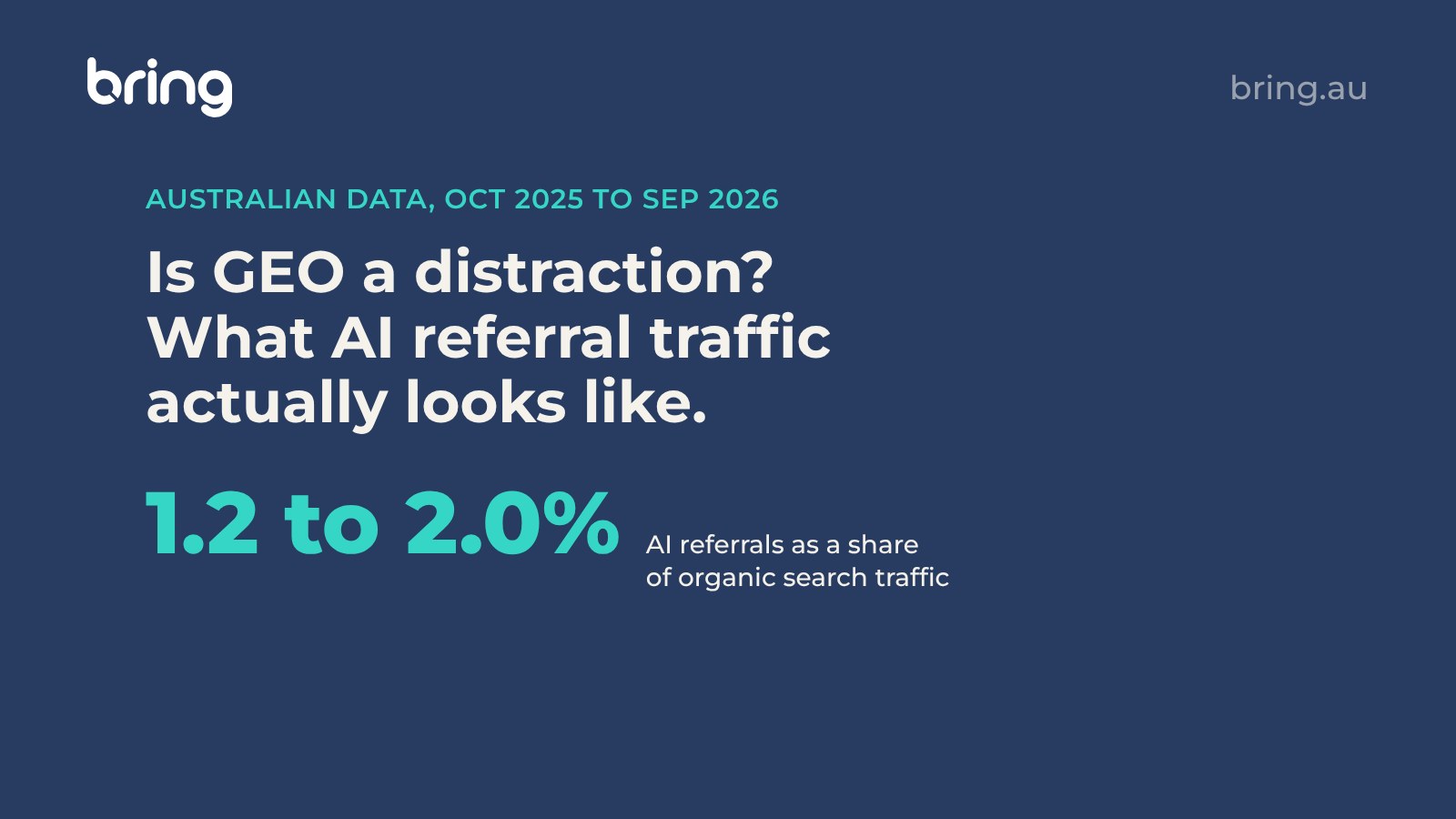
AI referral traffic in Australia equals just 1.2% to 2.0% of organic search traffic. That’s across four industries over the year to September 2026, from Similarweb data. Google organic still sends 51 to 80 times more visits than every AI chatbot combined.
AI referral traffic is the visits a website gets when someone clicks a link inside an AI chatbot such as ChatGPT, Gemini, Claude or Perplexity. GEO, or generative engine optimisation, is the practice of trying to get a brand mentioned or cited in those AI answers.
So is GEO a distraction? If GEO means chasing clicks from ChatGPT, mostly yes. But the same data shows Australians using AI chatbots 41% more than a year ago, organic search falling and direct traffic climbing. AI is clearly doing something. It just isn’t showing up as referrals.
Key takeaways
- AI chatbots send Australian websites 0.45% to 0.73% of their total traffic, depending on the industry.
- Worldwide, only 5.2% of ChatGPT’s outbound desktop clicks reach third-party websites. More go to search engines (7.9%).
- In Health and Finance, AI chatbots already send more traffic than paid social.
- Australian visits to AI chatbot sites averaged 171 million a month, up 41% year on year.
- Organic search traffic fell across all four industries, while direct traffic rose in three. Branded search held its share.
The GEO debate in brief
In October 2026, Marie Haynes published GEO is a distraction, one of the sharper pieces of industry research we’ve been tracking. It reached us through Rand Fishkin, co-founder of SparkToro, who shared it on LinkedIn. Rand has argued for years that much of what influences buyers never shows up as a click you can attribute, and his thinking has shaped how we approach search at Bring. This data lands squarely in that territory.
Marie’s GA4 data from 100 sites found ChatGPT sessions equalled 0.62% of Google organic volume, or 0.73% with every AI tool included. Google organic drove 27 times more conversions than all AI tools combined.
Her argument: the AI search that sends customers to businesses is Google itself, through AI Overviews, AI Mode and its core ranking systems. That lines up with Google’s official position on AEO and GEO, which is essentially “it’s still SEO”.
We wanted to know two things. Does the same pattern hold in Australia? And if AI isn’t sending clicks, where does its influence actually land?
How much AI referral traffic do Australian websites get?
Similarweb now reports “Gen AI” as its own marketing channel, which lets us compare AI referrals directly with organic search across whole industries. Here’s what four Australian industries look like over the 12 months to September 2026.
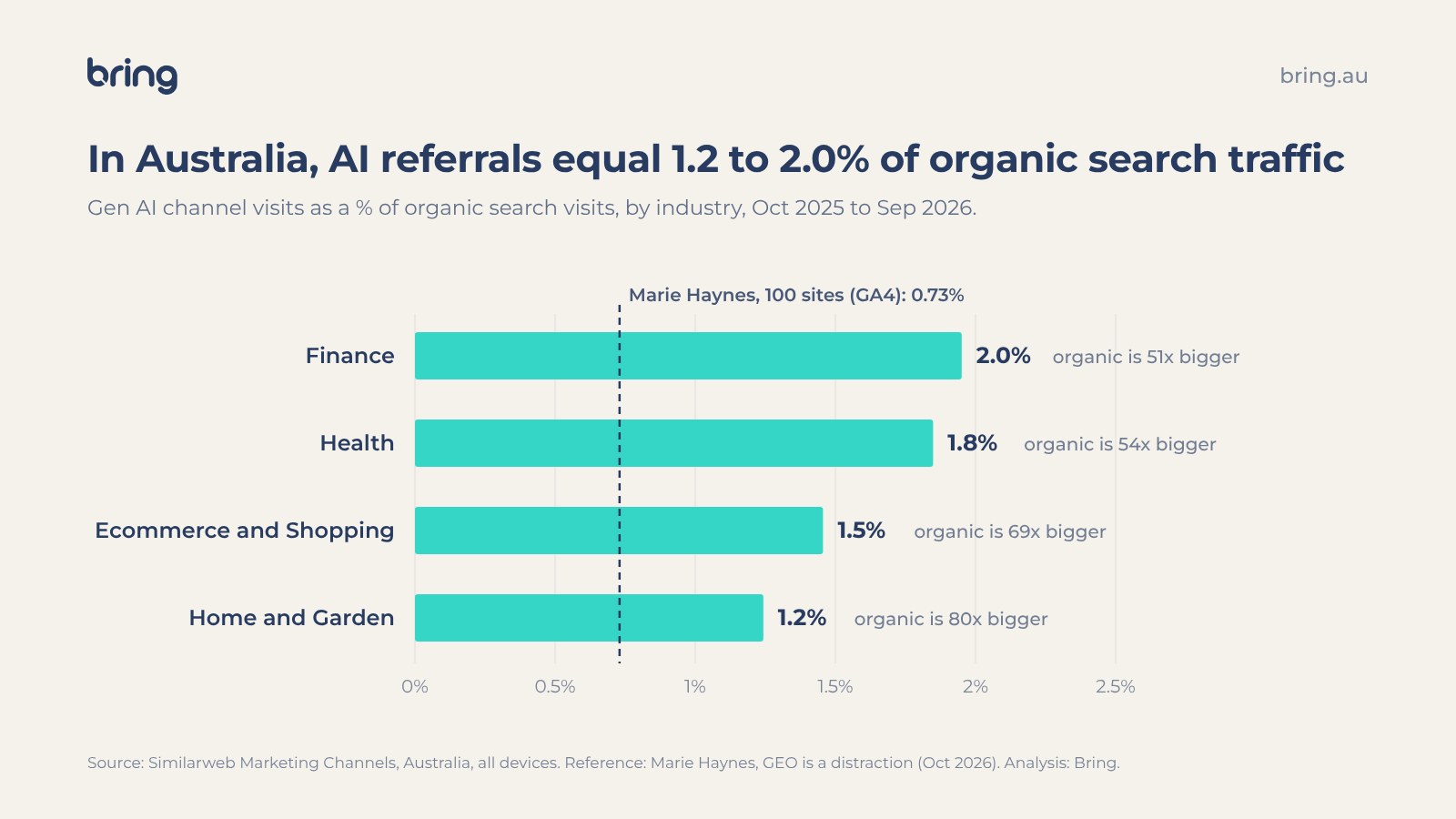
Australia sits two to three times above Marie Haynes’ 0.73%, but the conclusion holds. Organic search sends 51 times more traffic than AI in Finance and 80 times more in Home and Garden.
The ranking makes sense once you think about how people use AI. Finance and Health are research-heavy categories, where people compare options before committing. Home and Garden already gets 43% of its traffic from organic search, so AI barely registers.
Set against the rest of the channel mix, AI is small, but no longer a rounding error:
| Industry | Gen AI | Paid social | Affiliates | Paid search | |
|---|---|---|---|---|---|
| Health | 0.73% | 0.33% | 0.20% | 3.70% | 5.20% |
| Home and Garden | 0.53% | 2.11% | 0.22% | 2.18% | 18.88% |
| Finance | 0.49% | 0.17% | 1.08% | 4.67% | 3.56% |
| Ecommerce and Shopping | 0.45% | 1.46% | 1.64% | 5.17% | 11.19% |
Share of each industry’s total traffic, Australia, Oct 2025 to Sep 2026. Source: Similarweb.
In Health and Finance, AI chatbots already send more traffic than paid social, and in Health they beat affiliates too. But AI trails email in every industry, and paid search is 7 to 36 times bigger.
Why so little? Most AI clicks never leave the platform
Similarweb’s outbound click data shows where people go when they click out of each AI platform. For ChatGPT worldwide, the answer is mostly back to OpenAI.
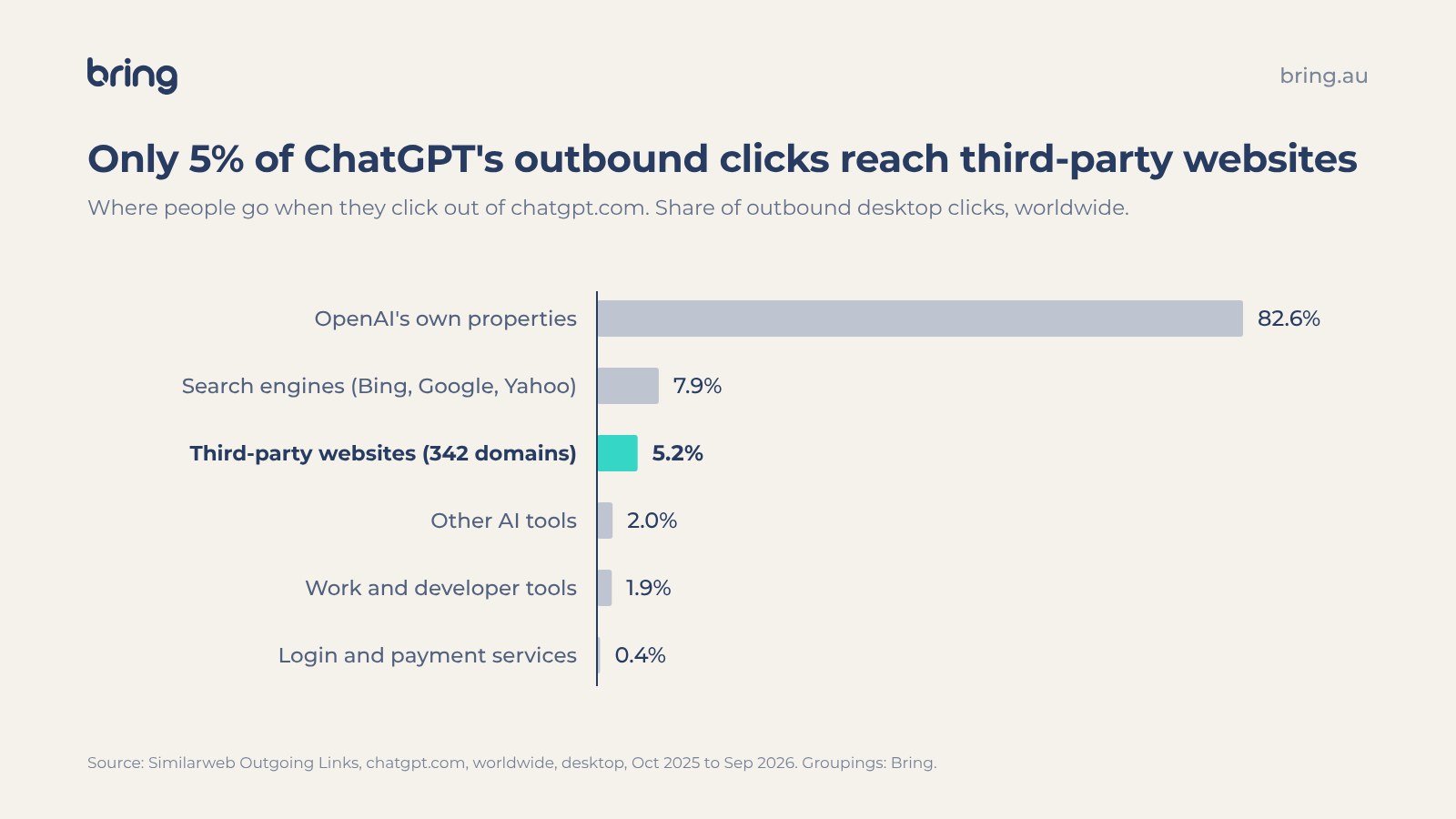
More of ChatGPT’s outbound clicks go to search engines (7.9%) than to every third-party website combined (5.2%). People leave ChatGPT to check something on Google or Bing more often than they click through to a business.
No single third-party site gets more than 1% of those clicks. The biggest is The New York Times (0.95%), which has a content licensing deal with OpenAI. Spotify is next (0.79%), most likely through its integration inside ChatGPT.
The other platforms follow the same pattern in their own ways:
| Platform | AU destinations Similarweb could detect | Where most outbound clicks go (worldwide) | Share to third-party sites (worldwide) |
|---|---|---|---|
| ChatGPT | 24 | OpenAI login and help pages | 5% |
| Perplexity | 5 | Google and Apple login | 29% |
| Claude | 2 | Work tools (Jira, ServiceNow, Shopify admin) | 15% |
| Gemini | 1 | NotebookLM | Close to 0% |
That first column is a finding in itself. Across a full year, Similarweb’s Australian panel could detect only one to 24 outbound destinations per platform, and just one Australian business among them. There simply isn’t enough click volume leaving AI platforms in Australia to measure properly.
Gemini is the telling one. Google keeps its AI users inside Google, so its AI influence on your business runs through Search (AI Overviews, AI Mode and the results page), not through the Gemini app.
Meanwhile, AI use in Australia keeps climbing
Low referrals don’t mean low usage. Australians made an average of 171 million visits a month to AI chatbot sites in the year to September 2026, up 41% on the year before. The audience grew from 9.8 million to 11.8 million monthly unique visitors, and that’s web only, before app usage.
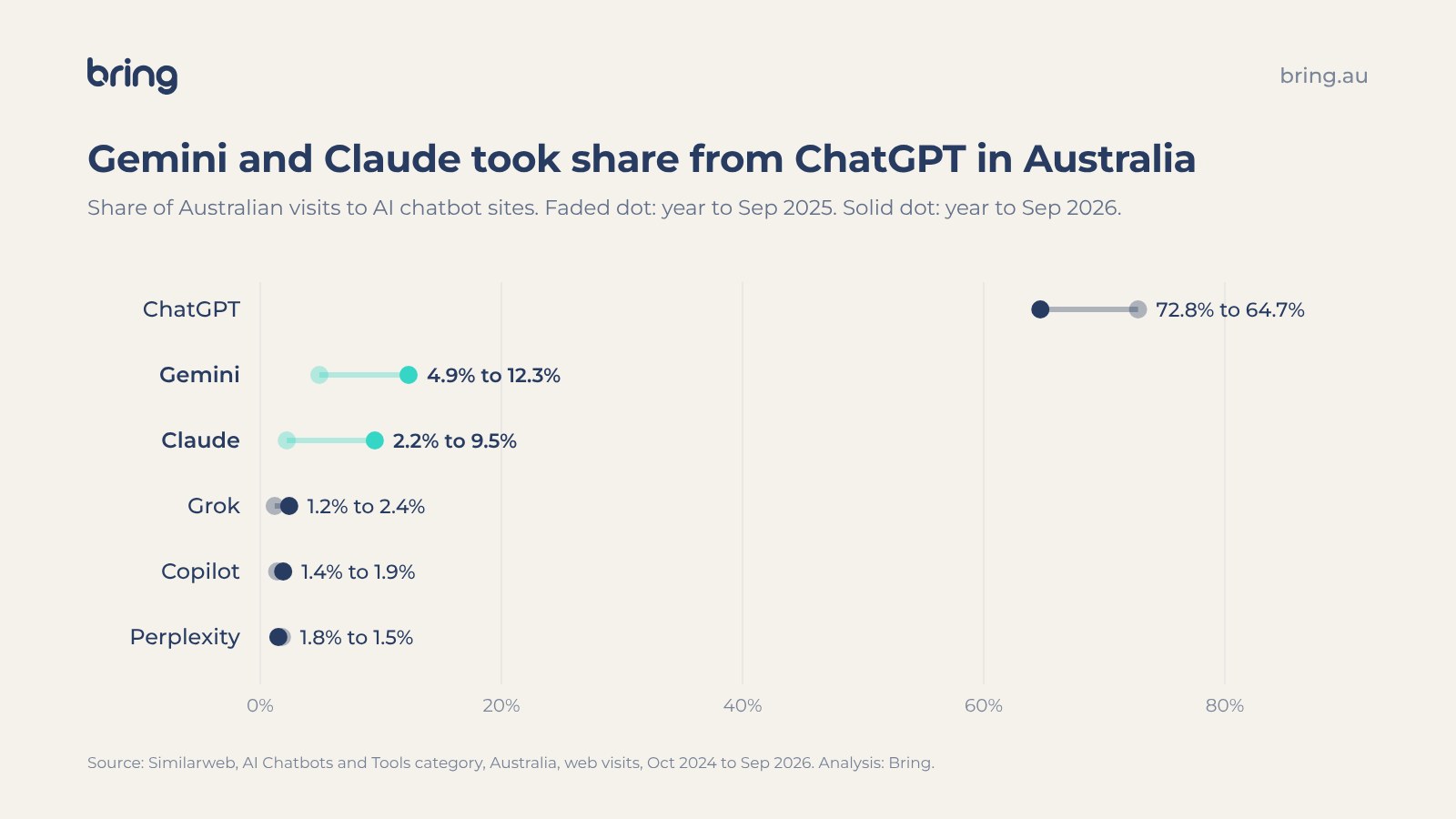
The market is fragmenting too. ChatGPT still grew its visits by 25%, but Gemini’s share more than doubled and Claude’s quadrupled. Perplexity went backwards. Optimising for “ChatGPT” alone is already the wrong frame, a point we covered in our analysis of AI search vs Google in Australia, which found almost every Australian ChatGPT user still uses Google.
Engagement is deepening as well. Bounce rate on AI chatbot sites fell from 28.5% to 21.9%, and roughly four in five visits happen on desktop. That points to AI being used for work and considered research, which is exactly the kind of activity that shapes buying decisions.
Where AI influence shows up instead: direct traffic and brand search
If people are using AI more but not clicking out, the effect has to land somewhere. Three signals in the Australian data point to brand demand and direct visits.
1. Direct traffic is gaining on organic search. Organic search traffic fell across all four industries over the year, while direct traffic rose in three. In Health, direct overtook organic search during the year.
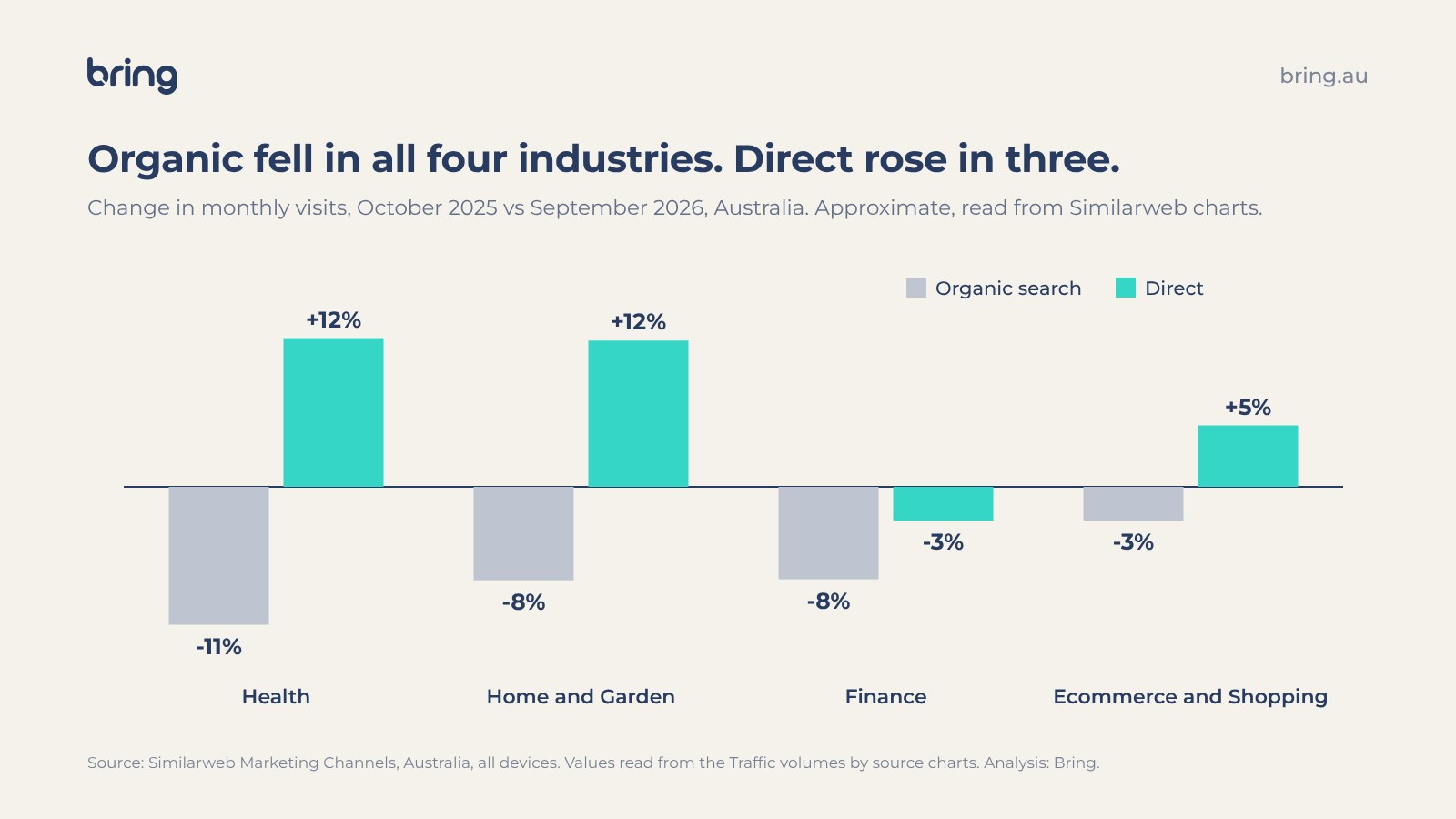
Finance is the exception, with both channels down. Home and Garden and Ecommerce also show a sharp organic drop in February 2026 that never fully recovered, so some of that decline may come from a Google update rather than AI.
2. Branded search is holding its ground. We split the top 50,000 Australian search terms into branded searches (think “bunnings opening hours” landing on bunnings.com.au) and non-branded, excluding AI tool names. For searches that end on a business’s own site, branded share held steady at about 56% across the year.
Non-branded search did grow, but the growth went to Wikipedia (up 25 million searches a month), YouTube (up 17 million) and Instagram (up 8 million). That’s celebrity, news and entertainment lookups, not commercial research.
3. Google is the front door to AI, not the other way round. “chatgpt” is Australia’s second most searched term, behind only “youtube”, at 4.9 million searches a month. And “ai mode”, Google’s own AI search experience, already draws 254,000 searches a month.
Put together, the pattern is consistent with people using AI to research and shortlist, then turning to Google or going straight to the brand to act. It isn’t proof yet (more on that below), but it’s a very different picture from “AI doesn’t matter”.
Why your analytics undercounts AI
Even if AI is influencing your customers, GA4 will struggle to show it. Three reasons:
- Missing referrers. Many AI apps don’t pass a referrer, especially on mobile and when people copy a link, so those visits land in Direct.
- Google’s AI counts as organic. Clicks from AI Overviews and AI Mode are recorded as Organic Search, not AI.
- The research happens off-site. Someone who gets a recommendation in ChatGPT and then searches your brand shows up as branded organic or direct, with no AI trace at all.
That’s why the Gen AI line in your channel report will always look small. The useful signals are branded search volume, direct traffic and branded conversion rate, tracked together over time. If you haven’t set that up properly, start with GA4 and Tag Manager setup. Marie found 45 of her 100 sites weren’t tracking any conversions at all.
Where I land on GEO
Matt Hodgson, founder, Bring
I’ve been in search long enough to watch it get declared dead more times than I can count. Every time, a new acronym turns up with a new price tag attached. GEO is the latest, and Marie’s right to call it out.
But “distraction” isn’t the whole story for me. What this data really shows is that the click was always a poor proxy for influence. Rand Fishkin has been making that point for years, and AI has just made it impossible to ignore. Someone asks ChatGPT for the best mortgage broker in Melbourne, gets three names, then Googles one of them. No referral, no AI line in GA4. But the shortlist was decided in that chat window.
So here’s my position. If you’re paying for GEO as a separate retainer, with a dashboard of ChatGPT citations and nothing tied to revenue, stop. Put that money into the fundamentals: a site Google can crawl, content that genuinely answers your buyers’ questions, and a brand that credible sites talk about. That’s what gets you named by AI and found on Google. It’s the same work.
And if you’re ignoring AI because the referral numbers are tiny, you’re making the bigger mistake. Your next customer is probably building a shortlist somewhere you can’t see. The job is to be on it, then measure what turns up afterwards: branded searches, direct visits and enquiries. Ranking is vanity. Being the name that comes up is the work.
What Australian businesses should do about it
- Keep Google as the main event. Organic search is still 51 to 80 times bigger than AI referrals. Technical SEO, helpful content and strong rankings still pay the bills, and they feed Google’s AI features too.
- Don’t buy GEO as a separate line item. What gets a brand named in ChatGPT, Gemini and Perplexity is mostly what wins in Google’s AI features: clear entity signals, useful content, consistent third-party mentions through digital PR and clean structured data. We treat AI search optimisation as part of Digital Performance, not a bolt-on. (Our SEO vs GEO breakdown covers the cost and ROI trade-offs.)
- Measure AI influence where it lands. Track branded search, direct traffic and branded conversions monthly, alongside your AI visibility. A rising brand line with flat AI referrals is AI working, not failing.
- Prioritise AI visibility in research-heavy categories. Finance and Health get the most AI referrals relative to search, and AI already beats paid social there. Local businesses can start with these Google Business Profile moves that earn AI citations.
- Get your data ready for AI agents. Merchant Center feeds, accurate structured data and clean booking or quote flows are what AI agents will read and act on next. Businesses with tidy data will be first in line.
How we ran the numbers
All figures come from Similarweb and cover October 2025 to September 2026, with prior-year comparisons where Similarweb provides them. A few honest caveats:
- Web only. Usage figures cover desktop and mobile web visits to AI chatbot sites, not app usage, so true AI use is higher.
- Outbound click data is desktop only and share-based. It shows where clicks go, not how many there are. Destination groupings are ours.
- A different method from Marie Haynes. Her figures come from GA4 and compare AI with Google organic only. Ours come from Similarweb’s panel and compare AI with organic search from all engines. Directionally comparable, not identical.
- Trend figures are approximate. The organic and direct changes were read from Similarweb’s channel charts, so treat each percentage as accurate to within a few points.
- No prior year for search terms. The branded split covers 12 months only, and we identified branded terms by matching each search to the site that receives most of its traffic.
- Correlation, not cause. Rising direct traffic and steady branded share are consistent with AI influence, but brand campaigns, seasonality and Google updates play a part too.
The next question worth testing is whether brands that AI recommends more often see faster growth in branded search. That needs AI visibility tracked across a set of brands over time, and it’s on our list.
Next step: find out where your brand shows up
Want to know how your brand shows up across Google and AI search, and whether it’s turning into real demand? Get in touch and we’ll take a look at your category, your competitors and what’s actually driving your enquiries.
Frequently asked questions about AI referral traffic in Australia
How much traffic does ChatGPT send to websites?
Very little compared with search. Across four Australian industries, all AI chatbots combined sent 0.45% to 0.73% of total website traffic in the year to September 2026, equal to 1.2% to 2.0% of organic search traffic. Worldwide, about 5% of ChatGPT’s outbound desktop clicks go to third-party websites.
Is GEO worth investing in?
As a separate service focused on ChatGPT referral clicks, rarely, because those clicks are small. As part of a broader SEO strategy, yes. The work that earns AI mentions (entity signals, useful content, authoritative third-party coverage, structured data) is largely the same work that wins in Google’s AI Overviews and AI Mode.
Why does AI traffic show up as direct in GA4?
Many AI apps don’t pass referrer information, particularly on mobile or when a link is copied, so GA4 records those visits as Direct. Clicks from Google’s AI Overviews and AI Mode are recorded as Organic Search. Both mean GA4’s AI channel undercounts AI’s real influence.
Does being mentioned in ChatGPT increase branded search?
It’s plausible but not yet proven. Australian data shows branded search holding its share of commercial searches at about 56% while direct traffic rose in three of four industries, which fits that idea. Testing it properly means tracking AI visibility across a set of brands over time and comparing their branded search growth.
Which Australian industries get the most AI referral traffic?
Of the four industries analysed, Health gets the largest share of its traffic from AI chatbots (0.73%). Relative to organic search, Finance (2.0%) and Health (1.8%) lead, while Home and Garden is lowest (1.2%). Research-heavy categories benefit most.
Sources
- Marie Haynes, GEO is a distraction, 21 October 2026
- Rand Fishkin, LinkedIn post sharing Marie Haynes’ research
- Similarweb, Marketing Channels: Ecommerce and Shopping, Health, Finance, Home and Garden (Australia), Oct 2025 to Sep 2026
- Similarweb, Top Sites and Engagement Overview: AI Chatbots and Tools (Australia and worldwide), Oct 2024 to Sep 2026
- Similarweb, Outgoing Links: chatgpt.com, gemini.google.com, claude.ai, perplexity.ai (desktop), Oct 2025 to Sep 2026
- Similarweb, Top Keywords: top 50,000 search terms (Australia and worldwide), Oct 2025 to Sep 2026
Matt Hodgson is the founder of Bring and an SEO and AEO specialist with three decades in digital performance. He’s helped brands from enterprise to SMB grow their visibility across search and AI-driven discovery, building data-led strategies that connect organic performance directly to business outcomes.