

Services
B2B Ecommerce SEO: A Practical Guide for Australian Manufacturers and Wholesalers
 Matt Hodgson
16 min read
Matt Hodgson
16 min read
Your trade buyers still order by phone and email. That makes B2B ecommerce SEO easy to dismiss.
But here is the thing: they research on Google long before they call you.
Yes, fewer people search than in consumer retail. But one new wholesale account can be worth thousands in repeat orders. That maths changes the whole strategy.
This guide shows how SEO works differently for a B2B ecommerce site in Australia. You get an ordered plan you can run in-house or brief an agency on.
Rather have it done for you? Start with our ecommerce SEO service and ask for an audit-first view of your trade catalogue.
The plan in brief:
| Step | What you do | What you get |
|---|---|---|
| 1. Set foundations | Tie goals to account value, sort access | Measurement before optimisation |
| 2. Research keywords | Map terms by buyer intent | A keyword-to-page map |
| 3. Fix the technicals | Crawlability, architecture, gating decisions | The right catalogue pages indexed |
| 4. Optimise money pages | Category and product page work | One owning page per target term |
| 5. Build useful content | Answer the questions that stall quotes | Guides sales actually sends out |
| 6. Earn authority | Relevant links from your industry | Credibility buyers recognise |
| 7. Measure what matters | Quotes and enquiries, not just clicks | A report tied to revenue |
Why B2B ecommerce SEO is different
Consumer SEO chases volume and fast checkouts. B2B ecommerce SEO chases fit and future orders. Three differences shape every step below.
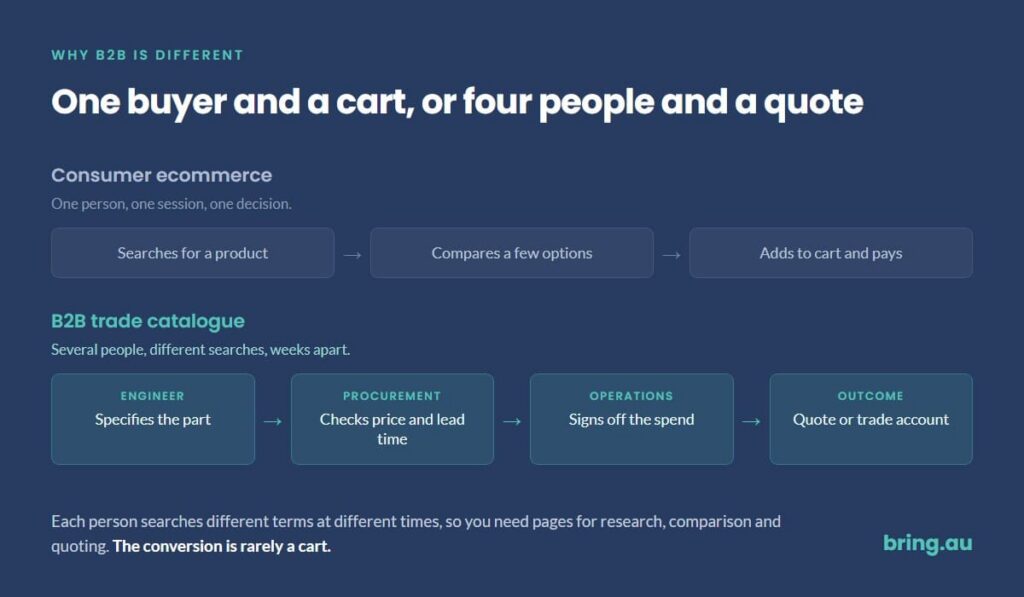
First, the funnel is longer and crowded. An engineer might spec the part, a procurement manager checks price and lead time, and an operations manager signs off. Each person searches different terms at different times, so you need pages for research, comparison and quoting, not just one buy page.
Second, keywords have low volume and high value. Search intent, meaning what the searcher is trying to do, matters more than raw counts.
How low is low? In Semrush estimates for Australia, the head term for this topic sits around 390 searches a month, and Semrush volumes for niche terms tend to run optimistic, so treat that figure as directional. In trade markets that is normal.
Ten searches a month for a part number plus “supplier Australia” can beat 1,000 searches for a generic term. One converts to an account. The other never does.
Third, conversion is rarely a cart. It is a quote request, an RFQ, a trade account application or a call.
That is quote-based conversion tracking: counting quote forms, phone calls from product pages and assisted enquiries in your analytics, not just completed checkouts. If you measure only carts, B2B SEO will always look like it failed.
Step 1: Set your foundations
Start with commercial clarity before you touch keywords. Name the accounts you want. A wholesaler chasing three new distributors a quarter needs a different plan to a manufacturer chasing 200 small reorders a month.
Write down two numbers: average first order value, and estimated lifetime value of a trade account. Prioritise every later decision against those numbers, not search volume.
Then build two short buyer personas. Keep them practical. For most Australian manufacturers and wholesalers they are procurement (price, minimum order quantity, lead time, terms) and end user or engineer (specification, compatibility, compliance, installation).
Note the language each uses. Procurement searches “bulk pricing”. The engineer searches by part number or standard.
Get access sorted now. You need Google Search Console, Google Analytics or equivalent, and admin access to your ecommerce platform and content. Without Search Console you cannot verify what is indexed, which queries bring impressions, or whether technical fixes worked.
Check: measurement is in place before optimisation. You can see organic enquiries by page, and you know which account type each enquiry should become.
Step 2: Research keywords for trade buyers
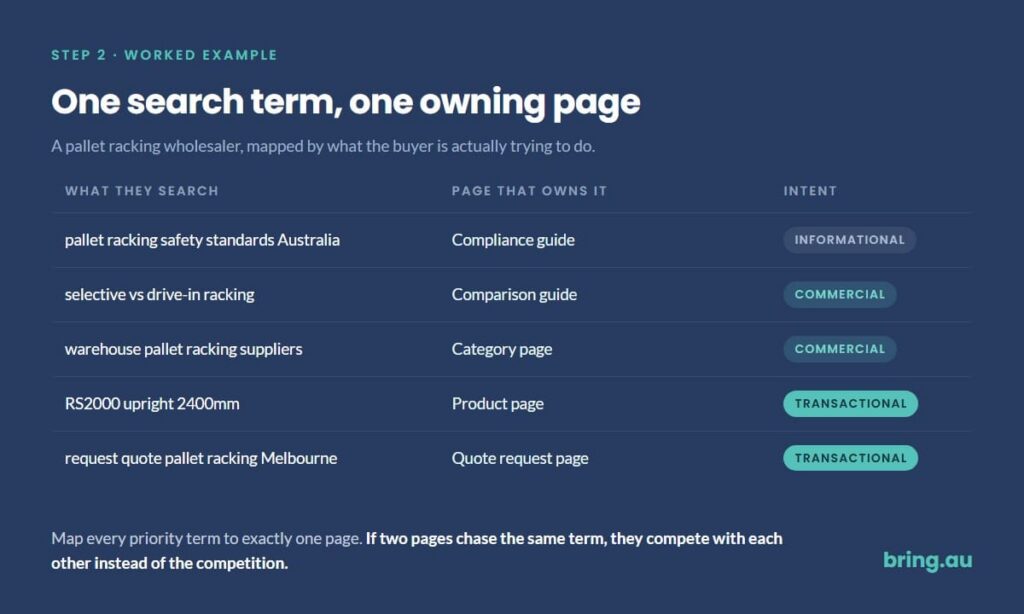
Forget chasing the biggest numbers. Build a keyword-to-page map where each target term has one owning page, and each page has one job.
Group terms by intent:
- Informational: learning and troubleshooting. Example: “how to specify stainless fittings for food grade use”.
- Commercial: comparing options. Example: “best industrial air compressor for workshop Australia”.
- Transactional: ready to act. Example: “buy 316 stainless ball valve Sydney” or “request quote pallet racking”.
Long-tail keywords, the longer, more specific phrases with lower search volume, carry most B2B value. Part numbers, specifications, standards, tolerances, pack sizes and “supplier”, “wholesaler” or “distributor” modifiers are typical.
Also collect the exact phrases your sales team hears. The questions reps answer by phone are usually the queries buyers type into Google.
Set Australian expectations early. You will find small, spiky demand, often only a few dozen searches a month per term, and any tool figure is directional rather than a precise count.
That is workable when one term maps to a category page that can win a repeat buyer. Prioritise by likely account value times realistic winnability, not by volume alone.
Check: you have a prioritised keyword-to-page map. Every money page owns one primary term, with intent labelled.
Step 3: Fix the technical foundations
Technical work makes sure search engines can find, crawl and index the pages you want found. Crawlability means Googlebot can reach the page through links. Indexing means Google keeps it in its database and can show it in results. This is the audit work our technical SEO team does first on any catalogue site.
For large catalogues, keep architecture shallow and predictable: home to category to subcategory to product, with no key page more than three clicks from home. Use clear URLs that describe the page, and link categories to subcategories to products.
Remove duplicate versions created by filters, sorting or tracking parameters. Where parameters must stay, use canonical tags to point search engines to the preferred URL.
Then comes the gated catalogue problem. A gated catalogue is a trade store where prices, stock or whole categories sit behind a login. Gating protects margins and distributor relationships, but anything fully behind login cannot rank.
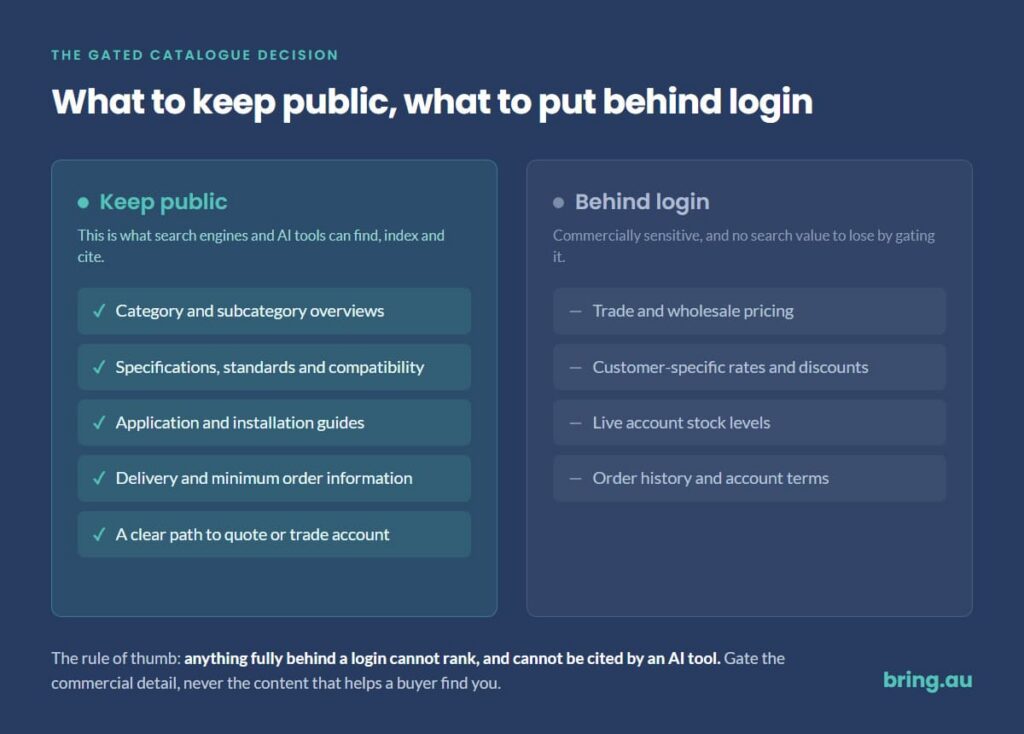
Do not decide gating on SEO alone. Before you lock pages away, keep this public: category overviews, specification content, application guides, delivery and minimum order information, and a clear path to apply for a trade account or request a quote.
Keep trade pricing, customer-specific pricing and account stock behind login. And if indexed pages have already been gated, audit what Google still holds, then remove or redirect what should no longer rank.
Cover speed basics too. Core Web Vitals is Google’s set of page experience measures for loading, interactivity and visual stability. Trade buyers often check specs on their phones, in warehouses. Compress images, keep apps and scripts lean, use a fast host, and test key category pages on mobile.
Check: indexed pages match your intended public catalogue. Search Console shows the right categories and products indexed, and gated pricing is not leaking into results.
Step 4: Optimise category and product pages
In B2B ecommerce, category pages are the money pages. Few buyers land on a single SKU first. They land on “industrial pumps”, compare, then drill down.
Give each category a clear title that matches how trade buyers search, one concise intro that states range, application and buying options, and useful filters for size, material, standard or compatibility. Link from the category to key products, related subcategories and one relevant guide.
Write for skimming. Headings, spec tables and short paragraphs beat slabs of marketing copy.
Product pages need spec-rich content, not thin supplier feeds. Include dimensions, materials, standards compliance, pack quantities, lead times and compatibility, plus clear next steps for trade: request quote, apply for account, or call.
Use descriptive image file names and alt text, and unique titles and descriptions per important product. Duplicate descriptions across 500 SKUs tell Google the pages are interchangeable.
Internal linking does quiet heavy lifting here. Link guides to the categories they support, and categories to the products they contain, using descriptive anchor text that names the destination. That helps buyers and search engines understand what each page should rank for.
Check: each target keyword has one owning page, and no two important pages compete for the same term.
Step 5: Build content trade buyers actually use
In B2B, content earns its place by answering the questions that stall a quote, not by keeping a blog busy.
Use a topic cluster to organise it. A topic cluster is one substantial pillar page on a revenue theme, linked to narrower cluster pages that answer specific questions.
The pillar might be “warehouse pallet racking buying guide”. The cluster pages answer “pallet racking safety standards Australia”, “selective vs drive-in racking costs”, “second-hand racking inspection checklist” and similar.
Good sources are already in your business. Ask sales for the five questions every prospect asks, the objections that kill quotes, and the spec mistakes that cause returns.
Turn each into one page: guides, spec sheets, comparison pages, FAQs and installation or maintenance notes. Keep each page focused on one query and link it to the relevant category or quote page.
Publish steadily rather than in a burst. One useful guide a month that sales actually sends to prospects beats ten generic posts. Review specs and standards yearly, because outdated compliance detail destroys trust fast.
Check: you have a cluster map where each guide links to its money page, and sales can name two pages they would send this week.
Step 6: Earn authority in your niche
Off-page authority still matters, but B2B needs relevance over volume. A handful of links from suppliers, industry associations, standards bodies and trade publications outweighs dozens of directory links.
Practical places to start:
- Supplier and distributor “where to buy” or stockist listings
- Industry association member profiles
- Co-authored guides with complementary vendors such as installers or integrators
- Case studies hosted on a customer’s site that link back to your implementation notes
If you have proprietary knowledge, package it. Benchmark data, lead time surveys or compliance checklists often earn mentions trade media will actually cite.
Keep digital PR narrow. Pitch vertical outlets your buyers read first, then let the story spread. Avoid link schemes, paid link networks and mass guest post swaps. They risk penalties and rarely convince a procurement team anyway.
Check: link quality over volume. Every new link comes from a site your buyers would recognise.
Step 7: Measure what matters in B2B
Report on enquiries and pipeline influence, not impressions alone. Track:
- Quote requests and RFQs by landing page
- Trade account applications
- Phone calls from product and category pages
- Assisted conversions, where organic search started a journey that closed later by phone or email
Expect months, not weeks. Plan for meaningful movement in three to six months and steadier enquiry flow in six to twelve, longer for new domains or highly competitive industrial terms.
A fair monthly report shows what was done, which pages moved for commercial terms in Search Console, how many quote-level enquiries organic drove, and what happens next. If a report shows only traffic and impressions, you cannot tell whether the money did anything.
Add one more line to the report in 2026: whether AI tools are citing you. The next section covers what that means for a trade catalogue.
Check: your monthly report ties organic work to enquiries, with quote tracking in place and timelines stated in months.
Getting your catalogue found in AI search
Your buyers have started asking ChatGPT, Perplexity and Google’s AI Overviews the questions they used to type into a search box. Which supplier stocks this fitting. What is compatible with that model. Who delivers to regional Victoria.
Some people call optimising for this AEO or GEO. The label matters less than the mechanics, and for a trade catalogue the mechanics are specific.
Gated catalogues are invisible to AI
You already know a login wall blocks Google. With AI tools it is worse, for two reasons.
There is no nuance. Google at least understands a paywall or a trade login and can treat the page accordingly. An AI crawler simply never sees the content, so your products cannot be part of an answer.
And there is no Search Console to warn you. With Google you can check what is indexed. With AI systems there is no report telling you what was missed, so a catalogue can stay invisible for months without anyone noticing.
This is the same gating decision from Step 3, with higher stakes. Public spec and category content is what gets you into answers. Trade pricing can stay behind login.
Spec-rich pages are what get cited
AI tools cite pages that answer a specific question cleanly. In B2B that works in your favour, because the boring detail is the valuable detail: dimensions, materials, standards compliance, pack quantities, lead times, compatibility.
A page that clearly states which fittings suit a given standard can be cited when someone asks exactly that. A page of marketing copy about quality and service cannot.
None of this is separate work. It is the same spec content and internal linking from Steps 4 and 5, which is why you do not need a standalone AI strategy to start showing up.
How to check whether you are being cited
Ask the tools directly. Once a month, put your real buyer questions into ChatGPT, Perplexity and Google, and note whether you appear, whether a competitor does, and whether what is said about you is accurate.
Watch for non-branded visibility in particular. Being found by people who already know your name is easy. Being found by people who do not is the whole point.
We took a foodservice distributor from an almost entirely branded search presence to 80% non-branded impressions, with average position improving from 25 to 6. The full numbers are in our foodservice distributor AI search case study.
For the wider picture beyond catalogues, see our comparison of SEO and GEO and what Google has actually said about AEO and GEO.
Check: your key spec and category pages are publicly crawlable, and you have tested at least five real buyer questions in an AI tool to see whether you appear.
Check: your monthly report ties organic work to enquiries, with quote tracking in place and timelines stated in months.
What this looks like in practice
Theory helps, but trade SEO is won on catalogue specifics and follow through. We have used this playbook in B2B work, including with lean consulting firm TXM, where considered purchases and multiple stakeholders shape the enquiry.
For catalogue-level detail, read our B2B SEO strategies case study alongside the B2B ecommerce strategic SEO case study for an agriculture B2B client. They show how keyword mapping, category work and content support enquiries in practice. For a revenue lens from retail ecommerce, see also our ecommerce SEO revenue case study.
When SEO is the wrong spend for a B2B business
SEO is compounding and durable, but it is slow and selective. Part of our job is telling you when it will not pay.
Do not buy SEO when:
- You need quotes in the next 30 days. Use Google Ads, outbound or distributors instead.
- Your core terms have almost no Australian demand and no adjacent problems to write about. A micro niche with a dozen potential buyers is a sales task, not a search task.
- Channel conflict blocks you. If distributors will delist you for selling direct and you cannot keep a public catalogue, SEO has nothing to rank.
- You cannot handle new enquiries. SEO that wins quotes your team cannot price or fulfil damages reputation.
- Your catalogue data is unusable. No specs, no images, no pricing logic and no access to fix them means any agency will burn hours on basics.
If any of those fit, fix the constraint first. Good SEO can wait three months. Bad timing cannot.
Next step: get an audit before you commit
If this plan fits, start with a technical and catalogue audit, not a retainer guess. If budget is the open question, our guide to SEO costs in Australia shows what retainers buy at each level. You want to know what should stay public, which categories can win, and what a realistic enquiry target looks like for your niche in Australia.
That is where Bring Digital Performance sits, and it is evidence, not a pitch: senior time on audits and catalogue strategy for SMEs, without big agency relay layers. Ask us through the ecommerce SEO service page for an audit-first view of your trade catalogue.
Frequently asked questions about B2B ecommerce SEO in Australia
Should we keep trade prices behind login?
Usually yes. Keep category, spec and application content public so it can rank, and keep customer-specific pricing, live stock and account terms behind login. Decide before you gate, and check Search Console afterwards for what remains indexed.
How many keywords should a B2B catalogue target?
Fewer than you think. As a working rule, map 20 to 60 priority terms to categories, key products and quote pages, plus supporting guides. Depth on high-value terms beats thin coverage of hundreds.
Can a manufacturer sell direct without angering distributors?
Sometimes, with clear rules. Common approaches are separate direct pricing, direct-only packs or bundles, lead referral for serviced territories, and public content that sends smaller buyers to stockists. Settle the commercial policy before you optimise, because SEO cannot fix a channel dispute.
How long does B2B ecommerce SEO take to show results?
Plan in months. Meaningful movement usually takes three to six months, with steadier enquiry flow in six to twelve, and longer for new domains or highly competitive industrial terms. Judge progress by quote-level enquiries and rankings for buying terms, not impressions.
Is SEO worth it for a wholesale business with low search volumes?
Often yes, because value per search is high even when volume is low. A handful of monthly searches for a part number or spec term can win a repeat trade account. It stops being worth it when your terms have almost no Australian demand and no adjacent buyer problems to write about; that is a sales task, not a search task.