

Five Google Business Profile moves that earn citations in ChatGPT, Gemini and AI Overviews, not just map pack rankings. A practical GBP checklist.
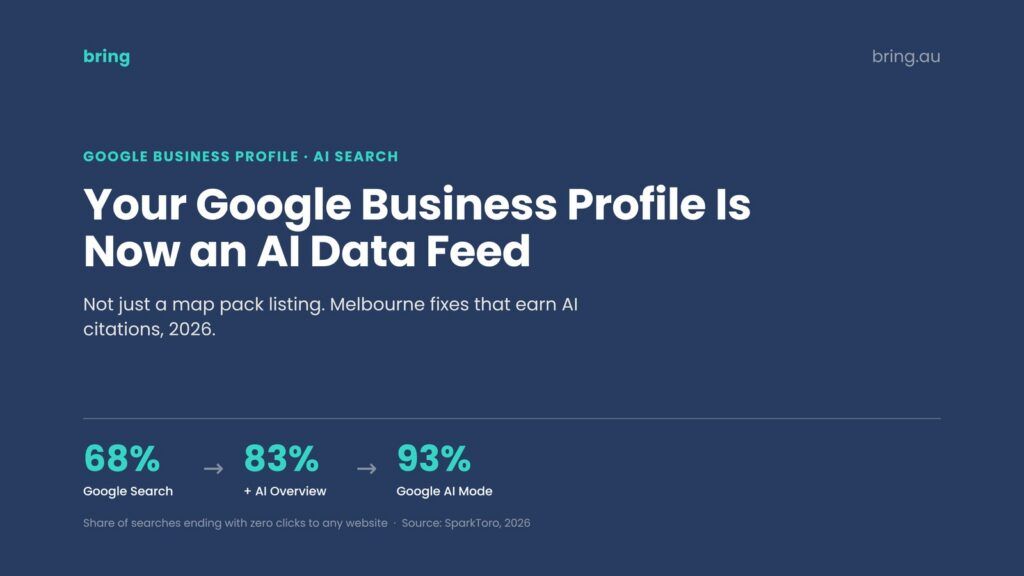
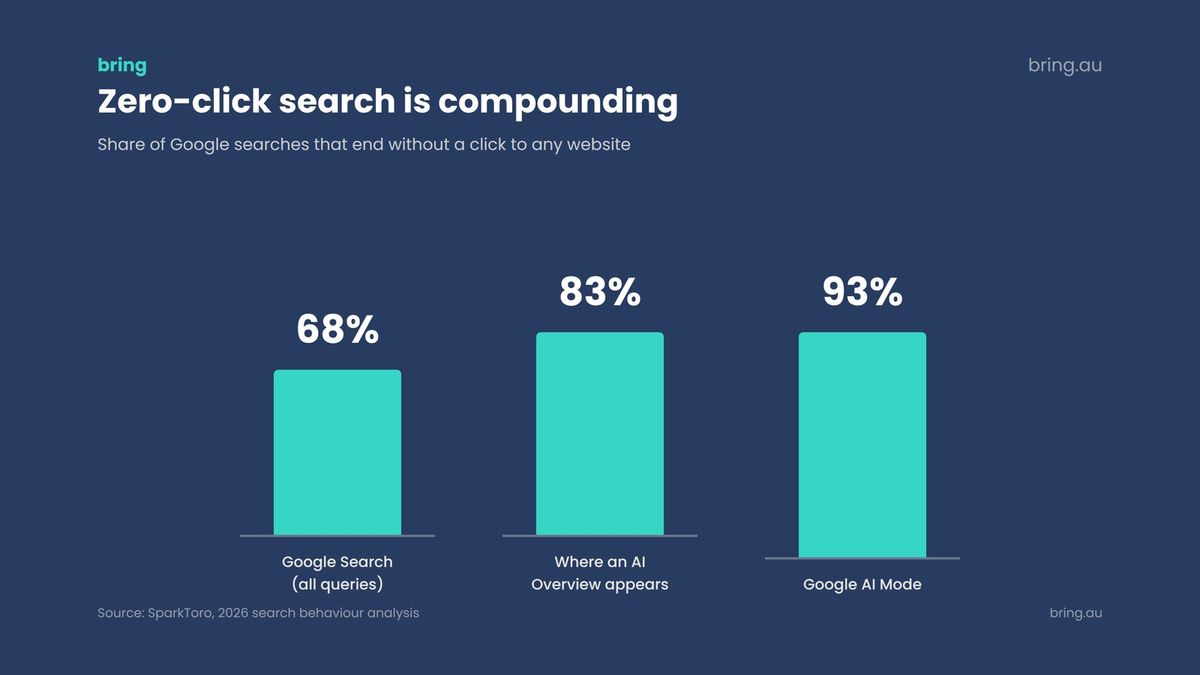
For fifteen years, the goal of local SEO was simple: get into the map pack, get the click, get the call. That model is breaking down in real time. SparkToro’s 2026 search behaviour data shows 68% of Google searches now end without a click to any website, and when an AI Overview appears in the results, that jumps to 83%. In Google’s AI Mode, it’s 93%. Business owners watching call volume and website traffic diverge from what feels like “good rankings” aren’t imagining it. The map pack hasn’t disappeared, but it’s no longer the finish line. The finish line is now an AI-generated answer, and the data feeding that answer comes almost entirely from your Google Business Profile. Below are five specific Google Business Profile optimisation moves that earn citations in that answer, not just a place in the map pack.
Source: SparkToro, 2026 search behaviour analysis
Why GBP is the primary data feed for AI search
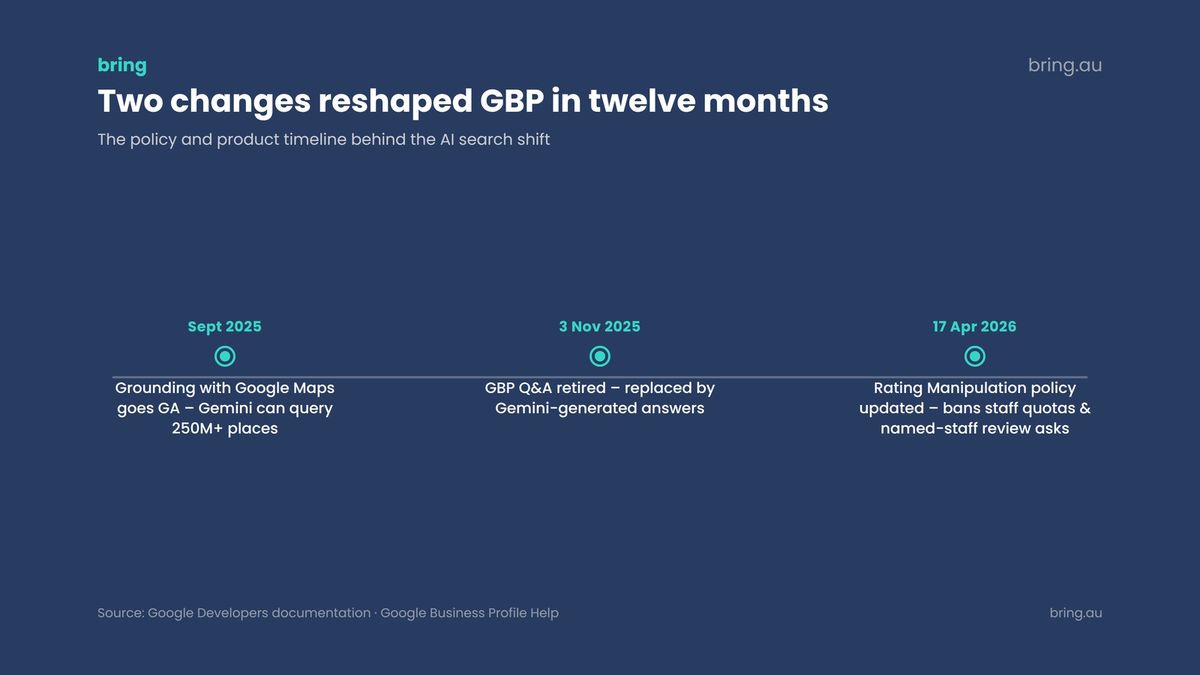
Google has confirmed the mechanism directly: Gemini’s “Grounding with Google Maps” capability, generally available since September 2025, lets AI models query a live index of more than 250 million verified businesses and places, pulling current hours, services, reviews and location data straight into a generated response. The developer API is scoped to the US and India for now, but the consumer product, the AI Overviews and Gemini answers Australians see every day, already runs on this same underlying data. ChatGPT and Perplexity work differently under the hood but land in the same place: when they answer a local query, they synthesise from whichever sources are most consistent and well corroborated, and Google Business Profile is consistently the most-cited source for that kind of query, ahead of aggregator directories like Yelp or Apple Maps, and well ahead of your own website.
That’s the reversal worth sitting with. For years, the website was the asset and GBP was a feeder channel pointing traffic at it. In 2026, for a growing share of searches, GBP is the asset and the AI answer is the endpoint. Your website still matters, but increasingly as a secondary corroboration source rather than the primary destination. We’ve mapped the broader version of this shift in SEO vs GEO: the search strategy question every business needs to answer.
What Google’s 2026 policy update means for your reviews
If you’ve noticed reviews vanishing, or you’re nervous about asking for them at all, the specific change is narrower than the panic suggests. Google’s 17 April 2026 update to its Rating Manipulation policy bans two things explicitly: setting staff quotas for review solicitation, and asking staff to solicit reviews that name them individually. Both target structured incentive programs, the “get five reviews mentioning your name this month” tactic that a surprising number of Melbourne trades and hospitality businesses still run informally.
What’s still entirely fine: asking happy customers for a review via a link, a QR code on the invoice, or a follow-up email or WhatsApp message, provided the business isn’t scripting the content or dangling an incentive. Google appears to be enforcing this through pattern detection (timing clusters, device signals, repeated phrasing) rather than reading staff training material, which is exactly why “just tell them verbally, don’t put it in writing” isn’t the loophole some agencies suggest it is. The behaviour still leaves a data pattern.
Source: Google Developers documentation and Google Business Profile Help
The bigger mindset shift this update should force: stop chasing review volume and start protecting review velocity. A profile with 400 reviews and nothing new in eight months reads as a stale entity to both Google’s ranking systems and to an LLM synthesising a recommendation. A profile adding a handful of genuine reviews every fortnight reads as active, current and trustworthy, precisely the signal both traditional ranking and AI citation now reward.
Five GBP moves that actually earn AI citations
1. Get the category and Services section doing the disambiguating. Primary category remains the single strongest signal for matching your listing to query intent, and the Services section is one of the few fields Google will lift verbatim into search snippets and AI answers. A generic “Lawyer” or “Plumber” category with an empty Services list gives an AI model nothing to cite you for specifically.
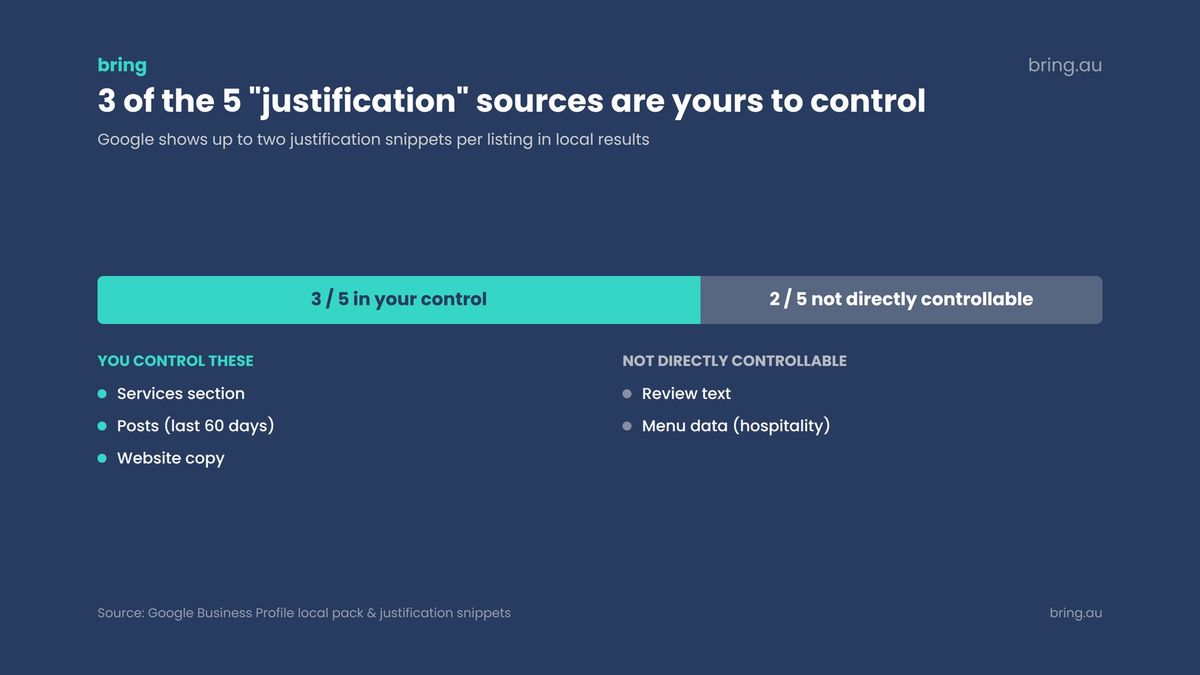
2. Treat Google’s “justifications” as a content channel, not an accident. Google shows up to two justification snippets per listing in local results, pulled from review text, your website, your Services section, recent Posts, and menu data where relevant. Three of those five sources, Services, Posts and website copy, are entirely within your control. A weekly Post targeting one suburb or one service is a direct, controllable input into what Google shows and, increasingly, what an AI answer quotes.
Source: Google Business Profile local pack and justification snippets
3. Stop waiting for GBP Q&A. It’s gone. Google retired the Q&A feature on 3 November 2025 and replaced it with Gemini-generated answers assembled from your website, profile and reviews. Any strategy still built around seeding your own GBP Q&A questions is working against a feature that no longer exists. The fix is to move that effort to your own site: a genuine, well-structured FAQ page answering the actual questions customers ask, in the language they use. That page now does the job the GBP Q&A box used to do, and it’s an asset you own rather than one Google can retire overnight.
4. Keep photos current and geotagged, not just present. Google’s vision models reportedly scan uploaded photos to verify category, service and location claims against what’s actually pictured. A profile with twelve photos from the 2023 shopfront refit reads as dormant. Weekly, genuinely new, geotagged photos, actual jobs, actual premises, function as both a freshness signal and a verification input.
5. Get entity consistency right everywhere, not just on Google. This is entity SEO applied specifically to GBP. AI systems without Google’s direct data access (ChatGPT and Perplexity, largely) build confidence in a listing from cross-source corroboration. Identical NAP, identical category language and identical service descriptions across GBP, your website, Apple Maps and any aggregator directories you’re listed on removes the ambiguity that makes a model hesitate to cite you.
What this looks like in Melbourne
A CBD accounting firm competing against a dozen similarly credentialed practices doesn’t win on brand awareness, it wins by giving an AI model something specific and verifiable to cite: named principals, defined practice areas, a description that doesn’t read like every other firm’s. A trades business covering Bayside through to the outer south east wins on service area precision: suburb specific Posts, job photos geotagged to where the work actually happened, and a service area radius that matches what the business genuinely covers, not an aspirational one. In both cases, the businesses currently being cited in AI Overviews and Gemini answers are, without exception, the ones treating GBP as a living, current data asset rather than a listing set up once and left alone.
GBP is the fastest-moving part of this shift, but it’s one piece of a wider picture. See how we approach AI search optimisation more broadly.
If you don’t know whether your profile is complete enough to be cited, that’s worth finding out before your competitor does. Run a free check at ads.bring.au/organic-visibility-check.
Matt Hodgson is the founder of Bring and an SEO and AEO specialist with three decades in digital performance. He’s helped brands from enterprise to SMB grow their visibility across search and AI-driven discovery, building data-led strategies that connect organic performance directly to business outcomes.