

SEO · Services
Google Has Tightened Its Domain Migration Rules. Here Is What Changed, and Why It Matters More Than It Looks
 Matt Hodgson
8 min read
Matt Hodgson
8 min read
A small line landed in Google’s site move documentation this month. On the surface it reads like housekeeping. In practice it raises the stakes on the single riskiest job in SEO, and it lands at exactly the moment a botched migration started costing you more than rankings.
We run a lot of migrations at Bring. Replatforms, rebrands, domain changes, the lot. So when Google quietly updates its guidance on how to move a site, we read the fine print, because the difference between a clean handover of authority and a six month traffic hole usually lives in exactly this kind of detail.
Here is what changed, in plain terms, and what you should do about it if a move is anywhere on your roadmap.
What Google actually changed
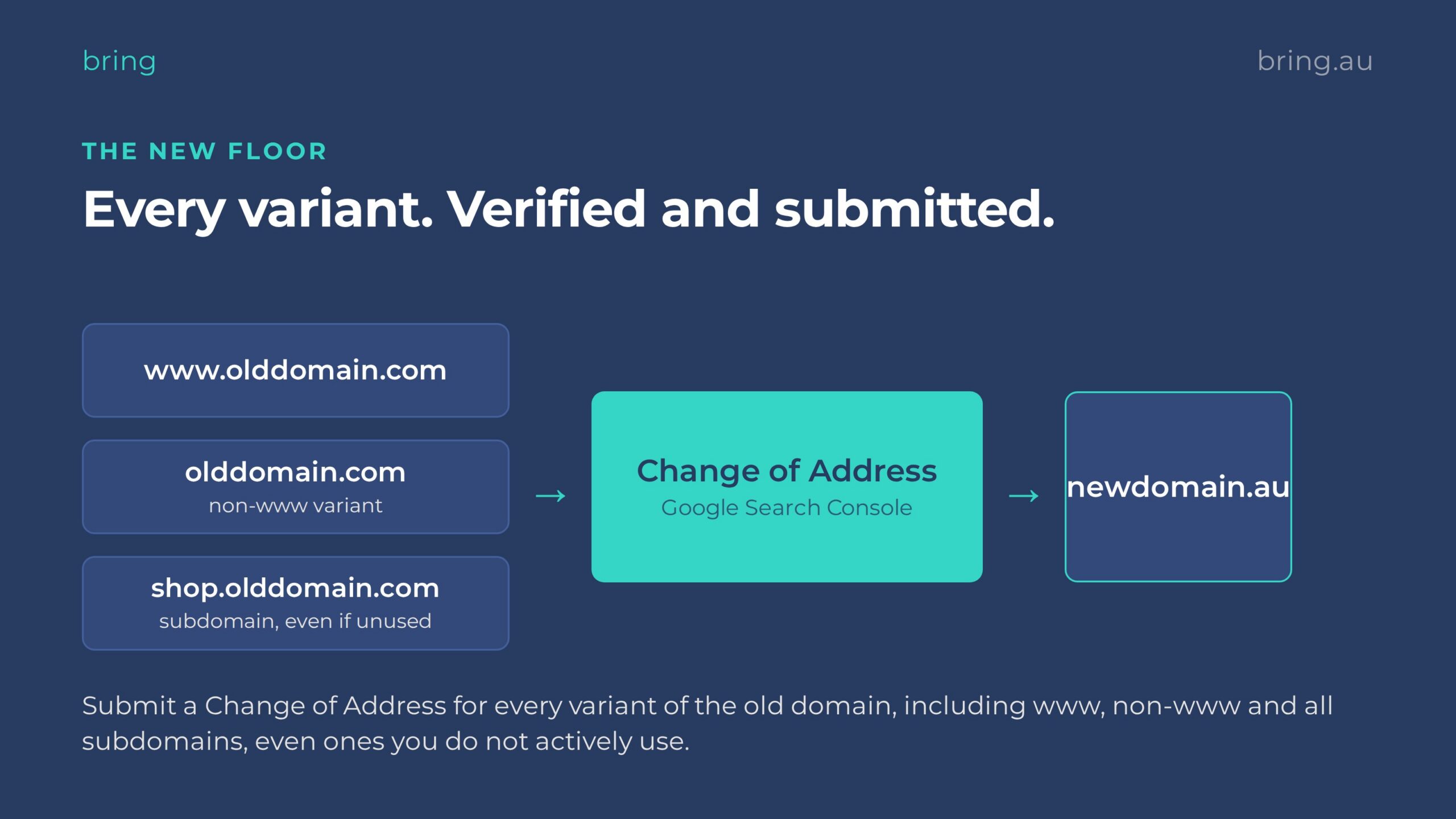
Google updated its site move guidance to spell out how the Search Console Change of Address tool should be used during a domain migration. The new instruction is blunt: when you move from one domain to another, submit a Change of Address request for every variant of the old domain. That means the www and non-www versions, plus every subdomain, even the ones you are not actively using. All of them need to be verified in Search Console first.
Google’s wording is that domain migrations work best when all variants of a site are migrated properly. The company did not fully explain the why, but the logic is not hard to follow. Links and references scattered across the web can point at any of those variants. If Google crawls a variant you forgot to account for, the signals can leak, the move gets muddy, and your search performance takes the hit.
Why one unused subdomain can derail a whole move
This is the part most teams underestimate. A migration is not one switch. Your domain has more surface area than you think, and each variant is a doorway Google can walk through.
On the moves we run, the variant problem is rarely the domain you are focused on. It is the leftover surface area: a non-www version nobody thinks to redirect, a blog or shop subdomain sitting on a different setup, an old app or staging subdomain someone spun up years ago and never killed off. Before we touch anything, we take a full snapshot of every URL and every backlink pointing at the old site, map each one to its new home, and verify the lot in Search Console first. The moves that drift are almost always the ones where a forgotten variant kept pulling crawl activity after launch. Google has now written that lesson into its own guidance.
If you want the full anatomy of how a domain move ripples through crawling, ranking and entity systems, we broke it down in our piece on how to perform a domain migration SEO during a rebrand.
The 180-day cliff most teams forget
The Change of Address tool is not permanent. It forwards signals between the old and new domains for exactly 180 days. After that, Google treats the two sites as unrelated. That is a hard edge, and it catches people out.
Your redirects, on the other hand, need to outlast that window by a long way. Google’s own guidance is to keep 301 redirects live for at least a year, and from a user’s perspective, ideally for good. Re-crawling and re-attributing every link that points at your old URLs takes time, and the bigger your backlink footprint, the longer it runs.
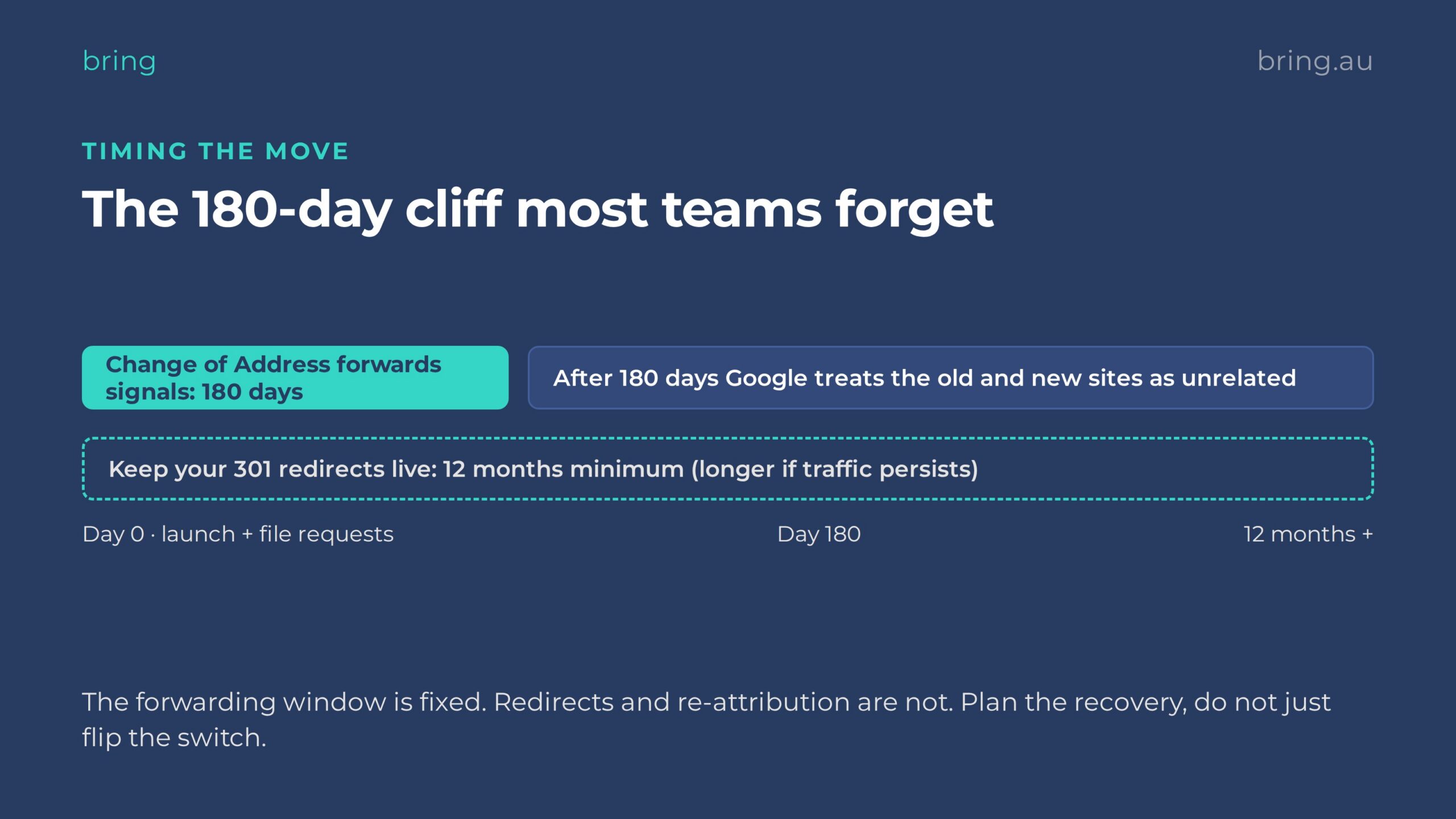
The practical takeaway: a migration is not done on launch day. It is done when the new domain has fully absorbed the old one’s authority, and that is a project measured in months, with monitoring built in. This is exactly why technical SEO discipline (redirect mapping, crawl checks, canonical hygiene) decides whether a move lands clean.
What good looks like
We saw the upside of doing this properly on a recent rebrand. A specialist travel brand moved to a full-service identity, and because the migration was scoped as a revenue project rather than a technical formality, there was no post-launch crash. The legacy domain held demand while the new one scaled. In the three months after the move, organic enquiries rose around 220 percent year on year, closed deals from organic search more than 400 percent, and gross profit from organic search roughly 500 percent. That is the gap a clean migration protects.
The bigger shift: a bad move now costs you AI visibility too
Here is why this update matters more than a documentation tweak usually would. Read it next to the other thing Google published recently.
In May, Google released its first proper AI optimisation guide and said the quiet part out loud: AI Overviews and AI Mode are built on the same crawl, the same index and the same ranking systems as classic Search. There is no separate AI index to win. As Google put it, optimising for generative AI search is optimising for the search experience, and thus still SEO. Industry studies back it up, with the overwhelming majority of links cited in AI Overviews coming from pages already ranking in the top organic results.
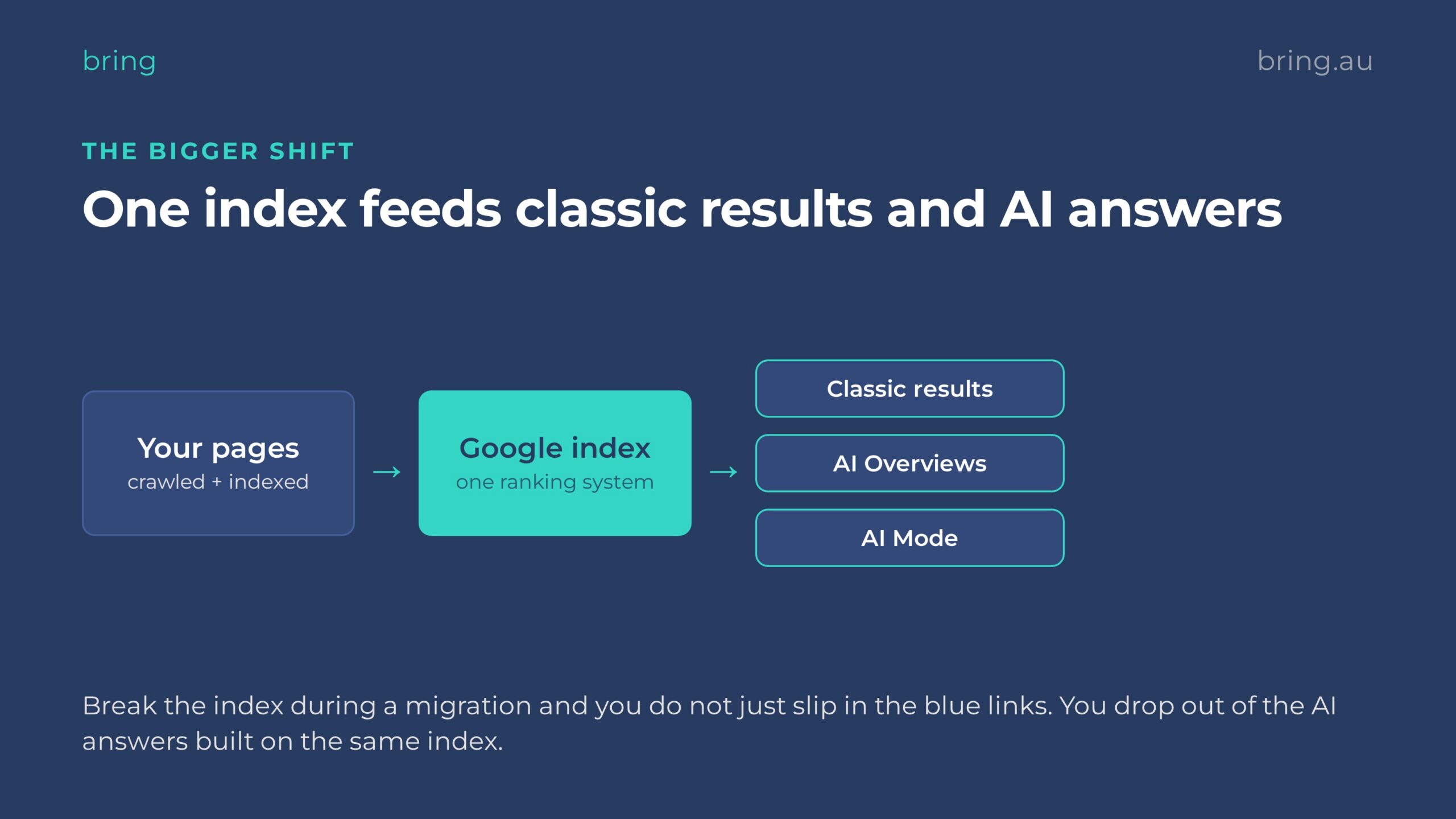
Now connect the two updates. A messy migration used to cost you rankings and traffic for a quarter or two. Painful, but recoverable. Today the same mistake can also drop your brand out of AI answers, because those answers are assembled from the exact index your migration just scrambled. The blast radius got bigger, and the new variant requirement is one of the details that decides which way it goes.
It also raises the value of your entity signals. Brand name, business details, structured data and the links between your properties are what AI surfaces lean on to understand who you are and keep citing you. During a move, those signals need protecting as a first-order priority, not a clean-up task for later.
What to do if you have a move coming up
If a replatform, rebrand or domain change is on your roadmap, treat these as the non-negotiables:
- Verify and submit a Change of Address for every variant. www, non-www and all subdomains of the old domain, verified in Search Console, even the ones you do not use. That is the new floor, not a nice to have.
- Map every old URL to its new home with a 301, and keep the redirects live for at least 12 months. No chains, no loops, no lazy redirects to the homepage.
- Protect your entity signals. Keep brand name, business details and structured data consistent through the move so AI surfaces and the Knowledge Graph do not lose the thread.
- Run launch-day crawl checks. Forgotten noindex tags and canonicals hardcoded to a staging hostname are still among the most common reasons a new site goes quiet.
- Quantify the revenue at risk before you move, not after. Most sites lose meaningful organic traffic in the first quarter and spend the rest of the year clawing it back. Know what that is worth before you flip the switch.
For the full picture of how we plan, execute and monitor a move without the post-launch crash, see our SEO website migration services, and read how we approach on-page SEO and content continuity so high performing pages keep their rankings through the transition.
Work out what a migration could cost you
Before you move a single URL, find out what the lost traffic is actually worth. Our Migration Risk Calculator turns a fuzzy fear into a real revenue number, so you can scope the move properly and protect the downside.
Frequently asked questions
What is a Change of Address request in Google Search Console?
It is the signal you send Google when you move your site from one domain to another, telling it to favour crawling and indexing the new domain and to migrate your search rankings across. It forwards signals between the old and new sites for 180 days.
Do I really need to submit it for subdomains I am not using?
Under Google’s updated guidance, yes. Submit a Change of Address for every verified variant of the old domain, including www, non-www and all subdomains, even unused ones, so stray crawl activity on a forgotten variant does not split your signals.
How long should I keep my 301 redirects in place?
At least 12 months, and ideally indefinitely from a user’s perspective. The 180-day Change of Address window is shorter than the time Google needs to re-crawl and re-attribute every external link pointing at your old URLs.
Will a domain migration affect whether I show up in AI Overviews?
It can. AI Overviews and AI Mode run on the same index and ranking systems as classic Search, so a move that disrupts your indexing or scrambles your entity signals can pull you out of AI answers as well as the standard results.
A clean migration is one of the few moments where you can genuinely step up your organic performance rather than just survive the move. A messy one can erase years of equity in a quarter. The gap between the two is planning, and the details have just got less forgiving. If a move is on the cards, let’s scope it properly before anything goes live.