


A founder’s guide to scoping, pricing and delivering technical SEO consultancy services for agencies. Real hours maths, rate bands, SLAs, reporting and where AI Overviews fit.
TL;DR: Most agencies undersell technical SEO because they scope it from gut feel and price it from how big the client looks. The fix is boring and it works: package the work into defined tiers, price from an hours model at senior rates ($180 to $250 per hour in the Australian market), put delivery commitments in the SLA instead of ranking promises, report on the technical metrics that actually move, and build implementation support into the engagement so recommendations get shipped instead of shelved. That last one is the churn killer.
I’ve been on every side of this. I’ve sold technical SEO consultancy services direct to brands, delivered them white-label through agency partners, and (early on) underscoped them badly enough to learn the hours lesson the expensive way. This is the playbook I’d hand another agency founder who wants to package technical SEO properly: scope, price, SLAs, reporting, and the delivery model that keeps clients past month four.
Technical SEO sells better as defined packages than as open-ended hours.
Why agencies get technical SEO consulting wrong
Three failure patterns come up again and again when agencies try to productise technical SEO.
They sell hours instead of outcomes. “20 hours of technical SEO per month” means nothing to a client and everything to a procurement team looking to trim. The client can’t see what 20 hours buys, so the line item is the first thing questioned at renewal.
They scope from the client’s size, not the site’s complexity. A 200 page site that’s been through two replatforms, runs three subdomains and has a decade of redirect debt is more work than a 5,000 page site with clean architecture. Pricing from logo size rather than crawl reality is how agencies end up doing $20k of work on a $6k quote.
They deliver a PDF and call it done. The 60 page audit lands, everyone nods on the call, and then it goes to the client’s dev backlog to die behind feature work. Six months later nothing has shipped, nothing has moved, and the client quite reasonably asks what they’re paying for. The audit wasn’t wrong. The package was.
Everything below is built to counter those three.
Scope it in tiers, not open-ended hours
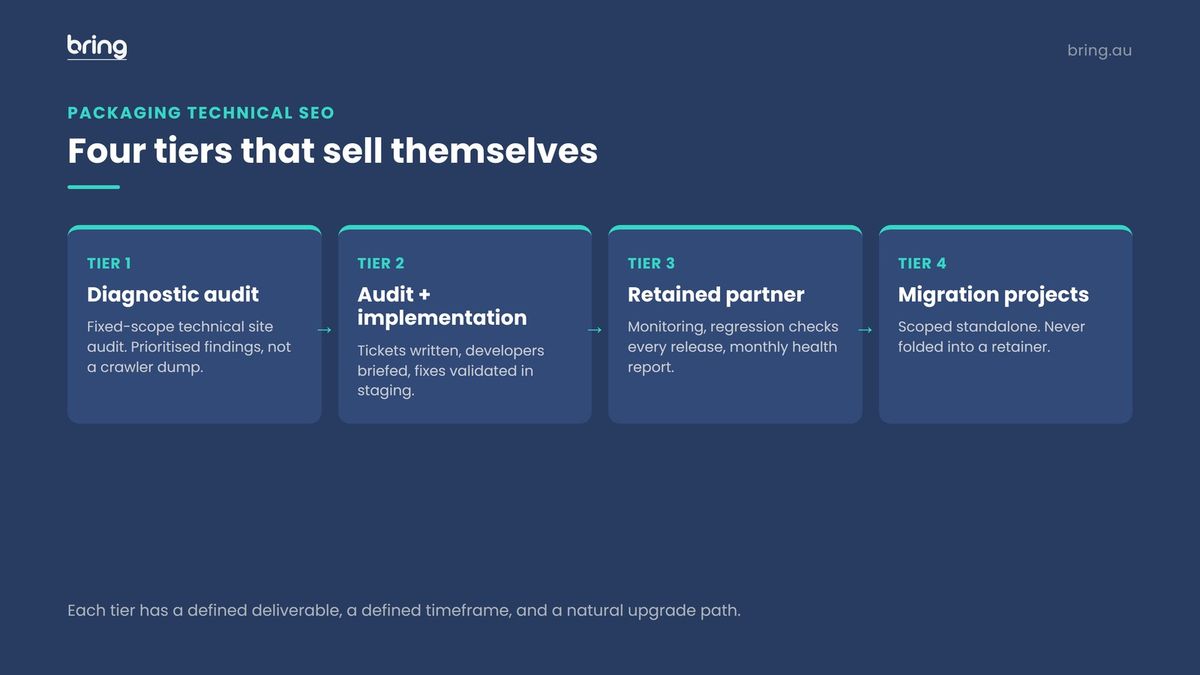
Technical SEO consulting for digital agencies packages cleanly into four tiers. Each has a defined deliverable, a defined timeframe, and a natural upgrade path to the next.
Tier 1: Diagnostic audit. A fixed-scope technical site audit covering crawlability, indexation, site architecture, redirects, structured data, Core Web Vitals and log-level crawl behaviour where access allows. Deliverable is a prioritised findings document with effort and impact ratings on every item, not an export of 400 crawler warnings. One-off, two to four week turnaround.
Tier 2: Audit plus implementation support. Everything in Tier 1, plus the consultant writes the dev tickets, briefs the developers directly, answers questions during the build, and validates fixes in staging before they ship. This is the tier most clients actually need, and the one most agencies don’t offer.
Tier 3: Retained technical partner. Ongoing monthly engagement: technical monitoring, regression checks on every release, a monthly technical health report, and a standing block of senior hours for whatever the month throws up. This is where website performance optimisation work lives, because CWV is never a one-off fix, it’s a discipline you hold across every deploy.
Tier 4: Migration and replatform projects. Scoped as standalone projects because the risk profile is different. URL mapping, redirect strategy, staging QA, launch support and post-launch monitoring. If you only take one thing from this section: never fold a migration into a retainer. The hours spike is too sharp and one party always ends up resenting the deal.
The tiers do the selling for you. A client who balks at Tier 2 pricing can start at Tier 1, see the findings, and upgrade once the dev queue reality bites. Which it will.
Price from hours maths, not vibes
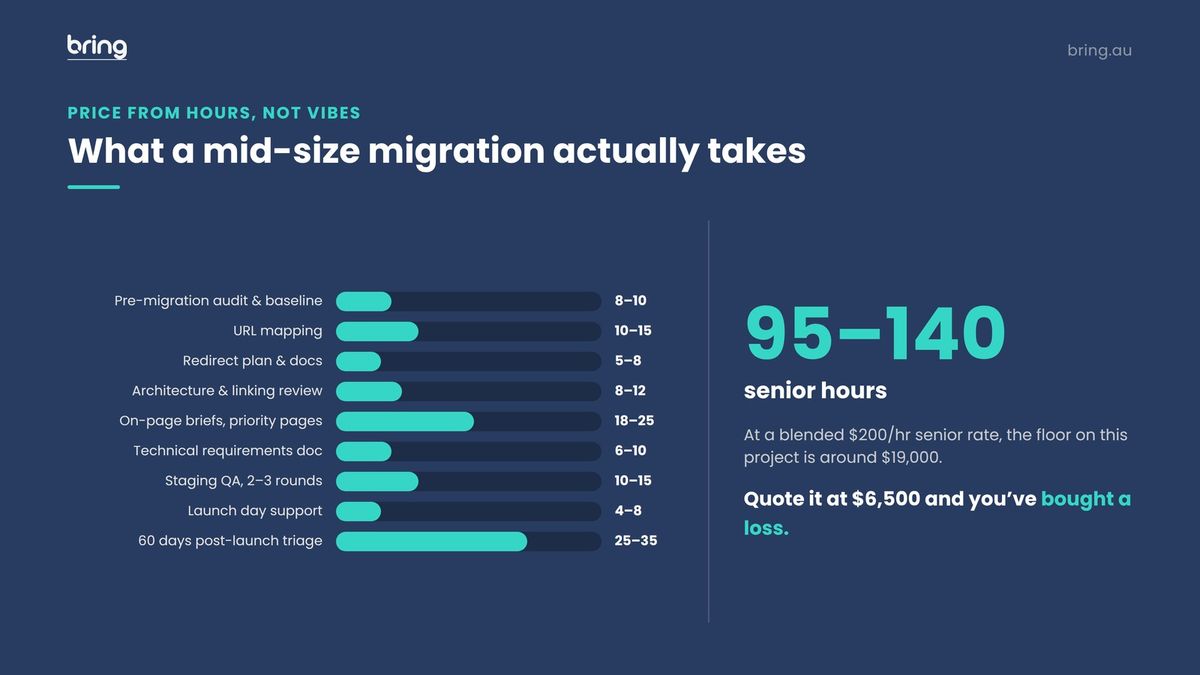
Here’s the worked example I use internally. Take a mid-size migration, the Tier 4 scenario, because it exposes lazy scoping fastest:
- Pre-migration audit and GSC, GA4, backlink baseline: 8 to 10 hours
- URL mapping where structures are changing: 10 to 15 hours
- Redirect plan and documentation: 5 to 8 hours
- Architecture and internal linking review: 8 to 12 hours
- On-page briefs for the priority pages: 18 to 25 hours
- Technical requirements doc for the dev team: 6 to 10 hours
- Staging QA across two to three rounds: 10 to 15 hours
- Launch day support: 4 to 8 hours
- 60 days of post-launch monitoring and triage: 25 to 35 hours
That’s 95 to 140 hours of senior work. At a blended senior rate of $200 per hour, the floor on that project is around $19,000. Quote it at $6,500 because the client “feels small” and you haven’t won a deal, you’ve bought a loss. I know because I’ve done it, and the hours don’t care how friendly the client is.
The rate band that holds up in the Australian market for genuinely senior technical SEO is $180 to $250 per hour. For the packaged tiers, that translates to roughly $3,000 to $6,000 plus GST for a Tier 1 diagnostic on a sub 500 page site, scaling with crawl complexity rather than brand size, and monthly retainers from around $1,800 plus GST at the entry end through to several thousand for a full Tier 3 technical partnership.
And the negotiation rule that protects all of it: when a client or partner pushes back on price, reduce the scope, never the rate. Pull the post-launch monitoring window in from 60 days to 30. Cut the on-page briefs from 50 pages to 25. The moment you discount the day rate instead, you’ve repriced your whole practice, and every future negotiation starts from the discounted number.
The hours maths for a mid-size migration. The floor exists whether you price to it or not.
Write SLAs you can keep, not ones that sound good
The SLA exists to make the engagement predictable for both sides. Commit to things you control:
- Critical issues (site down to Google, mass deindexation, robots.txt blocking) acknowledged within one business day, with a remediation plan inside two
- Monthly technical health report delivered on a fixed date
- Audit delivery within an agreed window from access being granted (the clock starts at access, not at signature, because chasing GSC and GA4 logins is not your delay)
- A named senior consultant, not a rotating queue
What never goes in an SLA: ranking positions, traffic guarantees, or “page one” anything. You don’t control the algorithm, and a contract that pretends otherwise becomes a stick at the first core update. Clients respect “here’s what we commit to and why we won’t commit to the rest” far more than agencies expect. The transparency is the differentiator, our longest-standing clients say exactly that.
Report on what moved, not what you did
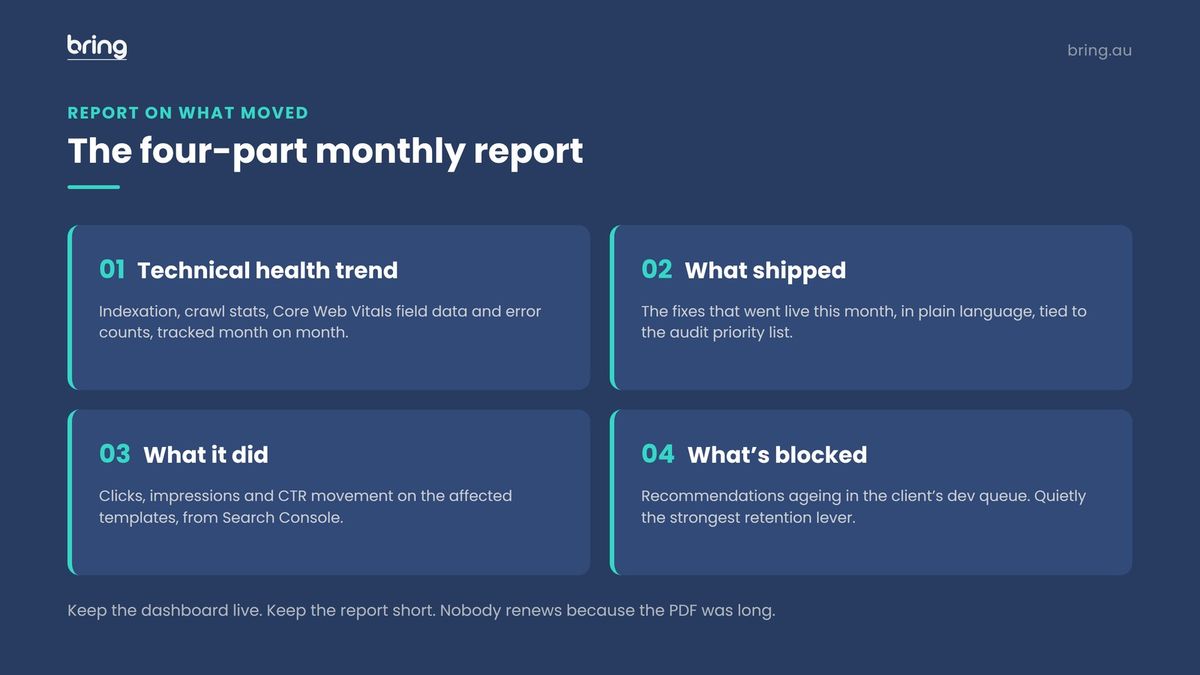
Technical SEO reporting fails when it’s a list of activity. Twelve tickets closed means nothing without the line that says what changed because of them. The monthly report that retains clients has four parts:
Technical health trend. Indexation coverage, crawl stats, Core Web Vitals field data from CrUX, and error counts, all tracked month on month so the direction is visible at a glance.
What shipped. The fixes that went live this month, in plain language, tied back to the audit priority list.
What it did. The performance line: clicks, impressions and CTR movement on the affected templates or sections from Search Console. Attribution is never perfect in SEO, but template-level before and after is honest and persuasive.
What’s blocked. The recommendations sitting in the client’s dev queue, ageing. This section quietly does more for retention than any other, because it puts the implementation gap on the record before it becomes your fault.
Keep the dashboard live (GSC, GA4 and CWV in one view) and the monthly report short. Nobody renews because the PDF was long.
Where AI Overviews and AEO actually fit
Every client conversation this year carries the same subtext: what does AI search mean for us, and do we need to pay someone new for it? The agencies handling this well are the ones giving a straight answer instead of selling a panic product. Here’s the straight answer, and it happens to be Google’s own position.
Google’s guidance on optimising for generative AI features is blunt. AI Overviews and AI Mode are built on the same core Search ranking and quality systems as classic Search, drawing from the same index. In Google’s framing, optimising for generative AI search is optimising for the search experience, and that’s still SEO. The “AEO” and “GEO” labels describe the goal, not a separate discipline with its own secret playbook.
The part that matters commercially for a technical consultant: to be eligible to appear in an AI Overview at all, a page first has to be indexed and eligible to show in Search with a snippet. That eligibility is decided by exactly the work in the tiers above, crawlability, clean indexation, sound architecture, fast pages and controlled duplication. A site with a botched technical foundation doesn’t just lose blue link rankings now, it loses the right to be quoted in the AI answer sitting above them. Same root cause, double the cost.
So when a client asks whether they need an AEO package, the honest agency answer is no. They need the technical foundation done properly, and that’s what makes them eligible for the AI surfaces. What does change is the scoreboard. Fold AI surface visibility into the performance line of the monthly report: whether the client’s priority pages are being cited in AI Overviews and answer engines for the queries that matter, not just where they rank in the ten blue links. The discipline is the same. The reporting gets sharper.
It’s worth steering clients away from the hacks doing the rounds, too. Google has said plainly you don’t need llms.txt files, you don’t need to chunk content into tiny blocks for the model, you don’t need to rewrite pages purely for AI, and structured data isn’t required for AI features (though it stays worth doing for rich results). Any vendor selling those as the AEO secret is showing you a flag, not a strategy.
Implementation support is the churn killer
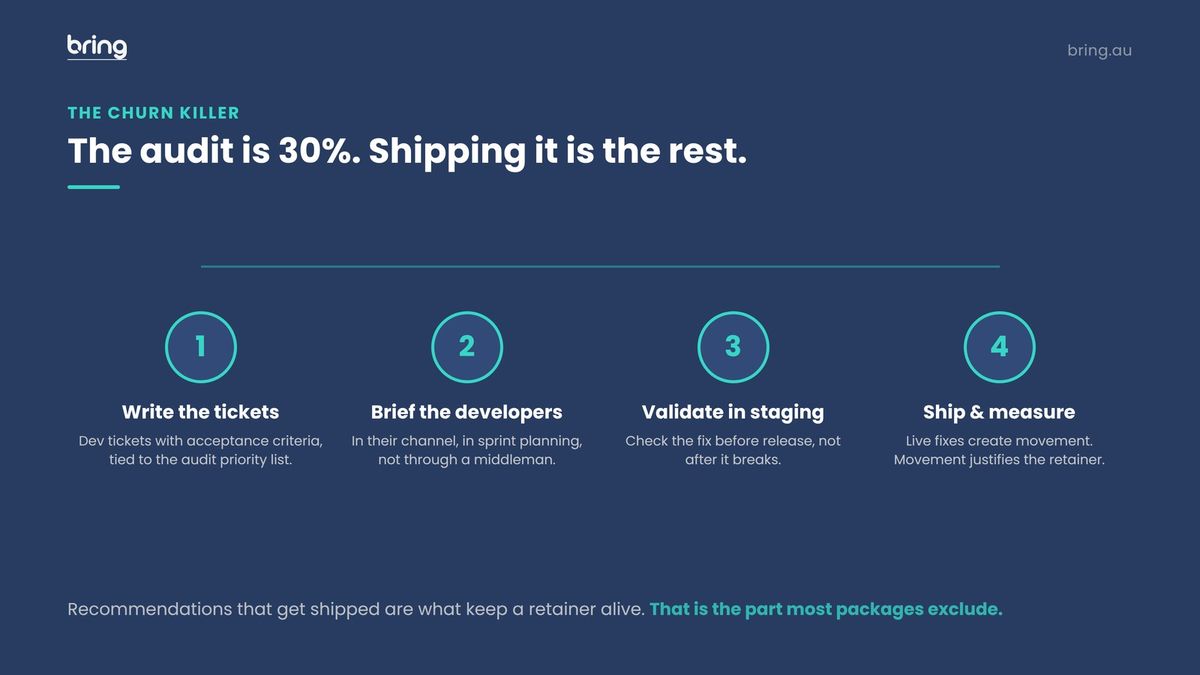
If I could only change one thing about how agencies package technical SEO consultancy services, it’s this. The audit is maybe 30 percent of the value. The other 70 percent is getting the recommendations shipped, and that’s exactly the part most packages exclude.
Implementation support means the consultant writes the actual dev tickets with acceptance criteria, joins the sprint planning call when the technical work is being prioritised, answers the developer’s questions in their channel rather than through a client middleman, and checks the fix in staging before release. It’s not glamorous. It’s also the difference between a client whose Core Web Vitals actually went green and a client holding a PDF that says they could have.
The commercial logic is simple: shipped recommendations create measurable movement, measurable movement justifies the retainer, and the retainer renews. We’ve watched this play out repeatedly, the engagements with implementation support baked in are the ones that run for years.
The audit is 30 percent of the value. Shipping it is the rest.
The build-or-partner question
Plenty of agencies reading this won’t want to build the capability at all, and that’s a legitimate packaging decision in itself. The maths: a genuinely senior technical SEO costs $200,000 plus a year in salary, tools and overhead in the Australian market. If you can’t keep that person 60 to 70 percent utilised on billable technical work, the in-house model loses to a partner model every time.
The partner model is how a lot of our agency work runs. We Are Scooter, a Melbourne marketing agency, plugs Bring in as the search specialist behind their client engagements: they own the relationship and the strategy, we bring the technical depth and the delivery. Their clients get senior technical SEO without Scooter carrying the fixed cost, and Scooter’s scope of services gets wider without their payroll getting longer. We run the same model for web development agencies who need SEO covered on builds and migrations, sometimes starting with nothing more than a technical SEO workshop for their dev team.
If you’re an agency founder doing the build-or-partner sums, the honest answer is that the playbook above works either way. Build it in house and this is your packaging structure. Partner, and this is the standard you should hold your partner to.
What good delivery looks like in the numbers
One example of where disciplined technical work lands. A major industry publisher came to us losing traffic to competitors. The work was almost entirely Tier 2: XML sitemap and robots.txt issues, redirect cleanup, Core Web Vitals remediation, with the fixes implemented alongside their team rather than left in a document. Comparing the last three months of 2023 to the same period in 2024, total clicks grew around 2,599 percent and impressions around 1,513 percent, driven substantially by the site becoming eligible for Google Discover once the technical foundation was fixed. The full breakdown is in the publisher case study.
Not every engagement produces numbers like that, and any consultant who promises they will should be shown the door. The point is narrower: the technical work was scoped properly, priced from hours, shipped through implementation support, and reported against movement. The package did its job.
The four-part monthly report: trend, shipped, moved, blocked.
Frequently asked questions
How much should an agency charge for a technical SEO audit?
Price from hours, not from how big the client looks. A diagnostic audit on a sub 500 page site typically runs 15 to 25 senior hours, which at $180 to $250 per hour puts a credible audit between $3,000 and $6,000 plus GST. Ecommerce complexity, multiple subdomains or migration history push the hours, and therefore the price, up.
What should a technical SEO consulting SLA include?
Response and delivery commitments you control: critical issue acknowledgement within one business day, a monthly report on a fixed date, audit delivery within an agreed window of access being granted, and a named senior contact. Never ranking guarantees.
Why do technical SEO retainers churn?
Because recommendations don’t get implemented. Audits that die in the client’s dev backlog produce no movement, and no movement is what gets questioned at renewal. Packaging implementation support into the engagement is the most reliable client retention lever in technical SEO.
Should a digital agency build technical SEO in house or white-label it?
Volume decides it. If you can’t keep a $200k plus senior hire 60 to 70 percent utilised on billable technical work, a partner arrangement gives you the same capability without the fixed cost, and you keep the client relationship.
Do agencies need a separate AEO or GEO service?
No. Google’s own guidance is that optimising for generative AI features like AI Overviews and AI Mode is still SEO, because those features run on the same index and ranking systems as classic Search. A page has to be indexed and snippet-eligible before it can be cited in an AI answer, and that eligibility comes from the technical foundation, not from a separate AEO product. What’s worth adding is AI surface visibility tracking in your reporting, so clients can see where they’re being cited, not just where they rank.
Where to from here
If you’re packaging this capability yourself, start with the tiers and the hours model, they fix the underpricing problem inside one quarter. If you’d rather plug in a partner who already runs this playbook, that’s a conversation we have with agencies most weeks. Get in touch and we’ll talk through how the partner model works.
Matt Hodgson is the founder of Bring and an SEO and AEO specialist with three decades in digital performance. He’s helped brands from enterprise to SMB grow their visibility across search and AI-driven discovery, building data-led strategies that connect organic performance directly to business outcomes.