

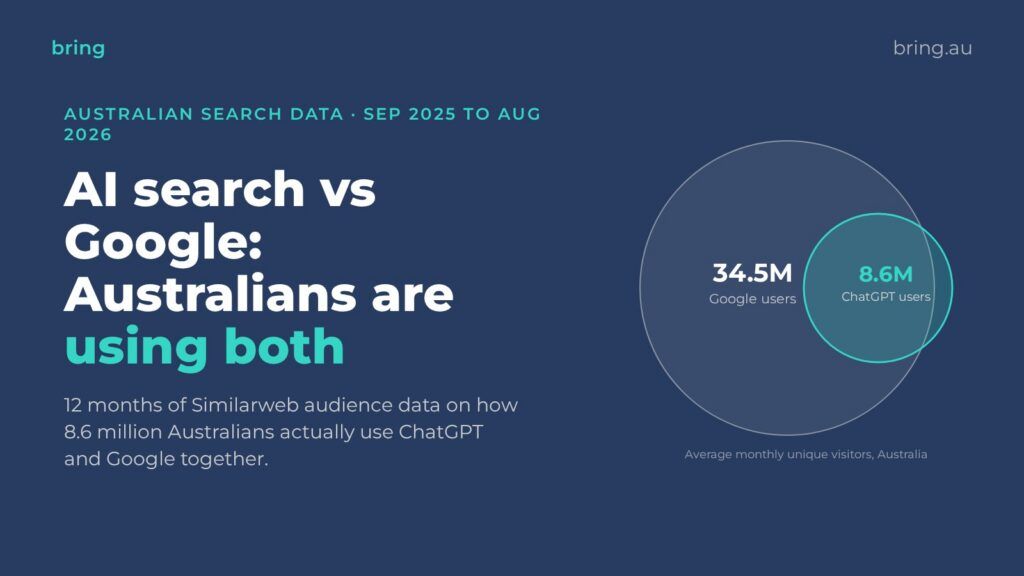
Is ChatGPT replacing Google in Australia? We analysed 12 months of Similarweb audience data covering 34.5 million Australians. The answer surprised us.
There has been a run of overseas coverage lately about whether people are abandoning Google for ChatGPT. Search Engine Journal’s recent piece, People Aren’t Leaving Google For AI. They’re Using Both, pulled together the US research neatly. The short version: 95% of ChatGPT users still show up in Google’s audience, yet households with ChatGPT access run about 9% fewer traditional searches, and forced exposure to Google’s AI Mode cut clicks to external sites by nearly 19 percentage points.
That is all US data. Nobody had run the numbers for Australia. So we did.
We pulled twelve months of Similarweb audience data for Australia, September 2025 through August 2026, covering google.com and chatgpt.com across all traffic. What it shows is more interesting than the “AI is killing Google” headlines, and more useful if you are deciding where to put your search budget in 2027.
The headline numbers: 8.6 million Australians use ChatGPT, and almost all of them still use Google
Over the twelve months to August 2026, google.com averaged 34.47 million unique Australian visitors a month. Chatgpt.com averaged 8.61 million. That makes ChatGPT’s Australian audience about a quarter the size of Google’s, which is no longer a rounding error. It is roughly one in three Australians.
The overlap is where it gets interesting, and it is lopsided in a way the “ChatGPT is the new Google” narrative never mentions:
Of Google’s Australian audience, 24.9% also visited ChatGPT during the period. So for every four Australians on Google, one is also using ChatGPT.
Of ChatGPT’s Australian audience, 99.7% also visited Google. The number of Australians who used ChatGPT without touching Google across the entire year was about 28,000 people. Out of 8.6 million.
That second number is the one that matters. There is no meaningful population of ChatGPT only users in Australia. ChatGPT is not a replacement audience. It is a behaviour that sits inside your existing Google audience.

Is ChatGPT replacing Google in Australia? The monthly data says no
An annual overlap figure can hide a trend, so we checked the monthly numbers. If Australians were genuinely migrating away from Google, you would expect ChatGPT users to visit Google less and less over the year.
They did not. The share of ChatGPT’s Australian audience that also visited google.com in the same month held between 87.4% and 88.6% for all twelve months. September 2025: 87.8%. August 2026: 87.9%. A full year of the fastest AI adoption in history, and the needle did not move.
Looking from the other direction, the share of Google’s Australian visitors who also visited ChatGPT in the same month sat at 22.8% in September 2025, dipped to about 16% over the December holiday period, and climbed back to just under 20% by August 2026. That summer dip tells its own story: a meaningful chunk of Australian ChatGPT usage is work and study driven. Usage softens when offices and unis wind down, then rebuilds through the year.
So the direct answer to “is ChatGPT replacing Google in Australia” is no, not on audience data. What is changing is what happens inside each session, and that is where the US research fills the gap our audience data cannot see. The Bocconi study found households with ChatGPT Search access ran 9.4% fewer traditional searches, with the biggest drops in informational categories: academic site referrals down 32.8%, reference sites down 26.5%. People keep Google. They just send fewer question-style queries to it.
For anyone managing organic traffic, that is the mechanism behind a pattern we see in client accounts constantly: impressions holding steady while informational clicks slide. Your audience did not leave. Their questions did.
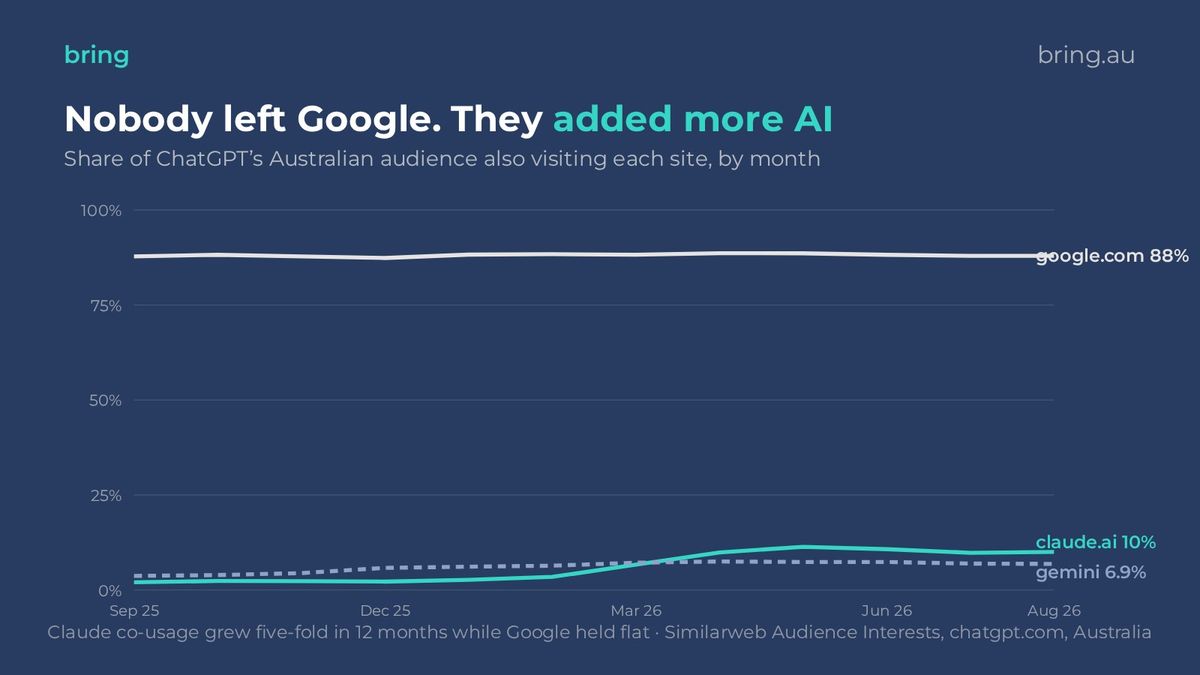
The real shift: Australians are not swapping Google for AI, they are stacking AI on AI
The most striking trend in the data is not Google versus ChatGPT at all. It is what ChatGPT users are doing with other AI tools.
Within ChatGPT’s Australian audience over the year, co-usage of a second AI assistant grew sharply:
Claude co-usage went from 2.0% of ChatGPT’s audience in September 2025 to 10.0% by August 2026, peaking at 11.4% in May. That is a five-fold increase in a year, and period on period the overlap grew 188%.
Gemini co-usage nearly doubled, from 3.7% to 6.9%.
Meanwhile Perplexity (1.5% down to 0.8%) and DeepSeek (1.7% down to 0.9%) both faded, and Grok spiked to 2.0% in January before drifting back to 1.1%.
The Australian AI market is consolidating around a stack, not a single winner. Power users are running two or three assistants for different jobs, the same way they run Google for some tasks and ChatGPT for others. For brands, that means AI visibility is not one platform problem. Being recommended by ChatGPT but invisible to Gemini and Claude is a gap, because a growing share of the same people use all three. We covered how differently each engine sees the web in our comparison of Claude vs ChatGPT vs Gemini for SEO.
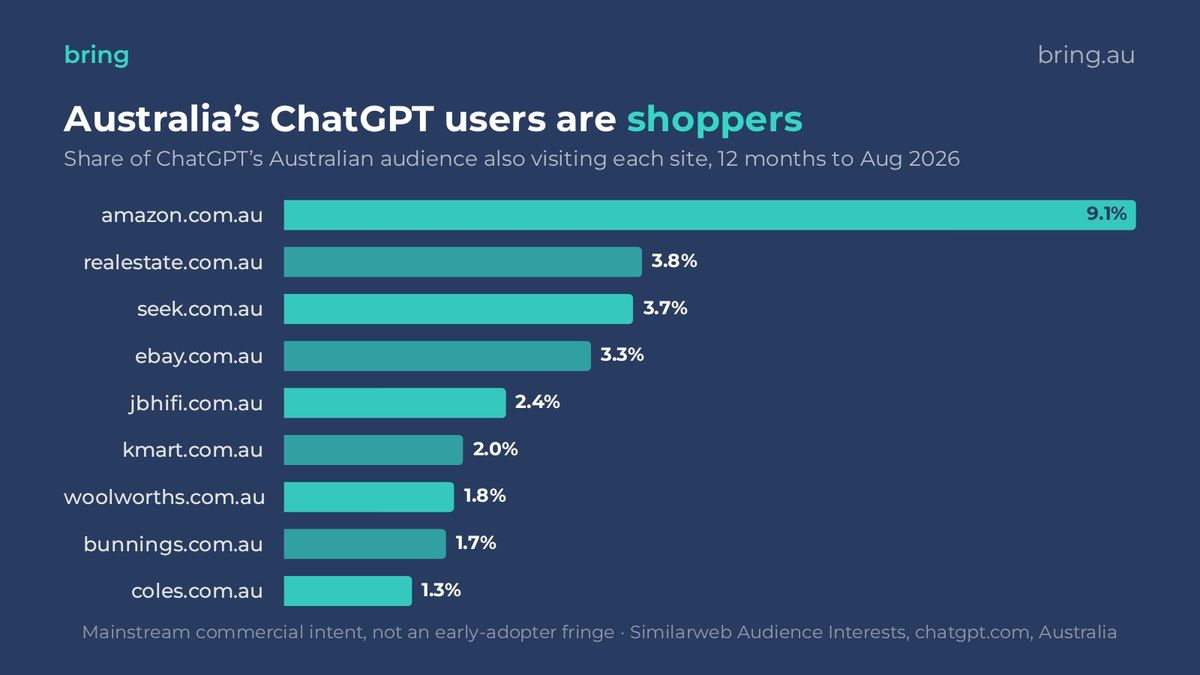
ChatGPT users are shoppers: the commercial profile of Australia’s AI audience
Here is the part of the dataset that should reframe how you think about this audience. The sites ChatGPT’s Australian users visit most are not tech blogs and research tools. They are the backbone of Australian commerce.
Among chatgpt.com’s Australian audience over the twelve months: 9.1% also visited amazon.com.au, 3.8% realestate.com.au, 3.7% seek.com.au, 3.3% ebay.com.au, 2.4% jbhifi.com.au, and the weekly shop is in there too, with woolworths.com.au at 1.8% and coles.com.au at 1.3%. Bunnings, Kmart and Big W all feature, and Kmart’s overlap grew 22.7% period on period.
Government and money round out the picture: myGov, the ATO and CommBank all sit in the top co-visited sites. This is not an early-adopter fringe. It is mainstream Australia, renting, job hunting, shopping and doing their tax, with an AI assistant open in the next tab.
The commercial implication is direct. When these people ask ChatGPT which accountant to call, which air fryer to buy or which physio to book, the brands that surface in that answer get the demand. And because this audience still uses Google at 88% monthly co-visit rates, the win shows up somewhere your analytics will misattribute it: branded Google searches. Someone gets a recommendation from ChatGPT, then Googles the brand name to check it out. Search Console logs an organic visit. The AI assist is invisible. If your branded search volume is climbing and you cannot explain why, this loop is a candidate explanation, and it is measurable if you set it up properly. Our analytics and measurement setup work increasingly includes exactly this.
What this means for your search strategy
The data points to a both/and strategy, not an either/or. Here is how we would sequence it.
1. Do not pull budget from Google SEO
Google still reaches 34.5 million Australians a month, four times ChatGPT’s audience, and 99.7% of ChatGPT users are in it. Every AI visibility strategy still runs through the fundamentals: crawlable architecture, technical SEO, and content that demonstrates real expertise. The engines answering questions learned about your brand from the same web Google indexes.
2. Add AI search optimisation as a layer, not a replacement
Generative engine optimisation (GEO) and answer engine optimisation (AEO) are the practice of making your brand legible to AI systems: structured data, entity clarity, consistent facts about your business across the web, and content that answers the specific questions people now ask assistants instead of search boxes. If you are weighing up how this differs from traditional SEO, we have broken down SEO vs GEO in detail, and it is worth reading Google’s own position on AEO and GEO before anyone sells you a silver bullet. The honest answer is that most of it is SEO done properly, with sharper entity work. That entity layer is where we focus our AI search optimisation engagements.
3. Optimise for the stack, not just ChatGPT
With Claude and Gemini co-usage rising fast inside the same audience, test your brand’s visibility across all the major engines. Ask each one the questions your customers ask. The gaps will tell you where your entity footprint is weak. Strong entity SEO tends to lift visibility across all engines at once, because they draw on overlapping sources.
4. Watch informational content economics
The US research is unambiguous: informational queries are the ones moving to AI, and AI-generated answers keep more clicks on the platform. Top-of-funnel blog traffic will keep getting harder. That does not mean stop publishing. It means publish content that AI engines cite and that positions your brand as the answer, rather than content that only worked when ten blue links sent traffic. Authority signals, original data and digital PR do double duty here: they earn links Google rewards and citations AI engines trust.
5. Measure branded search lift
If AI recommendations are feeding demand, branded search is where it lands. Baseline your branded query volume now, so when it moves you can connect it to AI visibility work rather than shrugging at an unexplained lift.
The bottom line
Australians are not leaving Google. They are adding AI on top of it, stacking multiple assistants, and bringing mainstream commercial intent with them. The 8.6 million Australians using ChatGPT are the same people shopping on Amazon, browsing realestate.com.au and Googling your brand name after an AI recommends you.
The brands that win the next few years will be visible in both places, because the audience is in both places. That is not a hedge. It is what the data says.
If you want to know how visible your brand is across Google and the major AI engines right now, talk to us. We will show you the data, not a sales deck.
Frequently asked questions
How many people use ChatGPT in Australia?
Chatgpt.com averaged 8.61 million unique Australian visitors a month between September 2025 and August 2026, based on Similarweb audience data covering all traffic. Google.com averaged 34.47 million over the same period, so ChatGPT’s audience is about a quarter the size of Google’s in Australia.
Is ChatGPT replacing Google in Australia?
No. 99.7% of ChatGPT’s Australian audience also used Google during the year to August 2026, and the share of ChatGPT users visiting Google each month held steady at around 88% for all twelve months. US research does show people with AI access run fewer traditional searches, so behaviour is shifting within sessions, but Australians are using both platforms, not switching.
What is the difference between AI search and Google search?
Google search returns a ranked list of sources (plus AI Overviews and AI Mode answers), while AI search tools like ChatGPT, Gemini and Claude generate a single synthesised answer, often naming a small number of brands. That makes being one of the few names in the answer far more valuable than ranking sixth on a results page, which is what generative engine optimisation targets.
How do I get my business to appear in ChatGPT recommendations?
AI engines build their picture of your business from the open web: your site’s content and structure, consistent business information, reviews, and coverage on sources they trust. Clear entity signals, structured data, genuinely useful content and authoritative mentions all improve your odds. Start with an audit of what each engine currently says about your brand and category, then close the gaps.
Matt Hodgson is the founder of Bring and an SEO and AEO specialist with three decades in digital performance. He’s helped brands from enterprise to SMB grow their visibility across search and AI-driven discovery, building data-led strategies that connect organic performance directly to business outcomes.