
State of Search: Healthcare and Aged Care
How Australians search for aged care and retirement living
We pulled the search data on Australian aged care and retirement living: where AI Overviews and local packs appear, which providers are gaining and losing share, and the reform vocabulary families now search with. Read the headline findings below, or download the full report free.
Google now answers most care questions before anyone clicks. We pulled November 2026 Semrush data on 73 core healthcare and aged care searches, 24 results pages, 26 websites and 12 months of organic history. In our sample, 19 of 24 results pages showed an AI Overview, government sites took 40% of the citations, and 15 of 20 provider websites showed no paid search activity at all.
This is Bring’s first annual State of Search report for healthcare and aged care. It covers aged care, retirement living, private hospitals, allied health and GP groups, and it replaces our earlier aged care articles from 2023, 2024 and 2025 with one dated data set. If you run marketing for a provider, here is what changed, who is winning, and where the gaps are going into 2027.
We use this data in our search marketing services for care providers and across the other industries we work with on SEO.
Key findings: aged care and healthcare search
- 79% of the care searches we sampled show a Google AI Overview (19 of 24).
- 71% show a local map pack (17 of 24). Twelve show both, stacked above the first organic link.
- 40% of AI Overview citations went to government sites (28 of 70). myagedcare.gov.au alone took 12.
- 0.36 is where interest in “home care packages” now sits on Semrush’s index, down from 1.00 a year ago. “Support at home provider” climbed from 0.23 to 0.81.
- 15 of 20 provider domains show no paid search keywords in Semrush.
- +66% growth in modelled organic visits for Opal HealthCare, the biggest gain among the providers we tracked.
How big is healthcare and aged care search?
The 73 core queries in our set add up to 366,770 searches a month in Australia (Semrush AU, November 2026). The split matters more than the total.
Get the full report (free PDF)
Every table and chart, plus eight ranked opportunities and a 90-day plan. Enter your details and the download link appears straight away.
- GP: 127,890 searches a month, 87.4% of them “near me”. “gp near me” alone is 60,500.
- Aged care: 125,160 a month. Take out the government brand search “my aged care” (49,500) and 75,660 remain. Only 11.8% carry “near me”. Aged care buyers are researchers first.
- Allied health: 97,780 a month, 47.6% “near me”. Definitions (“occupational therapy” 22,200, “physiotherapy” 14,800) sit alongside local searches (“chiropractor near me” 14,800, “psychologist near me” 8,100).
- Retirement living: 11,450 a month.
- Private hospitals: 4,490 a month, with the highest cost per click in the set: “private health insurance hospital cover” at $20.67.
Underneath sits a real shift in who uses care. As at 30 June 2025, 293,000 people were in home care, up 307% since 2017, while permanent residential care grew 9.9% and fell 10% per capita among people 65 and over (GEN Aged Care Data). The growth is at home, and so is the search demand.
AI Overviews now sit on most care searches
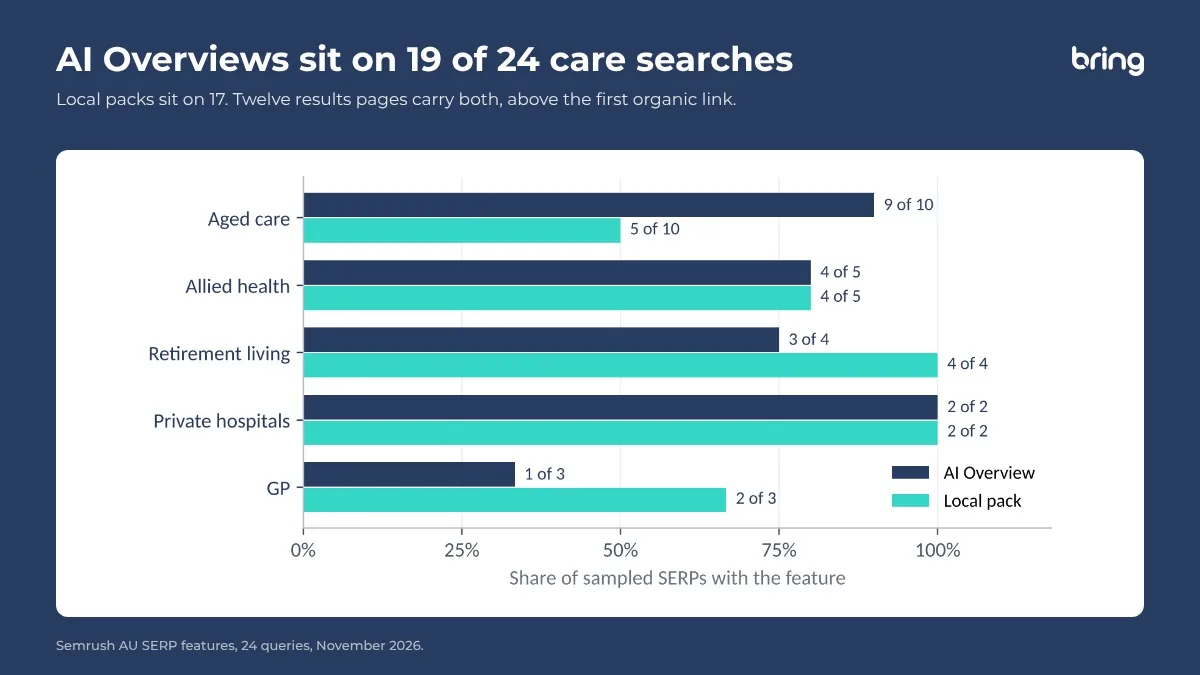
Nine of ten aged care searches in our sample triggered an AI Overview. So did four of five allied health searches and both private hospital searches. GP was the exception: “gp near me” and “medical centre near me”, the two biggest queries in the whole set, showed a map pack and no AI Overview.
Weighted by volume, the AI Overview searches account for 52.9% of the 219,000 monthly searches in the sample. Local packs cover 79%. In plain terms: for aged care and allied health, the first thing a family reads is Google’s summary. For GPs and retirement villages, it’s the map.
Google’s own guidance is refreshingly simple. There are “no additional requirements to appear in AI Overviews or AI Mode, nor other special optimizations necessary”. A page needs to be indexed and eligible for a snippet, and structured data should match the visible text (Google Search Central). AI Mode has also rolled out in Australia, and early testers were asking queries nearly three times the length of traditional searches (Marketing Mag). Longer, situational questions reward pages that answer a specific situation, not generic service pages.
Who Google’s AI quotes: mostly the government
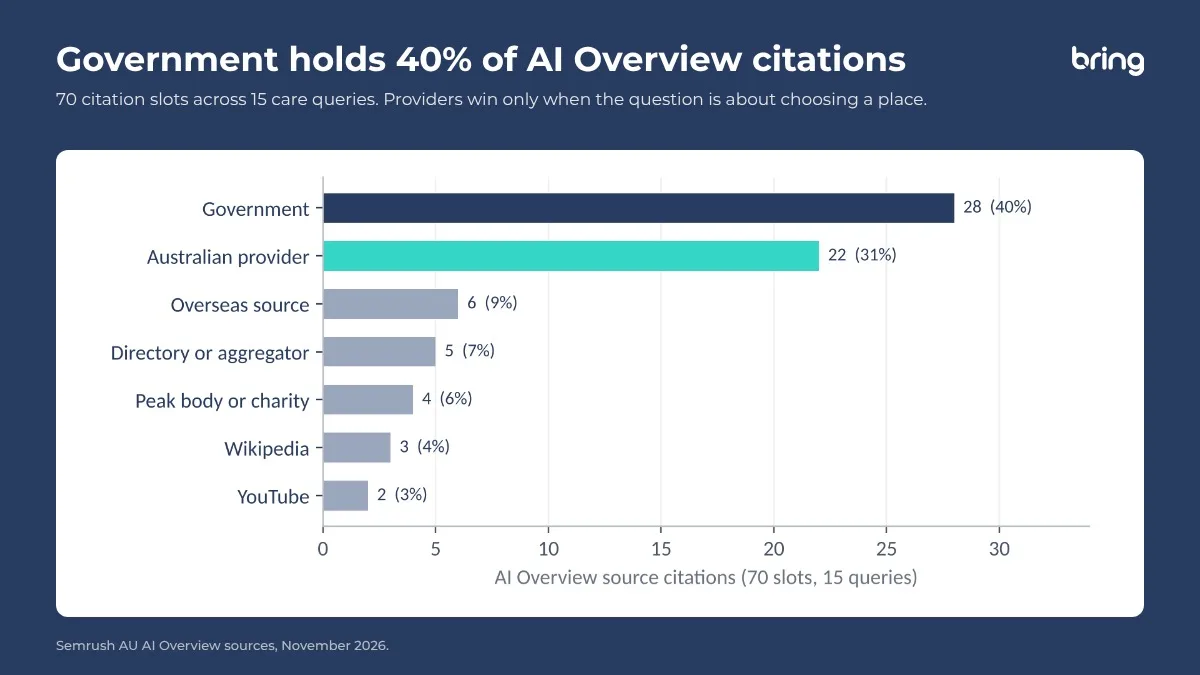
We captured the cited sources in 15 AI Overviews, 70 citation slots in all. Government sites took 28 (40%). The most cited single domain was myagedcare.gov.au with 12, followed by health.gov.au (5) and healthdirect.gov.au (4). Australian providers took 22 slots (31%).
The pattern is consistent. On process and definition questions, the government wins outright. Every source for “home care packages” was myagedcare.gov.au or health.gov.au. On “choose a place” questions, providers get in: Opal HealthCare, Bupa Aged Care, Regis and Estia Health filled four of five slots for “nursing homes near me”, and Amana Living, Bethanie, Brightwater and Juniper filled four of five for “residential aged care”.
Then there’s podiatry. “Podiatrist near me” gets 8,100 Australian searches a month. Every one of the five sources in its AI Overview was British: the Royal College of Podiatry (twice), Guy’s and St Thomas’ NHS trust, and a UK clinic chain (twice). No Australian clinic, association or health site made the cut. That’s what an empty answer layer looks like, and it’s an opportunity for any allied health group willing to publish properly.
One caveat. The canonical way we audit AI visibility is to run a fixed prompt set across ChatGPT, Perplexity, Gemini and Claude. This report covers Google’s AI Overviews only. The four-engine audit is what we run for individual brands in a Category Intelligence Report.
Want the full 16-page report, with every AI Overview source we captured and eight ranked plays for 2027? Download it free.
Support at Home changed the words families type
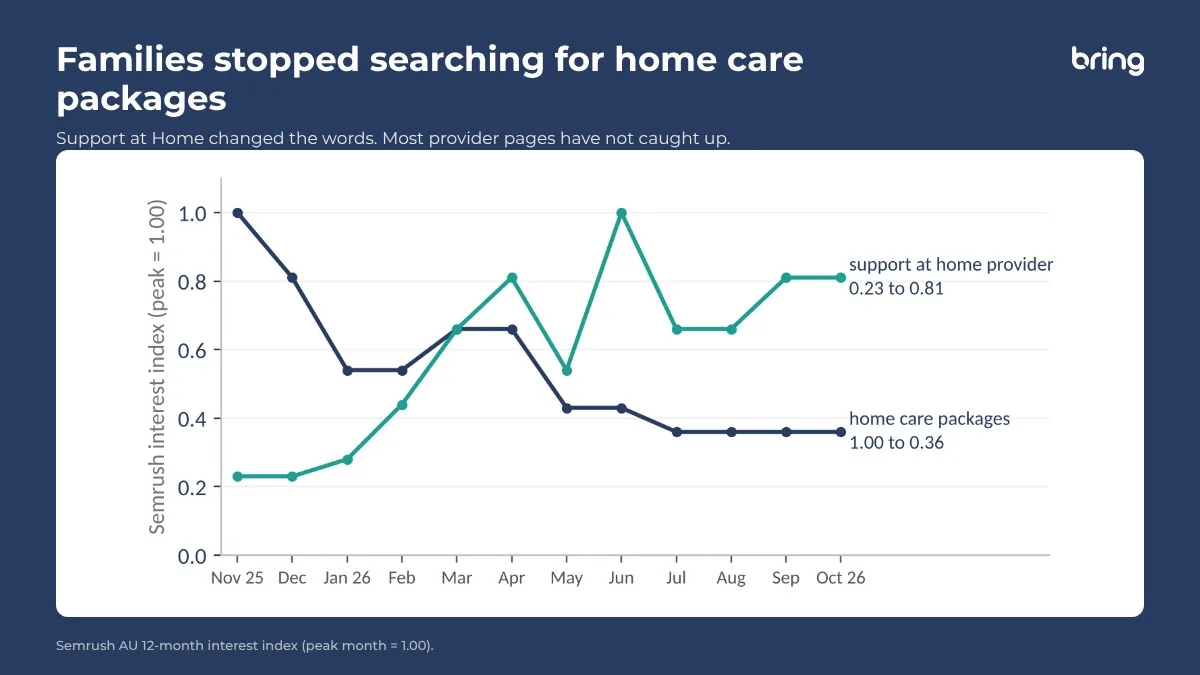
Support at Home replaced the Home Care Packages Program and Short-Term Restorative Care on 1 November 2025, alongside the new Aged Care Act 2024 (health.gov.au). A year on, search behaviour has moved, but not all the way.
- “Home care packages” fell from 1.00 to 0.36 on Semrush’s 12-month interest index.
- “Home care package providers” fell from 1.00 to 0.52.
- “Support at home provider” rose from 0.23 to 0.81.
The money follows the provider-selection searches. “Home care package providers” (1,300 a month) costs $8.23 a click and “support at home provider” $6.85, the two highest CPCs in aged care in our sample. “Support at home classifications” gets 390 searches a month with a keyword difficulty of 11 out of 100, which is about as easy as a commercially useful term gets.
Most provider pages haven’t caught up. When we reviewed the main conversion pages of five category leaders, one major home care page still led with “Transitioning from Home Care Packages” in its main heading a year after the change. Another had no Support at Home mention at all on its residential care page. Families still use the old words, so keep them in the copy, but the page title, heading and FAQs need to lead with the new program. The Commonwealth Home Support Program moves across no earlier than 1 July 2027, so expect a second wave of “what happens to my services” searches.
Who is winning organic search in aged care and healthcare
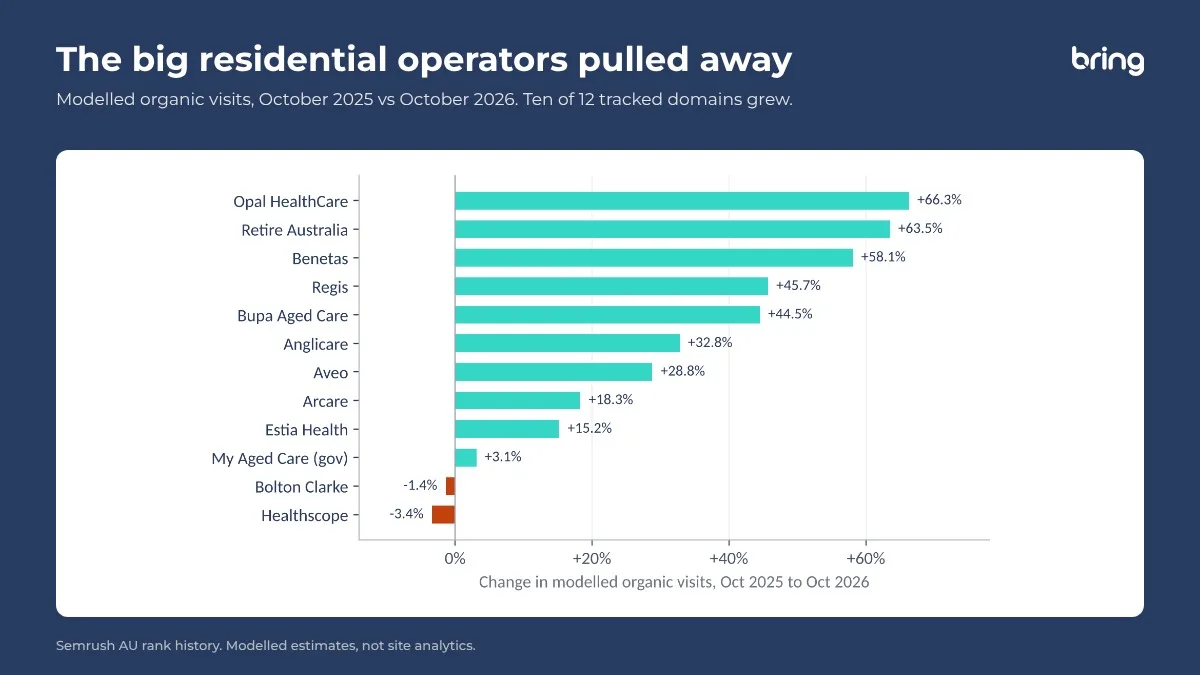
Ten of the 12 domains we tracked grew modelled organic visits between October 2025 and October 2026. The standouts:
- Opal HealthCare, 73,335 to 121,966 (+66.3%). It also ranks for more local pack keywords (5,332) than any other aged care provider we tracked.
- Retire Australia, 15,652 to 25,584 (+63.5%), with local pack results pointing at individual community pages.
- Benetas, 12,594 to 19,911 (+58.1%), one of the few providers publishing Support at Home funding levels in dollars.
- Regis (+45.7%) and Bupa Aged Care (+44.5%), with most of the gain landing in August and September 2026.
Two went backwards: Bolton Clarke (-1.4%) and Healthscope (-3.4%). Healthscope’s modelled visits peaked at 77,131 in June 2026 and were down to 52,405 by October. A Calvary-led consortium won control of the business in September, with Calvary to run 14 of the 25 remaining hospitals, Healthe Care 6, Acurio Health 3 and KnG Group 2 (The Real Estate Source). Every one of those changes is a website migration. Done badly, a migration can cost years of rankings. We’ve written about how Google has tightened its domain migration rules.
Two notes on reading this data. First, these are Semrush modelled organic visits, not total site traffic, so they won’t match your analytics. Our April 2026 aged care report used Similarweb total visits over a different window and showed some of the same providers declining. Different tools and windows, both directional. Second, ranking keyword counts dropped sharply across almost every provider during 2026 while traffic rose. That pattern points to measurement, not lost visibility, so judge 2026 on traffic, enquiries and AI Overview presence.
The bigger players in the category aren’t providers at all. myagedcare.gov.au pulls 297,391 modelled organic visits a month, about half the combined total of the 12 largest aged care provider sites we tracked. In GP and allied health, HotDoc (811,597) and HealthEngine (525,389) dominate.
Paid search: an almost empty auction
Across 20 provider domains, Semrush recorded 27 paid keywords in total, and 15 of the 20 showed none. It recorded no advertisers at all on six commercial searches, including “aged care near me” (9,900 a month), “support at home” (3,600) and “private hospital” ($6.02 a click). Meanwhile, Semrush values the organic traffic of those same 20 providers at $1.23 million a month at ad prices.
Treat that with some care. Semrush samples Australian paid results less thoroughly than organic, so “no advertisers recorded” means Semrush didn’t catch any, not that nobody bids. Check Google Ads Transparency Center for your own competitors. Even with that caveat, paid search is underused relative to the demand, and provider-selection terms at $6 to $8 a click are cheap against the lifetime value of a home care or residential client.
What leading care provider websites get wrong
We reviewed the main conversion pages of five category leaders on 6 November 2026. Three things stood out.
- Nobody publishes the price. One of five showed dollar figures, and those were government funding levels, not the provider’s own prices. Yet cost terms are among the easiest to rank for: “aged care fees” has a keyword difficulty of 26, “RAD aged care” 18, “retirement village fees” 10, “deferred management fee” 13.
- The phone number hides. Three of five either left it off the page or kept it in the footer. Aged care decision makers call.
- Social proof is almost absent. None showed reviews or ratings on the page. In allied health and general practice that’s partly regulation: AHPRA says advertising “must not use testimonials or purported testimonials” about clinical care (AHPRA). Aged care and retirement living don’t have that excuse.
Eight plays for 2027
- Own Support at Home provider selection. Build service pages with real prices, care management fees, classification explainers and a “how to switch provider” guide.
- Publish the price. RAD and DAP calculators, an aged care fees explainer, retirement village DMF and exit fee examples.
- Pair location pages with Google Business Profiles. One strong page per home, village or clinic, linked to a properly managed profile. Our post on Google Business Profile moves that earn AI citations covers the detail.
- Take the empty paid auction on provider-selection and near-me searches, after checking who else is bidding.
- Protect hospital migrations. Redirect maps, GBP updates and specialist directory continuity for every rebranded hospital.
- Be the Australian answer in allied health. AHPRA-compliant explainers by named practitioners, with schema that matches the page.
- GP clinics: win the map, keep the booking. Profile completeness, review velocity, bulk billing and new-patient status, and a booking path through your own site.
- Build the entity layer. Organisation and LocalBusiness schema, practitioner pages and citations from peak bodies and trade press. Start with our guide to entity SEO.
If you only do one thing this quarter, make it the price page. It answers the most-searched questions in the category, it gives Google’s AI something concrete to cite, and almost nobody has done it.
Questions about Google AI Overviews and search for aged care and healthcare providers
How common are Google AI Overviews on aged care and healthcare searches in Australia?
In our November 2026 sample of 24 high-volume Australian care searches, 19 results pages (79%) showed an AI Overview. Nine of ten aged care queries carried one, but only one of three GP queries.
Who gets cited in AI Overviews for aged care searches?
Government sites took 28 of 70 citation slots (40%) across 15 care queries, with myagedcare.gov.au alone taking 12. Australian providers took 22, mostly on “choose a place” searches like “nursing homes near me” and “residential aged care”.
Do I need special markup to appear in Google AI Overviews?
No. Google says there are no additional requirements or special optimisations. A page must be indexed and eligible for a snippet, and structured data should match the visible text.
Has Support at Home changed what families search for?
Yes. Over the 12 months to October 2026, interest in “home care packages” fell from 1.00 to 0.36 on Semrush’s index, while “support at home provider” rose from 0.23 to 0.81. Provider-selection searches now carry the highest aged care cost per click in our sample, up to $8.23.
Is paid search worth it for aged care providers?
The auction looks thin: 15 of 20 provider domains showed no paid keywords in Semrush AU. Semrush samples Australian paid results less thoroughly than organic, so check Google Ads Transparency Center for your competitors before setting a budget.
How we did this
All search figures come from the Semrush AU database, pulled on 6 November 2026: keyword volume, CPC and difficulty for 84 queries (73 in the core demand set), SERP features for 24 queries, AI Overview sources for the 15 where Semrush listed them, domain metrics for 26 websites and monthly organic history for 12 websites from October 2025 to October 2026. Organic visits are modelled estimates. AI Overviews vary by user, location and time, so treat the citation mix as a snapshot. For a broader view of how AI search is changing Australian behaviour, see AI search vs Google in Australia, and for how we approach the category, our aged care marketing services.
Download the full report
Every table and chart, plus eight ranked opportunities and a 90-day plan. Enter your details and the download link appears straight away.
See where your organisation sits
The report maps the category. A Category Intelligence Report maps you: your demand and your share of it, the three competitors taking the rest, your AI citations, your map pack position, and a ranked list of the pages and campaigns that would move the number. Free, and walked through with you in 45 minutes.
Ready to grow your search performance?
Talk to a senior strategist about what will move the needle for your business.
Get in touch