


Most accounting firms believe they have a reasonable digital presence.
The data tells a different story. In a recent audit of 2,344 Victorian accounting firms, we examined every measurable aspect of online visibility, from Google Business Profile activity and search rankings to AI discoverability and lead capture infrastructure.
The findings reveal a sector that is almost entirely invisible online, leaving significant revenue on the table at a time when clients are searching for financial expertise digitally. This article breaks down the key findings from our research report, The State of Digital for Victorian Accounting Firms 2026, and outlines what search marketing for accountants needs to look like in 2026 and beyond. If your firm is not actively investing in digital visibility, the numbers below should change that.
Want the full picture? Our complete report covers all 2,344 firms across metropolitan and regional Victoria with category-level SimilarWeb benchmarks, channel share analysis, and strategic recommendations. Request your free copy of the full report here.
The Category Is Growing, Not Shrinking
Before unpacking where Victorian firms are failing, it is worth establishing what they are failing against. There is a persistent belief inside the accounting profession that demand for professional advice is flat. The data says the opposite.
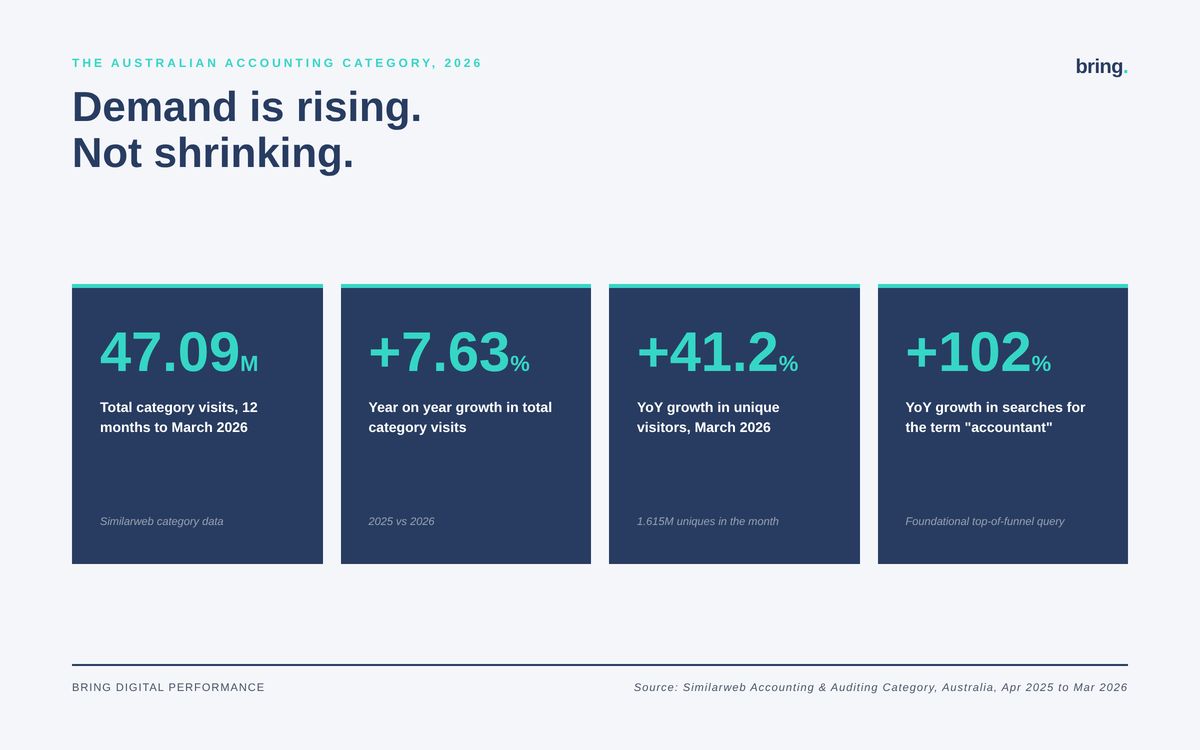
Total category visits in the Australian accounting and auditing vertical grew 7.63 per cent year on year to 47.09 million in the twelve months to March 2026. Unique visitors in March 2026 alone jumped 41.16 per cent year on year to 1.615 million. The audience is expanding and it is searching more, not less.
Foundational query growth is even more striking. Search volume for the term “accountant” is up 102 per cent year on year. This is a pure top-of-funnel term, capturing prospects at the earliest stage of considering whether they need a professional. A doubling in twelve months is a direct signal of rising underlying demand for the profession.
The audit that follows needs to be read against this context. Victorian accounting firms are not invisible in a quiet category. They are invisible in a category that is growing faster than most of them realise. END INSERT A
The Digital Visibility Crisis Facing Accounting Firms
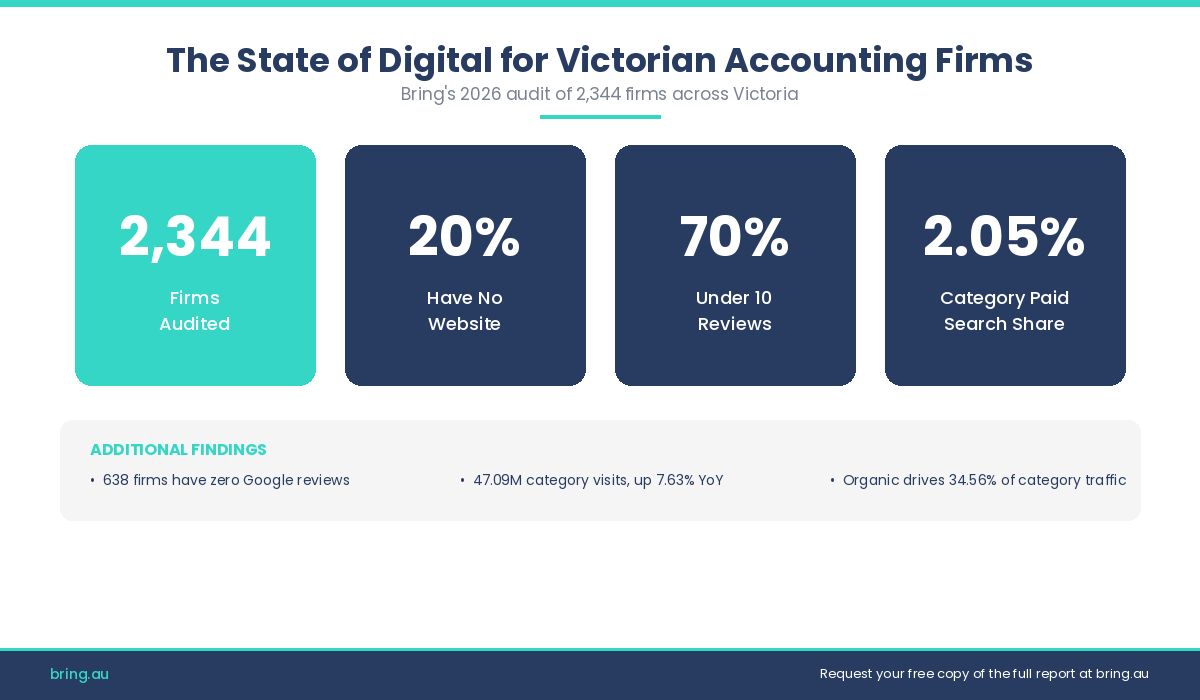
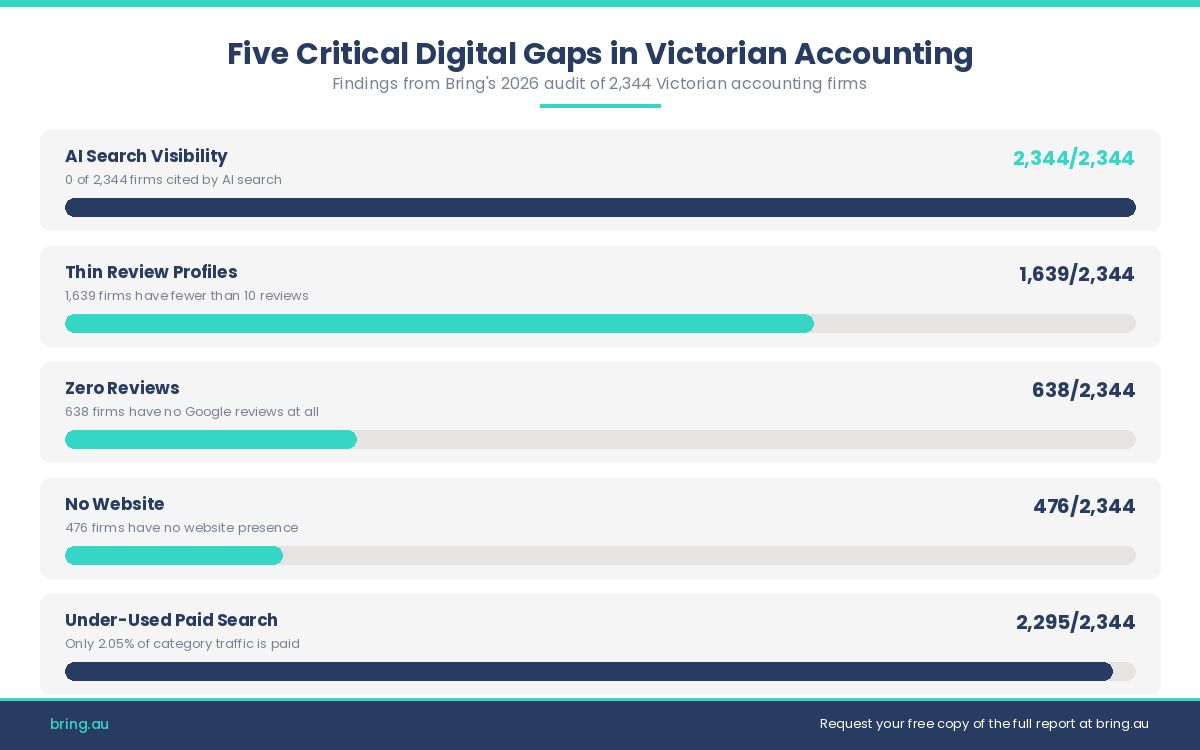
The headline numbers from our audit are difficult to ignore. Across 2,344 firms spanning Melbourne CBD, outer suburbs, and regional Victoria, the pattern is consistent. 476 firms (20 per cent) have no website at all. 1,639 firms (70 per cent) have fewer than 10 Google reviews. 638 firms (27 per cent) have zero reviews. Only 89 firms in the entire audit, under 4 per cent, have more than 100 reviews. That is a failing grade by any standard, and it reflects systemic underinvestment in the digital channels that prospective clients now use as their primary discovery method. In practical terms, the majority of accounting firms in Victoria have critical gaps in their digital presence that are actively costing them new clients.
For any practice leader reading this, the question is not whether search marketing for accountants matters. It is whether your firm can afford to remain invisible while competitors start closing these gaps. INSERT B
What the Market Is Actually Searching For
One of the most common objections we hear is that digital is fine for retail or consumer categories, but serious accounting clients come through referral. The search data undermines that view. Not only are buyers searching, practitioners inside the profession are searching, and the queries they are running are highly specific and highly commercial.
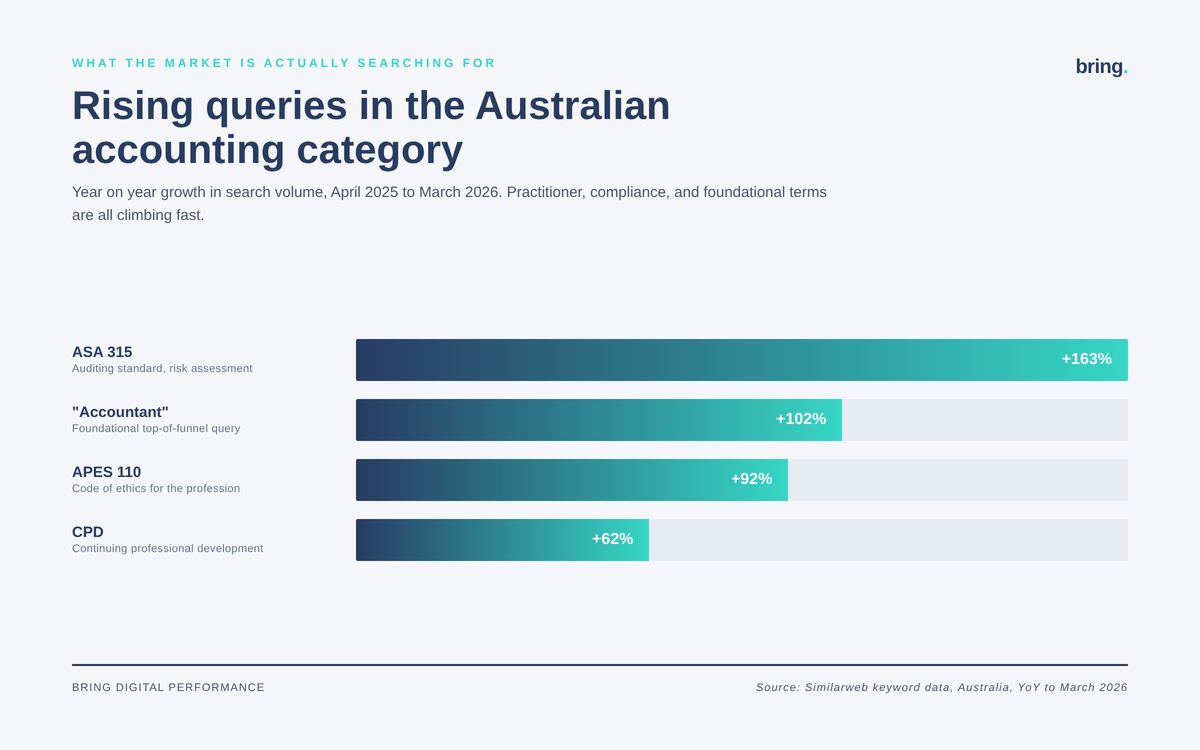
Compliance-driven queries are rising fastest. Searches for APES 110, the code of ethics that governs the Australian profession, are up 92 per cent year on year. Searches for ASA 315, the auditing standard on risk assessment, are up 163 per cent. Continuing professional development queries are up 62 per cent. These are practitioner queries, often run in the middle of a working day, and firms that rank for them sit inside the practitioner workflow every time a technical question arises. Calculator queries add another layer. Tax return calculator, tax withheld calculator, franking credit calculator, weekly tax calculator, and average super balance by age all sit inside the top twenty category terms by volume. These are not researchers killing time. They are people running numbers because they are about to make a decision. A firm that owns that moment, with a credible calculator experience and a clear pathway to a scoped conversation, converts search intent into enquiry at a rate no generic landing page can match.
The practical implication for the audit that follows is sharp. When we say the vast majority of Victorian firms are invisible in local search and zero are cited in AI answers, we are not describing abstract rankings. We are describing the absence of these firms from named, rising, commercial queries their prospects and referral network are running right now. END INSERT B
Google Business Profile: The Silent Revenue Leak
Google Business Profile (GBP) is the single most important local search asset for any professional services firm. When a prospective client searches for an accountant in their area, GBP listings dominate the results page. They appear above organic results, display reviews, show contact details, and provide a direct path to inquiry.
Our audit found that across the 2,344 firms examined, Google Business Profile coverage is broad but shallow. The overwhelming majority of listings are thin, incomplete or inactive. Combined with the 20 per cent of firms that have no website at all, the practical result is that a huge share of Victorian accounting firms are effectively invisible in local search results, the exact place where high-intent clients are looking for help. The common issues we identified include incomplete business descriptions, missing service categories, no regular posting activity, and outdated contact information. These are not complex technical problems. They are straightforward optimisation tasks that, when addressed, can dramatically improve local search visibility within weeks.
For firms serious about fixing this, local SEO services that focus on GBP optimisation, citation consistency, and local content development represent the fastest path to improved visibility. Our own case study with an accounting firm demonstrates what happens when these fundamentals are addressed properly: a predictable lead engine built on local search dominance.
The full report includes a detailed GBP scoring methodology across all 2,344 firms, including regional breakdowns and specific gaps by firm size. Request your copy here.
AI Search Invisibility: The Emerging Blind Spot
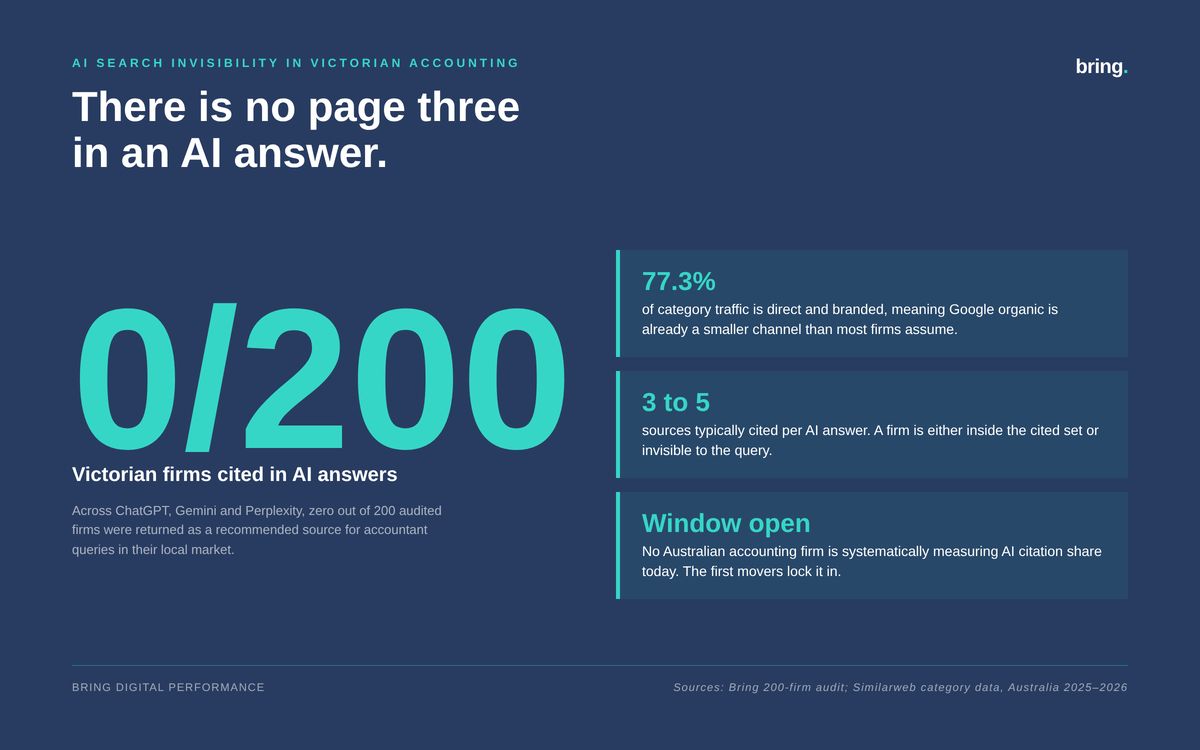
This was the most striking finding of the entire audit. Of the 2,344 accounting firms we examined, not a single one was discoverable through AI search platforms like ChatGPT, Gemini, or Perplexity. Zero out of 2,344. AI-powered search is no longer a future consideration. It is happening now. Millions of Australians are using conversational AI tools to find service providers, ask for recommendations, and research professional services. When someone asks ChatGPT to recommend a good accountant in Melbourne, your firm either appears in that response or it does not. Right now, the entire Victorian accounting sector is absent from these conversations.
The discipline of AI search optimisation is still new, but the fundamentals are clear. Firms need structured data, strong entity recognition across the web, authoritative content that AI systems can cite, and consistent brand signals across multiple platforms. This goes well beyond traditional SEO. It requires a deliberate strategy to make your firm recognisable to AI systems as a credible, authoritative source of financial expertise. Our article on SEO vs GEO explores the differences between traditional search engine optimisation and generative engine optimisation in more detail. For accounting firms, the opportunity is significant because the competitive landscape is currently empty. The first firms to invest in AI search visibility will dominate a channel that is growing rapidly. AUGMENT C There is a structural reason this matters more in accounting than in most categories. The Australian accounting and auditing vertical runs on 52.73 per cent direct traffic and only 34.56 per cent organic search, with paid search a mere 2.05 per cent. On the surface the direct number reads like brand strength. Underneath, it means Google organic is already a smaller channel than most firms realise, and the migration of practitioner and buyer queries to ChatGPT, Gemini, Perplexity, and Google AI Overviews will compress it further. AI answer engines do not return ten blue links. They synthesise an answer and cite a small number of sources per query. There is no page three in an AI answer. A firm is either inside the cited set or invisible.
The commercial implication is significant. A single citation inside an AI answer places a firm inside a workflow that is otherwise closed to outsiders. For a trust-led, referral-driven category like accounting, that is one of the highest leverage positions available in digital marketing today. It is also the position zero Victorian firms currently hold. END AUGMENT C
Lead Capture: The Missing Conversion Layer
Driving traffic to a website is only half the equation. Once a prospective client arrives on your site, there must be a clear, compelling mechanism to convert that visit into an inquiry. Our audit found that the majority of firms in Victoria have no meaningful lead capture infrastructure on their website.
Most accounting firm websites in Victoria function as digital brochures rather than lead generation tools. Visitors land on the site, browse briefly, and leave without any mechanism to capture their details, nurture their interest, or prompt them to make contact.
Effective lead capture for accounting practices does not require complex technology. It requires strategic thinking about what a prospective client needs at the moment they are considering their options. Useful approaches include downloadable tax planning guides, free initial consultation offers, compliance checklists, and calculator tools that demonstrate expertise while capturing contact information. This is where content planning intersects directly with conversion strategy. Content that answers the questions prospects are asking, supported by clear calls to action and simple inquiry forms, transforms a passive website into an active client acquisition channel. Combine this with proper analytics and tracking setup, and you have full visibility into which content drives inquiries and which channels deliver the best return.
Online Reviews: The Trust Gap
Professional services are inherently trust-based. Clients are handing over sensitive financial information and relying on their accountant’s expertise to make sound decisions. Online reviews have become the primary trust signal for prospective clients evaluating accounting firms, and the data here is concerning.
Our audit found that 1,639 out of 2,344 firms have fewer than 10 Google reviews, and 638 have zero. Only 89 firms in the whole audit have more than 100 reviews. In a market where consumers routinely check reviews before engaging any service provider, this represents a significant barrier to conversion. Even firms that rank well in search results may lose the click to a competitor with a stronger review profile. Building a review strategy is not complicated, but it does require consistency. The most effective approach is to systematically request reviews from satisfied clients at the conclusion of successful engagements, particularly after tax lodgements, advisory outcomes, or successful compliance work. Responding to every review, positive or negative, demonstrates professionalism and engagement that prospective clients notice. The relationship between reviews and local SEO performance is well documented. Google’s local algorithm weighs review quantity, quality, and recency heavily when determining local pack rankings. Firms with strong review profiles gain a compounding advantage: better rankings lead to more visibility, which leads to more clients, which leads to more reviews.
Regional Disparities Across Victoria
One of the more interesting dimensions of our audit was the regional breakdown. We examined firms across metropolitan and regional Victoria, from Melbourne CBD and inner suburbs through to Geelong, Ballarat, Bendigo, Mildura, Traralgon, Warrnambool, and Bairnsdale.
The digital maturity gap between metropolitan and regional firms was noticeable but perhaps not as large as expected. Melbourne CBD firms scored marginally higher on average, primarily due to better website infrastructure and slightly more active GBP listings. However, even in Melbourne, the vast majority of firms showed the same fundamental gaps: inactive profiles, no AI presence, weak lead capture, and minimal review strategies.
For regional firms, the opportunity is arguably greater. In less competitive local markets, even modest improvements in digital visibility can deliver disproportionate results. A Ballarat accounting firm that optimises its Google Business Profile and builds a basic review strategy could realistically dominate its local search results within a matter of months.
The full report includes a complete regional breakdown with firm counts and visibility benchmarks for every region audited. Request your free copy here.
The Incumbents Are Losing Ground
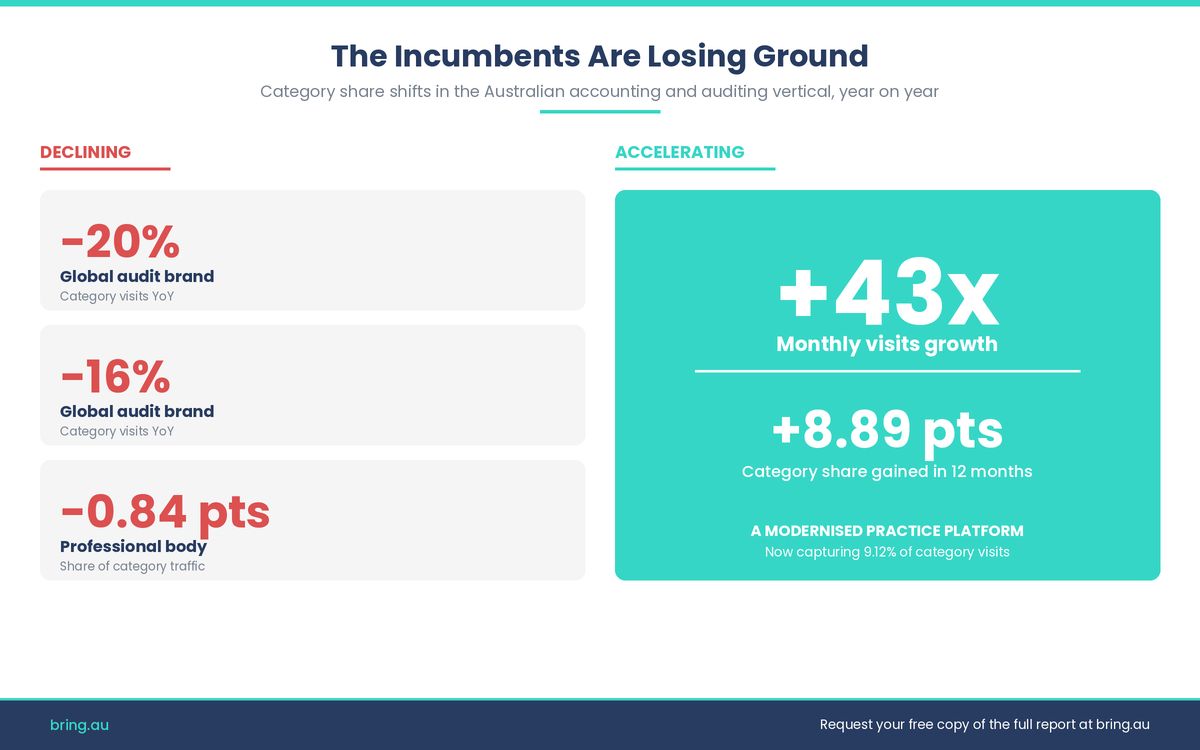
If the category is growing and the vast majority of Victorian firms are asleep, the obvious question is who is capturing the share. The answer surprises most practice leaders we speak with. The firms that built the institutional authority of the Australian profession, the global audit networks and large professional bodies, are losing visibility at an alarming rate. Two of the largest global audit brands have lost between 16 and 20 per cent of category visits year on year. Established professional membership bodies have lost share as well. Only a small number of modernised institutional properties are expanding. The rest are bleeding search traffic at a rate that would trigger an internal crisis in any business that depended on digital lead generation. The share they are leaving behind is not vanishing into thin air. It is being captured by a specific kind of challenger. The single biggest winner in the category is a modernised practice platform that has grown monthly visits by a factor of 43 in twelve months and captured nearly nine full points of category share from almost nothing. To put that in context, one software platform has captured more new category share in twelve months than the global audit networks have built in a decade of content marketing. It has done this by showing up on exactly the queries where practitioners are looking for a practical answer to a daily problem.
For a mid-tier or boutique Victorian firm, this is the opening. The global networks own the corporate brand gravity. Software platforms own the daily workflow. Professional bodies own membership and CPD. A mid-tier firm does not have a default position in any of those lanes, which means it does not have to defend anything. It has to build. The share leaving the incumbents is available to any firm willing to claim it with the right content and the right digital infrastructure. That is the opportunity our audit data quantifies at the local level. END INSERT D
What Effective Search Marketing for Accountants Looks Like in 2026
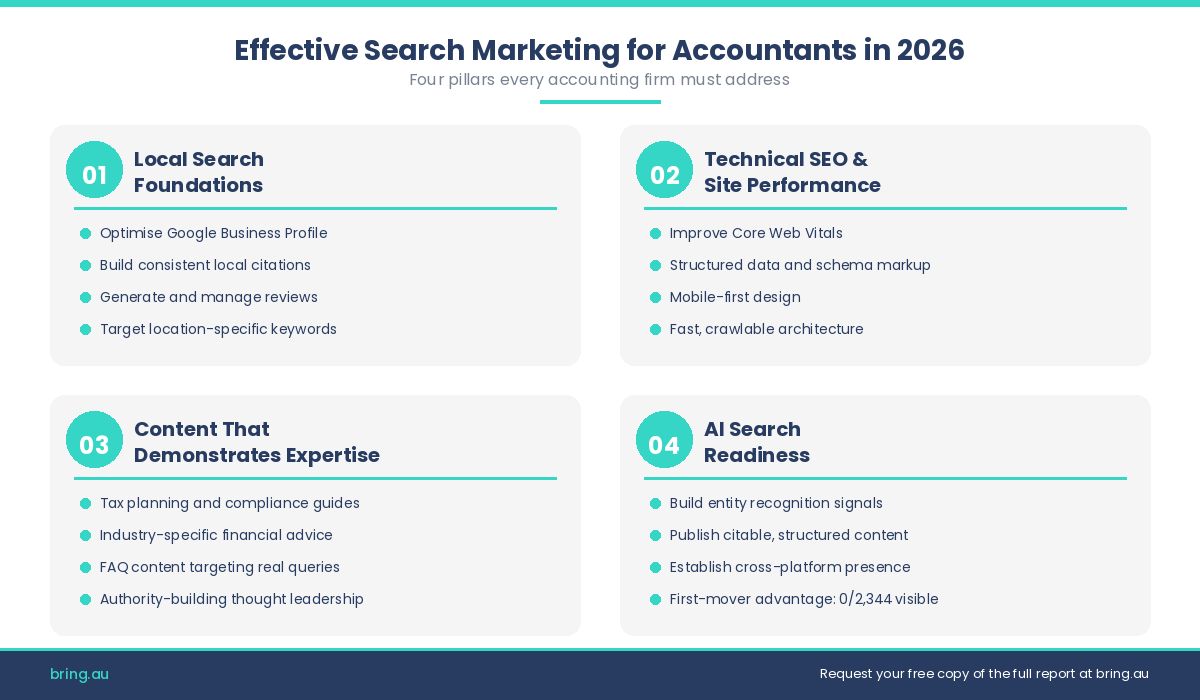
The audit paints a clear picture of where the sector stands. The question is what to do about it. Effective search marketing for accountants in 2026 requires an integrated approach that covers four key areas.
1. Local Search Foundations
Start with your Google Business Profile. Ensure it is fully completed with accurate business information, comprehensive service descriptions, professional imagery, and a regular posting schedule. Build consistent citations across relevant directories including CPA Australia, IPA, and local business associations. Invest in local SEO to ensure your firm appears in the local pack for every relevant service query in your area.
2. Website Performance and Technical SEO
Your website needs to load fast, work flawlessly on mobile, and be structured in a way that search engines can easily understand. Technical SEO covers the fundamentals: site speed, crawlability, schema markup, and Core Web Vitals optimisation. Beyond the technical layer, on-page SEO ensures your service pages are properly optimised for the terms prospective clients are actually searching for.
3. Content That Demonstrates Expertise
Generic website copy does not win in search. Accounting firms need strategic content that addresses specific client questions, demonstrates deep expertise, and covers the topics that matter to your target market. Tax planning guides, regulatory change summaries, industry-specific financial advice, and practical compliance checklists all serve dual purposes: they build search authority and they convert visitors into inquiries.
4. AI Search Readiness
This is the frontier. As our audit demonstrates, no accounting firm in Victoria has addressed this yet. The firms that move first on AI search optimisation and entity SEO will have a significant first-mover advantage in a channel that is growing exponentially. The principles are straightforward: build your firm’s entity presence across authoritative platforms, publish citable content, and ensure your structured data is comprehensive.
Paid Search: Accelerating Results
While organic search marketing builds long-term value, Google Ads provides immediate visibility for accounting practices that need leads now. The seasonal nature of accounting services creates specific windows where paid search delivers exceptional returns, particularly during tax season and EOFY periods.
The key to effective paid search for accountants is precision. Target high-intent keywords with clear service and location modifiers. Build dedicated landing pages for each service category. Track conversions rigorously so you know exactly what each lead costs and which campaigns generate the most valuable client relationships.
The category-level data reinforces why paid search can be particularly effective in this sector. Paid search accounts for just 2.05 per cent of all traffic into the Australian accounting and auditing vertical. That is less than one in forty-five visits, in a category generating 47 million visits a year. With so few competitors investing properly in paid search, the firms that enter this space now benefit from relatively low acquisition costs compared to more digitally mature industries.
Building Authority Through Digital PR
Search marketing for accountants is not limited to on site optimisation and paid advertising. Digital PR plays a critical role in building the authority signals that both traditional search engines and AI systems use to evaluate credibility. Media coverage, industry publications, expert commentary, and data-driven thought leadership all contribute to a firm’s perceived authority.
For accounting firms, there is no shortage of newsworthy topics. Tax law changes, budget impacts, regulatory updates, and economic commentary are all areas where accountants can position themselves as expert sources. This kind of authority building has a direct impact on search rankings and, increasingly, on whether AI systems reference your firm when answering relevant queries.
The Bottom Line
The data from our 2,344-firm audit makes one thing abundantly clear: the Victorian accounting sector has a massive digital visibility gap. With 20 per cent of firms having no website, zero firms discoverable through AI search, the majority lacking basic lead capture, and 70 per cent with fewer than 10 reviews, the opportunity for proactive firms is significant. AUGMENT E Read alongside the national category data, the implication sharpens further. Demand is rising, with the term “accountant” up 102 per cent and technical standards queries up between 92 and 163 per cent year on year. The incumbents are losing ground, with two of the largest global audit brands shedding 16 to 20 per cent of category visits and a single challenger platform taking nearly nine points of category share in twelve months. Paid search accounts for just 2.05 per cent of category traffic. And at the local level, the vast majority of Victorian firms are invisible on the exact queries where this demand is being expressed. The category is moving, the competition is distracted, and the local field is open. That combination does not appear often. END AUGMENT E Search marketing for accountants is not optional in 2026. It is the primary mechanism through which new clients discover, evaluate, and engage professional services. The firms that invest now, while competitors remain dormant, will build market positions that become increasingly difficult to challenge.
Download the Full Report Our complete research report, The State of Digital for Victorian Accounting Firms 2026, covers all 2,344 firms across metropolitan and regional Victoria. It includes category-level SimilarWeb benchmarks, channel share analysis, regional comparisons, and strategic recommendations. Whether you are an accounting practice looking to benchmark your own digital presence or a marketing professional advising firms in this sector, the report provides the data you need.
Request your free copy of the full report →
Frequently Asked Questions
How were the 2,344 accounting firms selected for the audit?
We identified 2,344 accounting firms operating across Victoria, covering Melbourne CBD, inner and outer suburbs, and regional centres including Geelong, Ballarat, Bendigo, Mildura, Traralgon, Warrnambool, and Bairnsdale. Firms were selected to represent a comprehensive view of the market by size, location, and service offering. Each firm was scored against a consistent set of digital visibility criteria.
What does “AI invisible” mean for an accounting firm?
AI invisible means the firm does not appear in responses generated by AI search tools such as ChatGPT, Google Gemini, or Perplexity when users ask for accountant recommendations in relevant locations. Our audit found that zero out of 2,344 firms were referenced by these platforms, indicating the entire sector has not yet addressed this emerging discovery channel. Learn more about the difference between traditional and AI search in our SEO vs GEO comparison.
How long does it take to improve a firm’s digital visibility score?
Quick wins like Google Business Profile optimisation and review generation can show results within weeks. More substantive improvements from technical SEO, content development, and authority building typically take three to six months to gain traction, with compounding returns over 12 months and beyond. The key is starting with the fundamentals and building systematically.
Is search marketing only relevant for large accounting firms?
The opposite is often true. Smaller and regional firms frequently benefit more from search marketing because they operate in less competitive local markets. A well-optimised small firm can realistically outrank larger competitors in local search results by focusing on local SEO fundamentals, active review management, and targeted content.
Can I see how my firm compares to the 2,344 firms audited?
Yes. Get in touch with our team and we can provide a complimentary assessment of your firm’s digital visibility benchmarked against the findings from the full audit. We will show you where you stand and what the highest-impact opportunities are for your practice.
Matt Hodgson is the founder of Bring and an SEO and AEO specialist with three decades in digital performance. He’s helped brands from enterprise to SMB grow their visibility across search and AI-driven discovery, building data-led strategies that connect organic performance directly to business outcomes.