

AI · SEO · Services
Why Your AI-Generated Content Isn’t Ranking: 7 Reasons (Backed by Data)
Your AI content is published but not ranking? You're not alone. The largest study on AI content found rankings collapse within three months. The 7 reasons it happens and the fixes.
 Matt Hodgson
13 min read
Matt Hodgson
13 min read
Why Your AI-Generated Content Isn’t Ranking: 7 Reasons (Backed by Data)
A diagnostic for businesses that adopted Claude or ChatGPT for content and watched the traffic flatline. The seven specific reasons it’s happening, the data behind each, and the fixes that actually work.
TL;DR
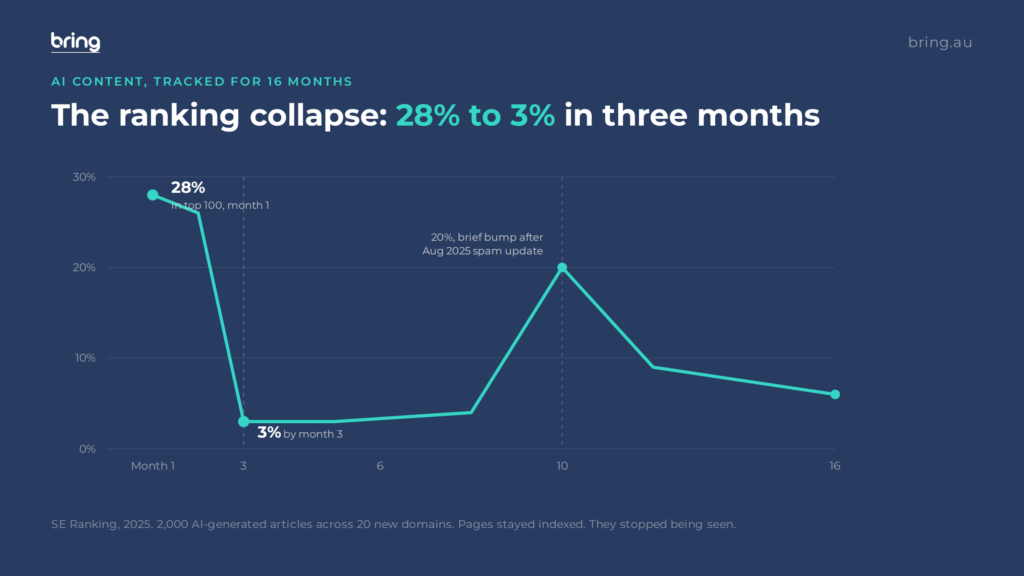
If your AI-generated content is published but not ranking, you’re in good company. The largest public study on the question (SE Ranking, 2,000 articles across 20 new domains) found rankings collapsed from 28% in the top 100 to 3% within three months. The Ahrefs study of 600,000 pages found the deciding factor isn’t whether content is AI-generated. It’s whether the content adds anything a thousand other pages don’t already say. Seven specific issues account for almost every case of AI content failing to rank. Each has a diagnostic test and a fix.
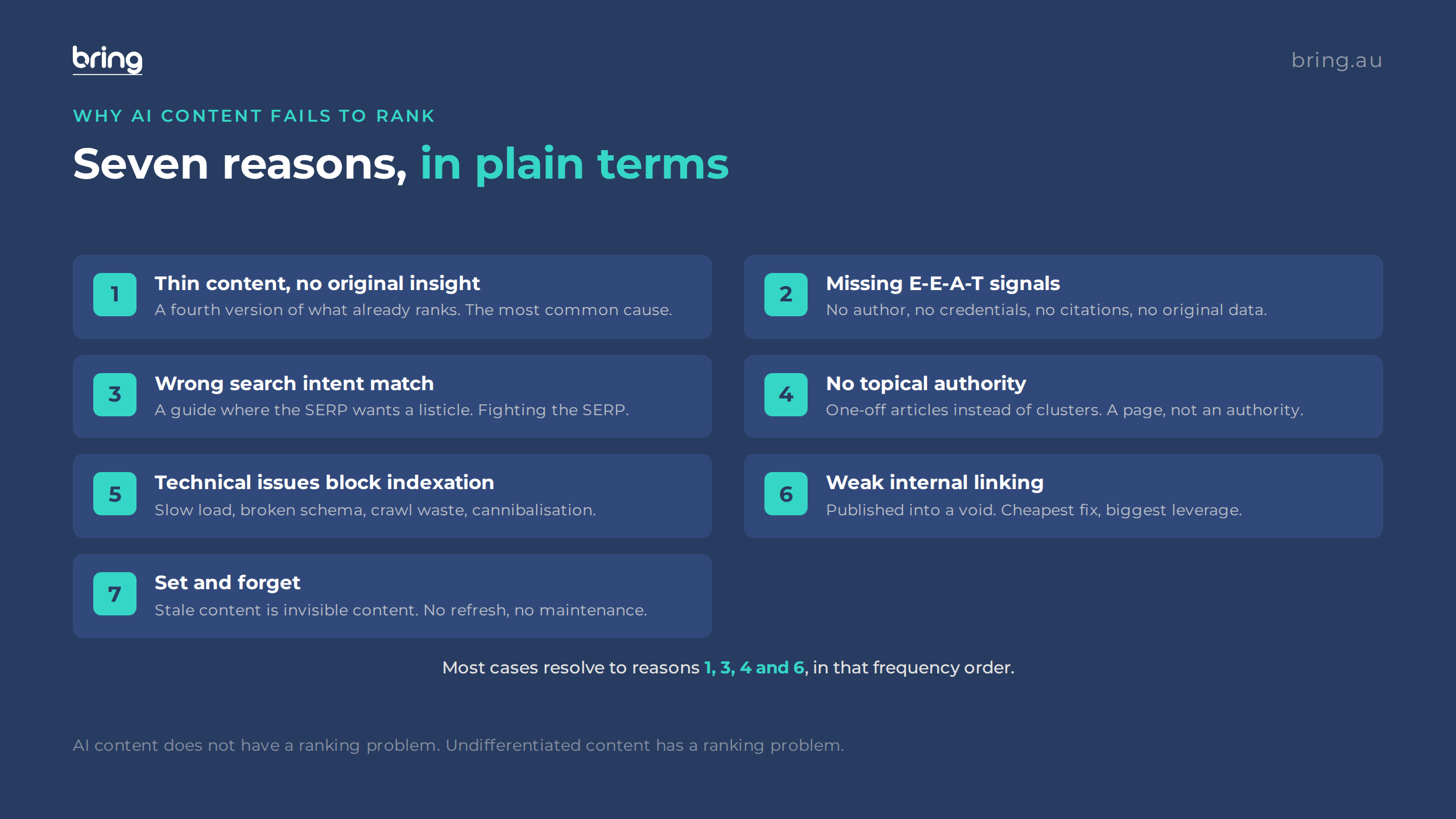
The seven reasons:
- Thin content with no original insight. Most common. Easy to diagnose. Hard to fix without effort.
- Missing E-E-A-T signals. Authorship, credentials, original data, citations.
- Wrong search intent match. The content answers a question nobody is searching.
- No topical authority. One-off articles instead of clusters.
- Technical issues blocking indexation or visibility. Slow load, broken schema, crawl waste.
- Weak internal linking. Articles published in isolation never accumulate authority.
- Set and forget. No refresh, no update, no maintenance. Stale content is invisible content.
The data context
Before we get into the seven reasons, three findings are worth sitting with.
SE Ranking’s 2,000-article experiment. They published 2,000 fully AI-generated articles across 20 brand-new domains in November 2024 and tracked them for over a year. By month one, 28% of pages were ranking in the top 100. By February 2025, three months in, 3%. Sixteen months later, recovery was minimal. The pages stayed indexed. They just stopped getting seen. The pattern was almost identical across all 20 domains.
Ahrefs’ 600,000-page study. Across more than 600,000 pages, the correlation between the proportion of AI content and ranking position was 0.011, effectively nil. Content with high AI assistance didn’t rank worse on average. But almost none of it ranked exceptionally well either. The deciding factor was differentiation, not authorship.
Originality.ai’s tracking study. AI saturation in Google’s top 20 results peaked at 19.56% in July 2025, then dropped to 17.31% by September following Google’s August 2025 spam update. Google’s 2025 Search Quality Rater Guidelines now explicitly tell raters to apply the lowest rating when content is “all or almost all” AI-generated with no original contribution.
The conclusion across all three studies is the same. AI content does not have a ranking problem. Undifferentiated content has a ranking problem. AI-only workflows produce undifferentiated content most of the time.
Now the seven specific reasons your content isn’t ranking.
1. Thin content with no original insight
This is the single most common reason and the hardest to fix without changing the workflow.
What it looks like. A 1,200-word article that covers the topic at a level any reader could get from the top three results in 30 seconds. No original data. No specific examples. No counterintuitive take. No first-hand experience. Just well-organised summary.
The diagnostic test. Read your article. Then read the three top-ranking pages for your target keyword. Could a reader get the same value from any of them? If yes, your article is undifferentiated. Google does not index the internet to give users a fourth version of the same thing.
Why AI workflows produce this. AI defaults to consensus. Trained on the web, it returns the median view. Without specific instructions to add original data, take a position, or include first-hand experience, it produces content that sits in the middle of every existing article on the topic. Smooth, well-organised, factually fine, ranking-incapable.
The fix. Before any AI drafting, decide what this article is going to say that no other article says. One specific finding from your own data. One opinion the obvious sources don’t hold. One worked example from a real client. One counterintuitive insight from your team’s experience. If you can’t fill that brief, do not publish the article.
2. Missing E-E-A-T signals
Google’s quality rater guidelines have hammered Experience, Expertise, Authoritativeness, and Trustworthiness for years. In 2026 the same guidelines explicitly instruct raters to flag AI content with no original contribution as lowest quality. The signals matter more than ever, not less.
What it looks like. No author byline. No author bio. No credentials. No citations to credible sources. No customer outcomes. No original research. No first-hand observations. The article reads like it could have been written by anyone, anywhere.
The diagnostic test. Open your article in an incognito window. Can a reader tell who wrote it? Can they tell what makes that author qualified to write about this? Are there citations to credible sources? Are there specific examples you couldn’t get from a Wikipedia summary? If the answers are no, no, no, and no, your E-E-A-T is broken.
The fix. Every article gets a real author byline with a real bio. Authors get a properly built-out author page on the site with credentials, qualifications, and a real LinkedIn profile linked. Citations go to primary sources, not to other content farms. Original data, even small, beats no data. First-hand examples beat generic ones. If you don’t have a person who can credibly own the topic, you don’t have content authority on the topic. That’s a strategic problem, not a content problem.
3. Wrong search intent match
Search intent is the most common cause of “I ranked, but the traffic doesn’t convert” and “I’m not ranking at all” in roughly equal measure.
What it looks like. You wrote a 2,000-word how-to guide. The keyword is dominated by listicles. Or you wrote a comparison post. The keyword is dominated by product pages. Or you wrote a definition piece. The keyword is dominated by tools and calculators.
The diagnostic test. Search your target keyword in incognito. Look at the top ten results. What format dominates? What angle dominates? What word count dominates? If your article doesn’t match the dominant pattern, Google has already decided what users want for that query, and it isn’t your article.
Why AI workflows produce this. Most AI content briefs start with “write a 2,000-word article on [topic].” The format is decided before intent is checked. The article gets written. The intent mismatch surfaces three months later when nothing ranks.
The fix. Before any drafting, run the SERP. Identify the dominant format (listicle, deep guide, product page, calculator, comparison). Identify the dominant angle (commercial, informational, transactional). Match it. If the dominant format is a listicle and you can’t make a credible listicle, change the keyword target. Don’t fight the SERP.
4. No topical authority
Single articles published in isolation do not rank for competitive terms. They never have. AI just makes the problem worse by lowering the cost of producing isolated articles.
What it looks like. You publish one article on a topic. Maybe a few. Each one stands alone. There’s no pillar piece, no cluster, no internal linking architecture, no breadth of coverage. Google has no signal that you’re an authority on this topic.
The diagnostic test. Pick a competitive keyword you want to rank for. List every page on your site that’s relevant to the broader topic. If the count is under 8 or 10, you don’t have topical authority on that topic. You have a page on it.
The fix. Build clusters. Pillar piece on the head term, supporting articles on the related sub-topics, internal links connecting them, schema marking up the relationships. The Sydney SEO 2026 research found comparative listicles dominate AI citations at 32.5% share, not because Google loves listicles, but because they sit inside cluster architectures that signal authority. Random one-off blog posts don’t.
A cluster of 6 to 10 well-built pages will outrank a single article of any quality, every time.
5. Technical issues blocking indexation or visibility
This is the silent killer. Content gets written, published, and never seen, not because it’s bad, but because the site won’t let Google find it or rank it.
What it looks like. Articles indexed but not ranking. Articles not indexed at all. Schema not validating. Page speed in the red. Internal links broken. Cannibalisation across multiple pages targeting the same query. Faceted navigation creating thousands of low-value URLs that eat crawl budget.
The diagnostic test. Run the article through Google Search Console URL Inspection. Is it indexed? When was it last crawled? Are there mobile usability issues? Are there schema errors? Run the page through PageSpeed Insights. Are Core Web Vitals in the green? Run a site:domain.com "exact phrase from your article" search. Are multiple URLs returning? That’s cannibalisation.
The fix. Most technical SEO is unsexy. Schema needs to validate. Page speed needs to be fast. Internal links need to work. Indexation needs to be deliberate, not accidental. Cannibalisation needs to be resolved, usually by canonicalising or merging duplicate intent pages. None of this is content work. None of it is something Claude can fix without judgement. It’s specialist work that an SEO does or doesn’t do correctly. If the technical layer is broken, no amount of content will rank.
6. Weak internal linking
Related to topical authority but worth its own treatment because it’s the cheapest fix on this list and almost nobody does it well.
What it looks like. Articles published with no internal links pointing to them from existing relevant pages. Or articles that link out to lots of external sources but not to other relevant pages on the same site. The new article exists. Google has no signal of where it sits in your site’s topic graph.
The diagnostic test. Pull a list of your last 10 published articles. For each one, count the number of internal links pointing to it from older relevant pages. If the average is under 3, your internal linking is broken. If the average is 0 or 1, you’re publishing into a void.
The fix. Every new article gets at least 3 to 5 internal links from existing relevant pages, using descriptive anchor text. Every article links out to 3 to 5 other relevant pages on your own site. This is a 30-minute job per article. It is also the single biggest difference between sites with strong topical authority and sites without.
7. Set and forget
Stale content stops ranking. AI assistants prefer fresh content even more aggressively than Google does. AirOps’ research found that content under three months old performs significantly better in AI visibility than older content.
What it looks like. You published a piece in 2024. It ranked for a while. It dropped. You haven’t touched it since. The information is now out of date. The data points are stale. The structure doesn’t match the current SERP. The article is invisible.
The diagnostic test. Sort your published content by last-updated date. How many of your top 50 pages have been updated in the last 12 months? If the answer is under 20, your refresh discipline is broken.
The fix. Quarterly content review. Every important page gets read, fact-checked, updated, and republished with a new date stamp. Add a “What changed in 2026” section to cornerstone pages so AI systems and Google both register the freshness. Update statistics, swap stale examples for current ones, refresh internal linking. Treat your top pages as living assets, not archived posts.
Putting it together: the diagnostic flow
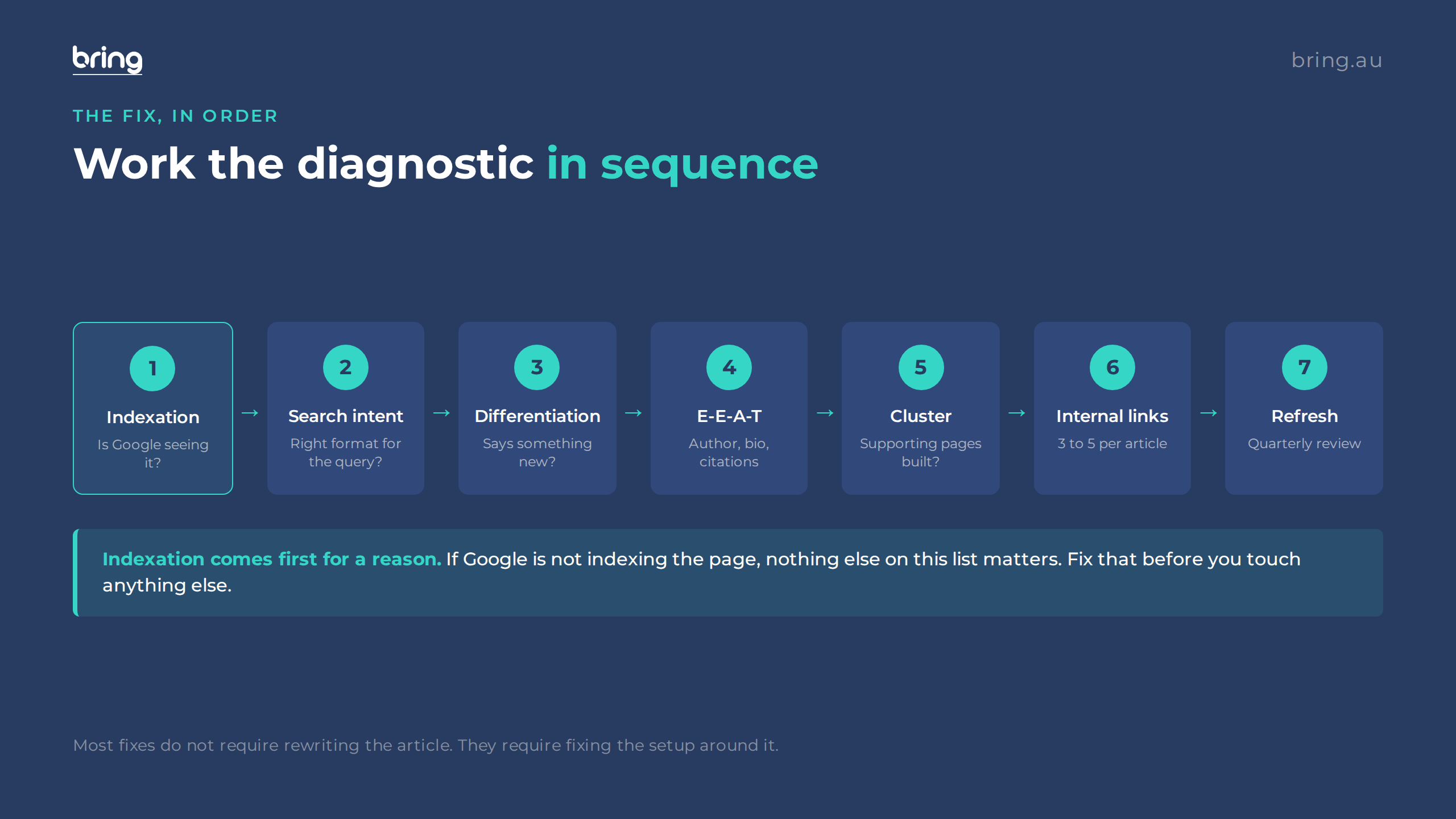
If your AI content isn’t ranking, work through the seven reasons in this order:
- Indexation check first. If Google isn’t indexing it, nothing else matters. Run the URL Inspection tool. Fix indexation before anything else.
- Search intent next. If the format is wrong for the query, fix that. Sometimes that means rewriting. Sometimes it means abandoning the keyword.
- Differentiation third. If the article is undifferentiated, no amount of optimisation will save it. Add original insight or rewrite from scratch.
- E-E-A-T fourth. Author bylines, bios, citations, original data. These are quick wins on existing articles.
- Cluster fifth. If the article is alone, plan and ship at least 5 to 7 supporting pieces.
- Internal linking sixth. Quick win, biggest leverage. Do it on every new and existing article.
- Refresh discipline last. Build the quarterly review into the calendar.
In our experience working through this diagnostic on client sites, most “AI content not ranking” issues resolve to reasons 1, 3, 4, and 6, in that frequency order. Most fixes don’t require rewriting the article. They require fixing the setup around it.
Frequently asked questions
Why isn’t my AI-generated content ranking on Google?
The most common reasons are thin content with no original insight, missing E-E-A-T signals, wrong search intent match, and weak internal linking. The largest public study on AI content (SE Ranking, 2,000 articles) found rankings collapse from 28% in the top 100 to 3% within three months when content is undifferentiated. AI content itself isn’t the problem. Undifferentiated content is.
How long does AI content take to rank?
If the underlying issues (intent match, differentiation, E-E-A-T, cluster context) are right, AI-assisted content can rank within 4 to 12 weeks for moderate competitive terms, similar to human-written content. If those issues are wrong, the content typically gets a brief testing window of 6 to 10 weeks where Google evaluates it, then drops out of the top 100. Recovery is rare without rewriting.
Does Google penalise AI content directly?
No. Google’s 2023 guidance and 2025 Search Quality Rater Guidelines confirm that AI use is not against the rules. What is against the rules is using AI to manipulate rankings without adding value. The 2025 update tells raters to apply the lowest rating to pages that are “all or almost all” AI-generated with no original contribution. The penalty is on quality, not authorship.
Can I fix existing AI content that isn’t ranking?
Often yes, if the content has a viable target. Run through the seven-reason diagnostic. Indexation issues, intent mismatches, and internal linking problems are quick fixes. E-E-A-T can usually be retrofitted with author bylines and citations. Differentiation requires rewriting at least the key sections to add original insight. If the topic itself is wrong (no commercial relevance, dominated by content farms), retire the article and don’t replace it.
How do I write AI content that ranks?
Start with intent and differentiation, not output volume. Run the SERP for every target keyword and match the dominant format. Decide what your article will say that no other article says. Use AI for the production layer (drafting, schema, formatting, alt text) and humans for the strategic layer (intent, original insight, editing, validation). Build clusters, not standalone articles. Maintain quarterly refresh discipline. Pages built this way rank at the same rate as fully human-written content, with the BCG study showing 40% quality lift on tasks inside AI’s capability when experts run the workflow.
What’s the most important fix for AI content not ranking?
Differentiation. Every other fix on this list helps, but if the article isn’t saying something the existing top results aren’t, no amount of technical or structural optimisation will make it rank. Add original data, original opinions, or original examples before publishing. If you can’t, don’t publish.
If your AI content workflow isn’t producing rankings, we’ll run an audit on a sample of your published pieces and tell you which of the seven issues is biggest. No retainer pitch. Just the diagnostic and the priority fixes.