

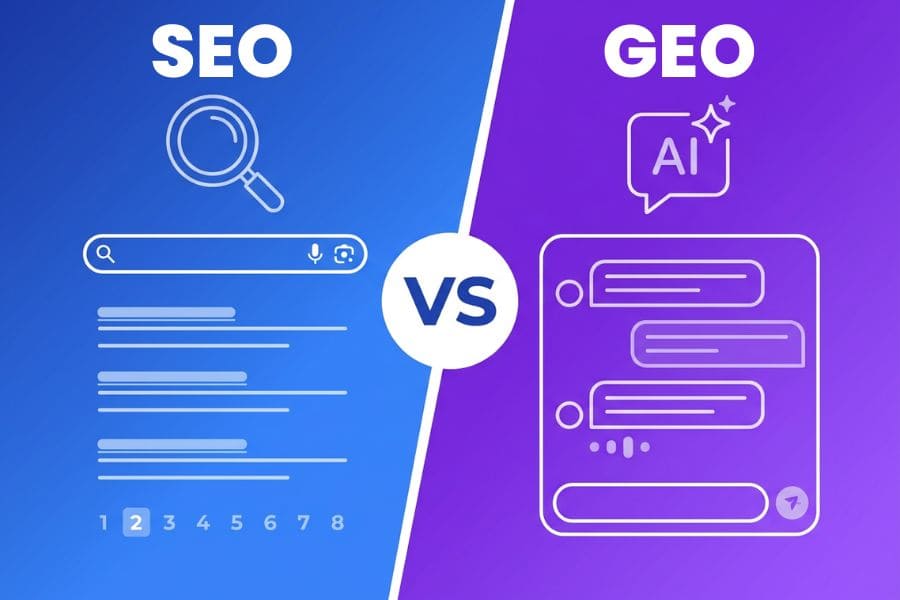
According to Ahrefs data, AI search visitors generate signups at 23x the rate of traditional organic traffic. The SEO vs GEO debate is no longer theoretical.
Google still processes billions of searches daily. Meanwhile, AI-driven platform traffic has grown 156% year-over-year according to Microsoft Clarity data, with platforms like ChatGPT and Perplexity becoming mainstream research tools. The real question is not which one wins, but how you allocate your next marketing dollar between both.
This guide breaks down every comparison point that matters: ROI, cost, timelines, platforms, and industry-specific playbooks. By the end, you will know exactly where to invest based on your business type, budget, and goals.
SEO and GEO at a Glance
SEO (Search Engine Optimisation) targets traditional search engines like Google and Bing. Crawlers discover your pages, index them, and rank them based on hundreds of signals: keywords, backlinks, site speed, mobile friendliness, and user engagement. The playbook is well established and the tools are mature.
GEO (Generative Engine Optimisation) targets AI-driven platforms like ChatGPT, Perplexity, Google AI Overviews, Claude, and Gemini. These systems use large language models and Retrieval Augmented Generation (RAG) to pull content from the web in real time, then synthesise a single answer from multiple sources. Instead of a list of blue links, the user gets a direct response and may never visit your site at all.
The core difference comes down to what each strategy rewards. SEO rewards keeping people on your site and building topical authority across multiple pages. GEO rewards being quotable, having the clearest and most direct answer that an AI platform can cite when someone asks a question.
One optimises for clicks. The other optimises for citations.
| Dimension | SEO | GEO |
|---|---|---|
| Target platforms | Google, Bing (search engines) | ChatGPT, Perplexity, Gemini, AI Overviews |
| How it works | Crawl, index, rank by signals | RAG: Retrieve, augment, generate answer |
| Success metric | Rankings, organic traffic, CTR | Share of voice, citation frequency, mentions |
| Content goal | Rank #1 for target keywords | Be cited across multiple AI responses |
| User behaviour | Click a link, visit your site | Read AI answer, may or may not click |
1. ROI and Conversion Rates: Where the Money Actually Goes
Webflow reported that ChatGPT traffic converts at 24%, which is 6x higher than Google traffic. As of June 2025, 8% of their total new signups came from AI platforms, up from just 2% in October 2024. That single stat reframes the entire SEO vs GEO conversation around revenue, not just visibility.
Intent drives the gap. The average AI prompt is 25 words compared to 6 words in a Google search. Users have longer, more detailed conversations before taking action. By the time someone clicks through from an AI answer, they have already narrowed their options and are primed to convert. According to Semrush’s AI search study, AI search visitors convert at 4.4x the rate of traditional organic traffic. Microsoft Clarity data shows AI traffic converts at 3x the rate of other channels.
The conversion quality advantage is consistent across studies. Ahrefs found that while AI search visitors represent only 0.5% of their traffic, they generate 12.1% of signups. Microsoft reported that Copilot converts subscriptions at a 17x higher rate compared to search’s 0.41% rate.
Volume still matters. SEO drives the bulk of total website traffic for most businesses. But the question is which mix produces the most revenue for your specific traffic profile.
SEO delivers higher total volume at lower per-visit value. GEO delivers lower volume (for now) with dramatically higher conversion quality. Smart businesses are investing in both and measuring the blend.
2. Cost and Budget: What Each Strategy Actually Requires

Most SEO vs GEO comparisons skip the one question business owners ask first: how much does each actually cost?
SEO Investment Profile
SEO has a well-understood cost structure. Tool subscriptions (Ahrefs, Semrush), content production, technical audits, and link building form the core spend. Agency retainers or in-house team salaries are predictable.
The catch is that domain authority takes years to build, so early-stage businesses face a long runway before seeing returns. Once that authority compounds, the cost per lead drops significantly over time.
GEO Investment Profile
GEO costs are less predictable because the playbook is still emerging. Key investments include answer tracking tools, off-site citation building (affiliate placements, YouTube production, community engagement), and content restructuring for AI readability.
A major warning: the GEO tool market is flooded with overpriced solutions. Some vendors charge $50,000 or more for what amounts to keyword tracking with an AI label. Over 60 tracking tools exist in the space, and many deliver commodity features at premium prices.
Team Structure Changes
This is where budgets quietly expand. SEO typically requires one team or agency handling on-site optimisation. GEO adds a layer: you need people managing off-site citations, Reddit engagement, YouTube content, and community participation. This is additional capability, not a replacement for your SEO team. For smaller businesses, the same people can handle both, but the workload increases.
Budget allocation depends on your stage. Established businesses with existing SEO traffic should allocate 20-30% of new marketing effort toward GEO. Startups without domain authority should prioritise GEO first and build SEO foundations gradually.
3. How Each Strategy Works Under the Hood
The same page can rank number one on Google and be completely invisible to ChatGPT. Understanding why requires a look at the mechanics behind each system.
SEO follows a linear path: crawlers discover your pages, index the content, and rank it against 200+ signals including keywords, backlinks, domain authority, page speed, and user engagement. You optimise for one algorithm at a time, and ranking first means winning the click.
GEO works differently at every step. AI platforms use RAG to search the web in real time, chunk your content paragraph by paragraph using tree-walking algorithms, then synthesise an answer from multiple sources. The AI reads top to bottom, decides what to keep per section, and combines findings from dozens of pages into a single response. The average prompt is 25 words compared to 6 in a Google search, meaning AI breaks queries into dozens of long-tail sub-queries before pulling sources.
In SEO, ranking number one means you win the click. In GEO, even if your URL appears as the first citation, you do not win unless your brand is mentioned across multiple sources. Frequency of mentions beats position. The Ahrefs study of 75,000 brands, mentioned previously, confirmed that branded mentions on credible sites have the strongest correlation with AI visibility, higher than backlinks, referring domains, or domain rating.
Every paragraph on your site needs to stand alone. If an AI pulled just one section from your page, would it still deliver a complete, quotable answer? That is the GEO content test.
4. Timeline to Results: How Long Before You See Returns
GEO can deliver results in days, not months. That timeline gap is the single biggest practical difference between the two strategies.
SEO timelines are well documented. Expect 6 to 12 months for meaningful organic traffic gains. Domain authority builds over years, and for startups, experienced practitioners are blunt: do not invest heavily in SEO until you have reached Series A or B funding, because you cannot compete without that authority.
GEO flips this entirely. Early-stage companies can get mentioned via Reddit threads, YouTube videos, or blog posts and show up in AI answers the next day. A brand new startup can answer a niche question that has never been asked before and become the only citation. Microsoft Clarity data shows AI-driven platform traffic grew 156% year-over-year, creating immediate opportunities for new entrants.
Content refreshes accelerate both channels simultaneously. AI platforms prefer content that is 25.7% fresher than what typically ranks in Google results. ChatGPT and Perplexity both list the newest citations first. Regular content updates with new statistics, quotes, and examples signal freshness to both traditional search engines and AI platforms.
Best for: Startups and new businesses wanting immediate visibility. GEO gives you a head start while SEO compounds in the background.
Skip if: You need predictable, compounding traffic over three or more years. That is where long-term SEO investment still dominates.
5. Platform Differences: Why ChatGPT, Perplexity, and Google AI Play by Different Rules
Only 14% of the top-cited domains appear across all three major AI platforms. That means 86% of the sources feeding AI answers are unique to each platform. Optimising for one does not cover the others.
Each platform has distinct preferences for where it pulls information.
| Platform | Preferred Sources | Google Overlap | Best For |
|---|---|---|---|
| Google AI Overviews | YouTube, Reddit, Quora | N/A | Local and long-tail queries |
| ChatGPT | Publishers, news outlets | 35% | B2B and research queries |
| Perplexity | Niche blogs, regional sites | 70% | Technical and specific queries |
Google AI Overviews leans heavily on user-generated content. YouTube, Reddit, and Quora threads appear frequently. Ahrefs found that branded mentions on credible sites have the strongest correlation with visibility in AI Overviews, stronger than backlinks or domain rating. These overviews trigger most often on longer, niche queries.
ChatGPT prefers established publishers and news outlets. Its citation overlap with Google search results is only around 35%, which means ranking well on Google gives you less than a coin flip chance of appearing in ChatGPT. Freshness matters. ChatGPT lists the newest content first.
Perplexity sits closest to traditional search with a 70% overlap with Google results. It favours niche and regional sites, making it a strong entry point for businesses that already rank well organically.
Pick the two or three platforms your audience actually uses and build platform-specific citation strategies for each. Spreading effort across every AI tool is wasteful. Targeted diversification is essential.
6. Industry Playbook: E-commerce vs SaaS vs Local Services
The advice that works for a SaaS company will actively waste money for a local tradie. Your industry determines which SEO vs GEO tactics deserve your budget.
E-commerce and Product Businesses
Product schema, review aggregation, and listicle placement matter most. For product businesses, the priority is making sure your items appear in “best of” and comparison content across the web, because that is what AI pulls from when answering purchase queries. Focus on structured data markup, comprehensive product information, and getting featured in industry roundups and listicles.
B2B SaaS and Technology
The Webflow model works here: invest in three pillars simultaneously. Traditional SEO landing pages targeting high-volume keywords. YouTube and Vimeo videos for niche B2B terms with low competition. Authentic Reddit engagement where employees identify themselves and provide genuinely useful answers. Help centre optimisation is another quick win. Move it from a subdomain to a subdirectory, cross-link thoroughly, and cover the long tail of questions from customer support and sales calls.
Local Service Businesses
Google Business Profile is your foundation. AI platforms scan reviews, hours, services, photos, and Q&As when answering “best X near me” queries. Review volume, sentiment, and recency across platforms (Google, Yelp, TrustPilot, Facebook) send trust signals that both search engines and AI models understand. Get listed in local listicles. Even small regional publications help. Keep your NAP (name, address, phone) data consistent everywhere.
One-line summary: E-commerce invests in product schema and listicle placement. SaaS builds landing pages, YouTube, and Reddit presence. Local businesses prioritise Google Business Profile and review management.
7. Measurement and Attribution: Tracking What Matters
You are probably already getting GEO traffic. You are just counting it as something else.
A user asks ChatGPT about your product category. Your brand appears in the answer. The user opens a new tab, types your brand name into Google, and clicks through. Your analytics records this as “branded search.” Or they type your URL directly, and you count it as “direct traffic.” In both cases, AI drove the visit, but your data will never show it.
SEO measurement is mature and predictable. Rankings, organic traffic, click-through rates, and conversions all flow through Google Analytics and Search Console. You know what is working and where to invest more.
GEO measurement requires a different mindset. Share of voice across AI platforms, citation frequency, and mention tracking are the primary metrics. Answer variance makes this tricky. The same question asked twice can produce different results because AI models calculate a probability distribution across potential answers. You need a statistical approach, not a single snapshot.
Practical steps to close the gap: set up answer tracking to monitor whether your brand appears in AI responses. Add a “how did you hear about us?” question to post-conversion surveys. Monitor branded search volume increases as a proxy for growing AI visibility. Be cautious with tool spending. The GEO tracking market has over 60 tools, and many charge enterprise prices for basic monitoring features.
Start with free monitoring. Ask AI platforms about your brand monthly. Invest in proper tracking tools only when AI traffic volume justifies the cost.
8. Content Strategy: Writing for Algorithms vs Writing for AI
The content that works best for AI is also better for humans. The shift is in structure, not substance.
SEO content priorities have not changed. Keyword targeting, topical authority across multiple pages, internal linking, meta optimisation, and backlink-worthy depth still drive organic rankings. These fundamentals remain essential.
GEO content priorities add a structural layer on top. Every paragraph should be quotable and self-contained. Direct answers to specific questions need to appear early and clearly. Fresh data and statistics get preferential treatment. Author expertise and clear attribution signal trustworthiness to AI models.
The overlap between both strategies is roughly 80%. Well-structured, authoritative, and regularly updated content wins on both channels. The remaining 20%, the citation-building and structural adjustments, separates businesses showing up in AI answers from those that are invisible.
Content freshness drives results across both channels. AI platforms cite content that is 25.7% fresher than what typically ranks in Google organic results. Build a regular refresh cycle: update statistics, add new quotes, remove outdated sections, and redate meaningfully. ChatGPT and Perplexity both list the newest citations first, so recency gives you a measurable edge.
One important caveat on AI-generated content: only 10-12% of pages cited in Google and ChatGPT are AI-generated. Fully automated, no-human-in-the-loop content does not perform well. AI-assisted content with human editing is the sweet spot.
Your quick win: Audit your top 10 pages. Add direct-answer paragraphs, update statistics, and structure each section to stand alone. That is the fastest path to GEO visibility with content you already have.
9. Risks and Downsides: What Could Go Wrong
Both strategies carry risks. Here are the ones that actually matter for your business.
SEO risks are well understood. Algorithm updates can wipe rankings overnight. Click-through rates are declining as AI Overviews expand and take up more screen real estate. Over-reliance on organic search as a single traffic channel leaves you exposed to platform changes you cannot control.
GEO risks are newer and less predictable. AI may summarise your content inaccurately or attribute ideas incorrectly, misrepresenting your brand to potential customers. Traffic can drop while visibility grows because users get their answer from the AI without ever visiting your site. You can appear in AI answers without any link or credit, giving you influence without measurable attribution.
The industry itself carries risk. Significant misinformation circulates in the GEO space. Expensive tools sell commodity features at inflated prices. Many so-called “best practices” have never been validated through actual analysis. Someone says something, it gets repeated, and suddenly it is accepted wisdom without anyone checking the data.
Mitigation is straightforward. Do not abandon SEO for GEO. Monitor AI mentions for accuracy regularly. Start with free tools before committing to expensive platforms. Test and measure before scaling any tactic.
The biggest risk is not choosing the wrong strategy. It is ignoring GEO entirely while your competitors build citation momentum that compounds month over month.
10. Where to Start: Your First 30 Days
You do not need to overhaul your entire marketing strategy. Start here.
Week 1: Audit
Check your robots.txt for AI bot blocking. Some websites inadvertently block AI crawlers from accessing their content. Ask ChatGPT and Perplexity what they know about your brand. Note what is accurate, what is missing, and where competitors are mentioned instead. Review your Google Search Console baseline so you have data to compare against later.
Week 2: Foundation
Ensure your SEO fundamentals are solid. Fast, mobile-friendly site. Clean HTML. Structured data on key pages. Add FAQ schema to your top five pages. Go through your highest-traffic content and make key sections quotable and self-contained. Each paragraph should deliver a complete thought that an AI could extract and cite on its own.
Week 3: Citations
Identify where competitors are being cited in AI responses. Use Ahrefs Brand Radar or manually check by asking AI platforms comparison questions in your category. Start authentic participation in Reddit communities relevant to your industry. Reach out for inclusion in listicle and comparison articles. Create YouTube content for niche keywords where video coverage is thin.
Week 4: Measure and plan
Set up basic answer tracking. Establish a “how did you hear about us?” post-conversion survey. Create a content refresh schedule for your top-performing pages. Review what you have learned from weeks one through three and decide where to invest deeper.
Do not wait for the perfect strategy. Run this 30-day sprint, measure results, then allocate budget based on what the data tells you.
The Bottom Line
The answer to SEO vs GEO is both. But the mix depends entirely on your situation.
Established business with SEO traffic: Maintain your SEO investment. Allocate 20-30% of new effort to GEO. Focus on restructuring existing content for citability and building off-site mentions.
Early-stage startup: Prioritise GEO immediately. You can win AI visibility now without the domain authority that SEO demands. Build SEO foundations gradually, but do not expect organic returns until you have significant traction.
Local service business: SEO and Google Business Profile come first. Layer in GEO through review management across platforms and getting listed in local comparison content.
E-commerce: Both simultaneously. Product schema and technical SEO for organic rankings. Review aggregation and listicle placement for AI citations.
Industry experts note that everything effective in SEO also works in GEO, but GEO requires additional strategies beyond traditional optimisation. The businesses winning today are not choosing between the two. They are building integrated strategies that compound across both channels.
You are playing this game whether you want to or not. The only question is whether you are playing it well.
Frequently Asked Questions About SEO and GEO (AI Search)
Is SEO dead now that AI search is here?
No. SEO is still a $100+ billion industry. Google processes billions of searches daily, and search volume grows every year. GEO is the next evolution of search visibility, not a replacement for organic rankings.
Should I block AI bots from crawling my site?
You can block training bots while allowing indexing bots. But blocking AI indexing entirely means your competitors show up in AI answers and you do not. If you block crawling, you simply forfeit your spot.
Does AI-generated content work for GEO?
Not if it is 100% AI-generated with no human involvement. Only 10-12% of content cited by Google and ChatGPT is AI-generated. AI-assisted content edited by humans performs well. Fully automated content without human oversight does not, and will likely face increasing penalties over time.
Do I need to optimise separately for ChatGPT, Perplexity, and Google AI?
Yes. Each AI platform has different source preferences and there is limited overlap in which domains get cited across all of them. Google AI Overviews favours YouTube and Reddit. ChatGPT prefers publishers. Perplexity cites niche blogs. Target the two or three platforms your audience uses most.
What is the difference between GEO, AEO, AIO, and LMO?
They are essentially the same concept with different labels. GEO (Generative Engine Optimisation) and AEO (Answer Engine Optimisation) are the most widely used terms. All refer to optimising your content to appear in AI-generated answers from platforms like ChatGPT, Perplexity, and Google AI Overviews.
Can early-stage startups benefit from GEO?
Yes, immediately. Unlike SEO, which requires domain authority built over years, startups can get cited in AI answers via Reddit threads, YouTube videos, or blog mentions from day one. GEO is one of the few channels where new businesses can compete with established players right away.