
State of Search: Professional and Financial Services
Who wins search in Australian law, accounting and finance
We pulled the search data on Australian law, accounting, advice, lending and insurance: how much demand there is, who wins it, what Google’s AI Overviews cite, and where firms are losing clicks to directories and comparison sites. Read the headline findings below, or download the full report free.
Search is still where Australians go to find a family lawyer, a tax accountant, a financial adviser or an income protection policy. That part hasn’t changed. What’s changed is who answers first.
We pulled Semrush data on 16 Australian domains across law, accounting, financial advice and insurance, plus the comparison sites and government pages they compete with. The headline is simple enough to fit on a slide: Google now writes an AI answer above most of the searches these firms rank for, and most of the time it quotes someone else.
This is Bring’s first annual State of Search report for professional and financial services. Below is the short version for marketing leads and managing partners. The full report, with every table, is free to download.
We run the same analysis for law, accounting and finance clients through our SEO and paid search services, and for the other industries we do SEO for.
What we looked at
All search figures come from the Semrush AU database, pulled on 6 November 2026. We sampled 52 keywords (buyer searches like “family lawyer” and “accountant near me”, plus agency-side terms like “law firm SEO”), the top 10 results for eight head terms, and domain-level data for 16 sites.
Get the full report (free PDF)
Every table and chart, plus eight ranked opportunities and a 90-day plan. Enter your details and the download link appears straight away.
The 13 practitioner firms were Maurice Blackburn, Slater Gordon, Gordon Legal, Johnston Withers, Blackwood Family Lawyers, Mills Oakley, H&R Block, BDO, William Buck, PKF, Hudson Financial Partners, SuperGuy and TAL. The three intermediaries were Canstar, iSelect and Moneysmart. Most were picked because they sit on page one for the head terms we tested. It’s a visibility sample, not a census, and Semrush numbers are modelled estimates, so read them as comparisons rather than exact counts.
1. Demand: 652,400 searches a month, and most of it isn’t about firms
Across 39 buyer-intent head terms we counted 652,400 Australian searches a month. Insurance dwarfs everything else (520,000 searches, with “life insurance” alone at 246,000 and a $63.15 cost per click). Strip insurance out and the professional services core is 132,400 searches across 31 terms.
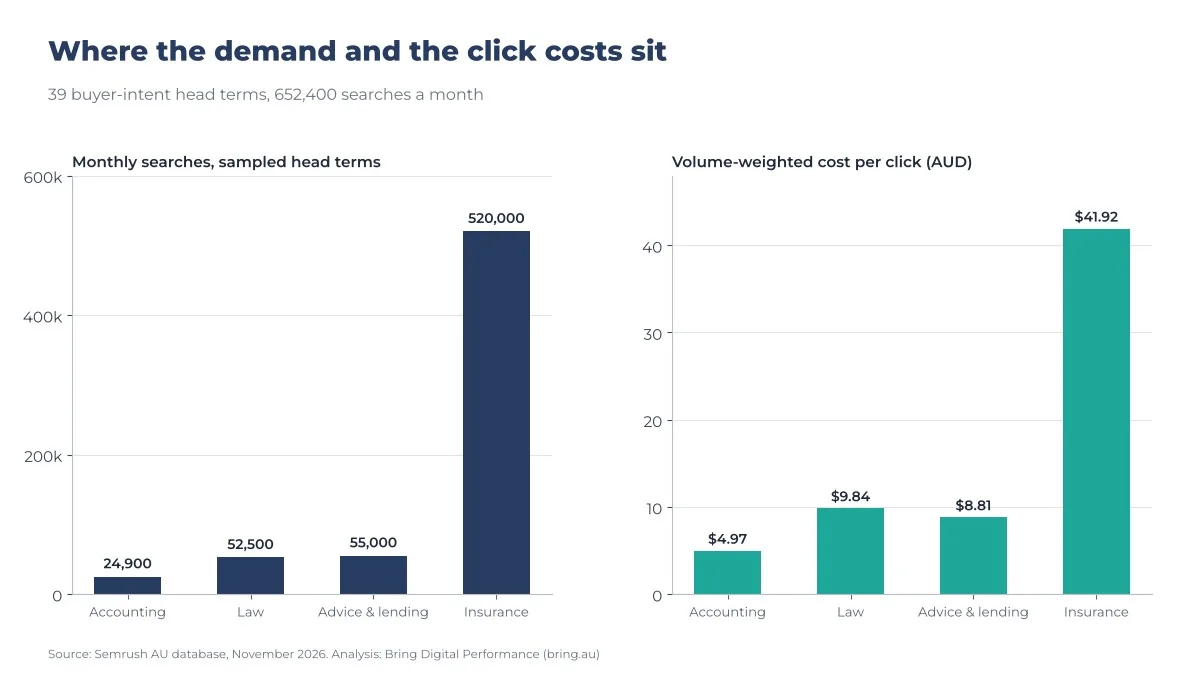
A few patterns stand out once you look at individual terms:
- Accounting is a “near me” category. “accountant near me” (6,600), “tax accountant near me” (4,400) and “tax agent near me” (4,400) each beat any city-named search. “accountant melbourne” sits at 1,300.
- Legal buyers search by matter. “conveyancer” (14,800), “family lawyer” (4,400), “divorce lawyer” (3,600) and “immigration lawyer” (3,600) all outsize “lawyer near me” (2,400).
- Advice buyers start with a question. The top 10 for “financial adviser” is mostly explainer content: what an adviser does, when to see one, how to choose one.
- There are soft spots. “smsf accountant” gets 2,400 searches with a keyword difficulty of 14. “small business accountant” gets 1,900 at difficulty 19 and $12.02 a click.
The takeaway for anyone planning professional services SEO: build around the matter, the fee question and the suburb, not around the firm’s service menu. If you work with accountants specifically, our earlier piece on search marketing for accountants goes deeper on the local side.
2. Page one belongs to whoever answers best
We classified the top 10 organic results for six head terms by who owns the page. Firms do well when the search is specific and commercial. They lose ground fast when it’s local, comparative or educational.
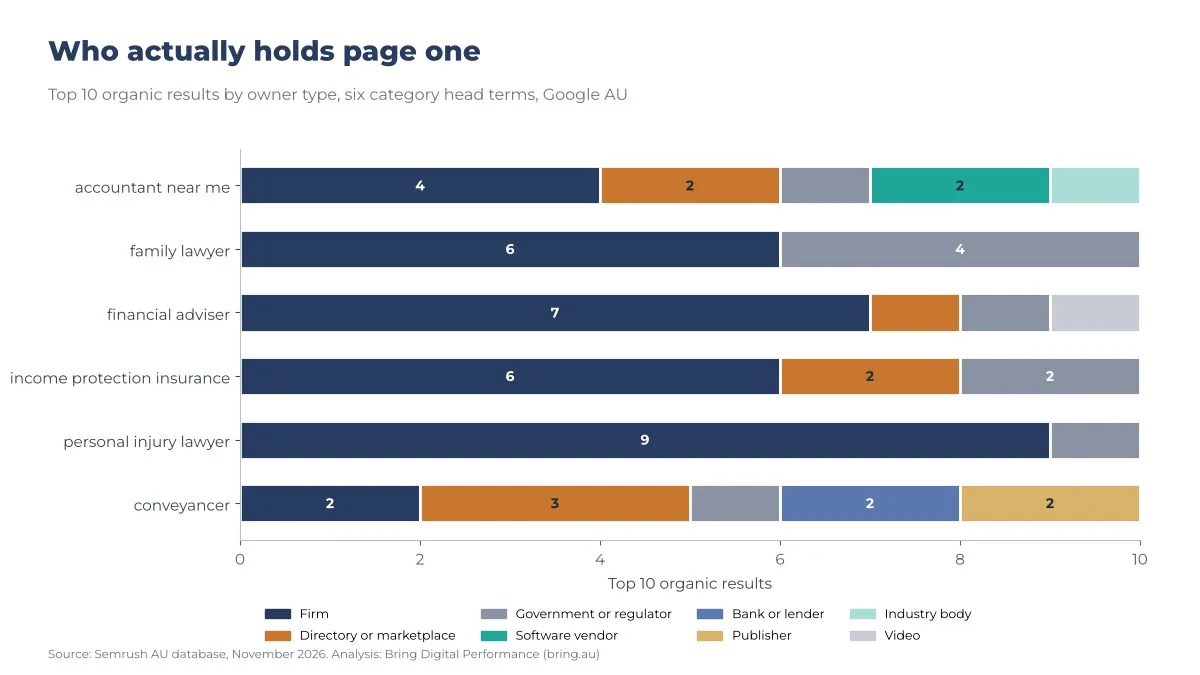
- “personal injury lawyer”: 9 of 10 results are firms. Slater Gordon is first.
- “family lawyer”: 6 firms, 4 government or legal aid pages. The Federal Circuit and Family Court’s “find a lawyer” page ranks first.
- “accountant near me”: only 4 accounting practices. The rest are a professional body, Bark, Airtasker, Xero, QuickBooks and Moneysmart.
- “conveyancer”: just 2 conveyancing firms. NSW Government, two banks, RACV, Compare the Market and a directory take the rest.
Small firms don’t usually lose to big firms in search. They lose to directories, software vendors and government pages that answer the buyer’s question better.
3. Three intermediaries out-traffic 13 firms five to one
Canstar draws an estimated 1,332,222 organic visits a month. Moneysmart, ASIC’s consumer site, draws 1,130,767 without spending a cent on paid search. iSelect adds 234,100. Together that’s 2.70 million visits, 4.99 times the 540,957 we measured across all 13 firms.
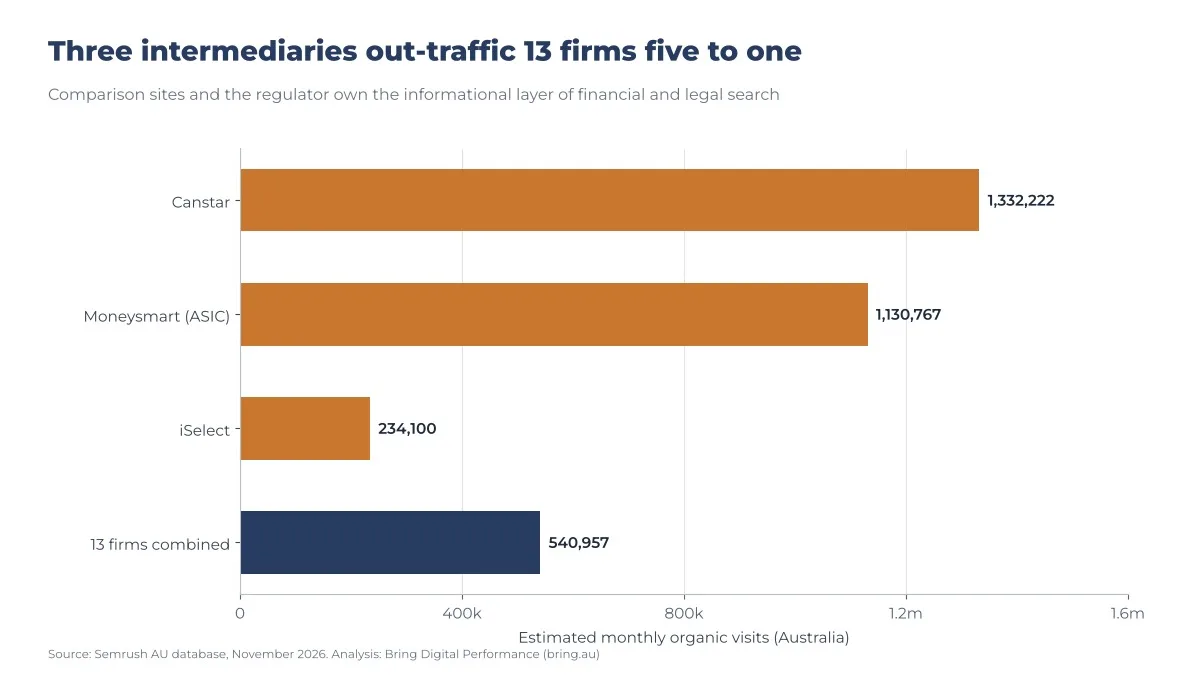
That isn’t a reason to give up on head terms. It’s a reason to stop treating them as the main event. A firm will rarely out-explain Moneysmart on “what is income protection”. It can absolutely be the best answer for “income protection for surgeons in Victoria” or “how much does a family lawyer cost in Melbourne”.
Want every table and the 90-day plan? Download the full report or request a report on your own brand.
4. AI Overviews: everywhere, and rarely quoting firms
This is the finding that should change budgets. Across the 13 firms, 120,711 of 175,414 ranking keywords (68.8%) now show a Google AI Overview. The firms are cited as a source in 11,008 of those, or 9.1%.
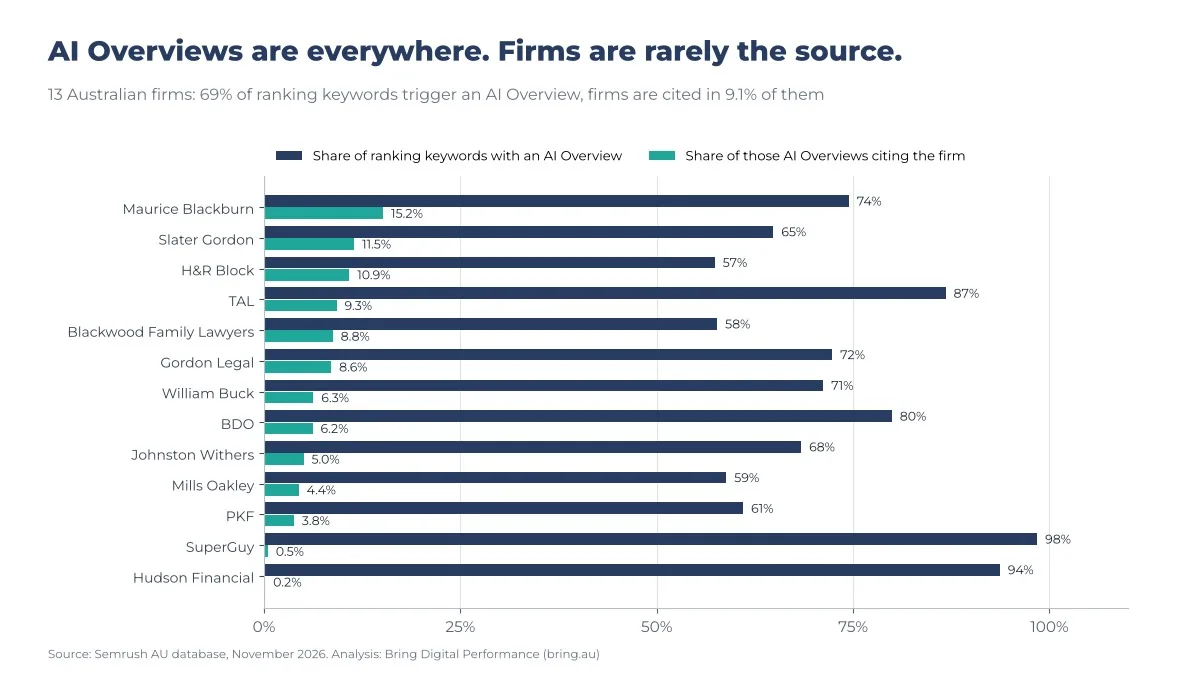
The spread is wide:
- Best cited: Maurice Blackburn (15.2%), Slater Gordon (11.5%), H&R Block (10.9%).
- Least cited: the two advice firms. Hudson Financial Partners has AI Overviews on 93.7% of its keywords and is cited on 0.2%. SuperGuy: 98.5% and 0.5%.
- Who gets cited instead: Moneysmart holds 28,535 AI Overview positions and Canstar 39,296.
Advice is the most exposed because its searches are educational, and educational questions are exactly what Google now answers on the results page. Since Google rolled out AI Mode in Australia on 8 October 2025, the questions are getting longer too: Google says early testers ask queries two to three times the length of a traditional search.
So what gets a firm cited? Google’s own guidance on AI features is blunt: there are no special requirements or AI-specific markup. Pages need to be indexable, eligible for a snippet and genuinely useful. In our experience, for law and finance that comes down to a few things:
- Answer the question in the first two or three sentences, then explain.
- Name the person answering, with their accreditation (Accredited Specialist, AFSL authorised representative, registered tax agent).
- Be specifically Australian: state jurisdiction, ATO rules, super thresholds, court process.
- Publish fee ranges. AI answers to “how much does it cost” need a source, and very few firms give them one.
For financial services marketing there’s an extra layer. ASIC re-issued RG 234 on 9 June 2026, consolidating its advertising guidance and withdrawing RG 53. Content written to win AI answers about returns, fees or products still has to meet it.
5. The map pack: 3.3% vs 32.7%
The 13 firms rank organically on 35,846 searches where Google shows a map pack. They appear in that pack on 1,198 of them, or 3.3%.
One firm breaks the pattern. Blackwood Family Lawyers, a Melbourne family law practice, appears in the pack on 365 of its 1,117 local-pack searches: 32.7%. Nobody else in the sample clears 6.0%. National brands do worst relative to their footprint: William Buck 0.4%, Gordon Legal 0.8%, PKF 0.9%, BDO 1.0%.
For a category where “accountant near me” alone gets 6,600 searches a month, that’s the most direct commercial gap in this report. The fix isn’t glamorous: one verified Google Business Profile per office, primary and secondary categories that match each service, a review request built into the end of every matter, and suburb pages that line up with the profile. Our SEO services for lawyers and accountants pages cover how we approach this for firms.
6. Paid search: high click costs, thin auction
Legal clicks are expensive. “compensation lawyer” costs $24.54 a click and “personal injury lawyer” $22.66. “income protection insurance” sits at $37.27.
Yet 9 of the 13 firms showed no paid keywords at all in Semrush’s AU sample, including Maurice Blackburn and Slater Gordon. Semrush captured no ads at all for “personal injury lawyer” or “family lawyer melbourne”, and a single advertiser on “small business accountant”, “financial planner” and “income protection insurance”.
A caveat matters here. Semrush samples paid results and under-counts campaigns that are tightly geo-targeted or run at set times of day. So read this as “observed paid presence is light”, not “nobody advertises”. Even so, the gap is telling. The 13 firms’ organic traffic is worth an estimated $5.41 million a month at paid click prices, against roughly $147,000 of observed paid spend. Organic is carrying the category.
Where the auction looks thin, a focused paid programme on two or three matter types buys share in weeks. It also hands the content team real search term data to build from, which is how paid and organic should work together. For an example, see our accounting lead generation case study.
7. What converts once the buyer lands
We opened leading pages from four firms to see how they turn a visit into an enquiry.
| Firm | Primary call to action | Fees shown | What stands out |
|---|---|---|---|
| Slater Gordon | Start your free claim check | No Win, No Fee with conditions | Claim-check tools for each claim type |
| Blackwood Family Lawyers | Get in touch with us | Not published | Accredited Specialist badges; says up front it doesn’t offer free first consultations |
| Hudson Financial Partners | Book your free call | $550 SOA implementation; $7,700 Division 296 modelling | Calculators, an AI plan check, an example statement of advice |
| Max Accountants | Contact us for a free quotation | “From $140” in one news item | Referral claim plus professional body badges |
Notice what Blackwood does with its “no free first consultations” line. It’s a filter, not a weakness. In a category where every enquiry costs a lawyer’s time, telling the wrong buyer to look elsewhere is a conversion tactic in its own right. Hudson does the opposite with the same goal: it publishes prices so the people who book a call already know roughly what they’re signing up for.
Three lessons. Tools beat forms, because the buyer gets something before giving their details. Fee transparency is rare, which makes it a differentiator for buyers and a citation source for AI. And accreditation is the trust currency in this vertical: every strong page leads with it.
What to do in the next 90 days
- Benchmark. Find your own AI Overview citation rate and map pack share and compare them with the numbers above.
- Rewrite for citation. Take the ten pages that rank for the most AI Overview keywords and restructure them answer-first, with a named, credentialed author.
- Fix local. Audit every Google Business Profile, its categories and its reviews, then match suburb pages to them.
- Test paid where it’s quiet. Two or three matter types, tightly geo-targeted, with search term reports feeding the content plan.
- Publish fees and a tool. A fee range page per matter type and one self-qualification tool or calculator.
Questions about Google AI Overviews and search for law and finance firms
How often do AI Overviews appear on searches for law and finance firms?
In our sample of 13 Australian firms, 68.8% of the keywords they rank for trigger a Google AI Overview (Semrush AU, November 2026).
How often are firms cited in those AI Overviews?
9.1% of the time across the sample. The range runs from 15.2% for the best-cited law firm to 0.2% for the least-cited advice firm.
Do I need special markup to appear in AI Overviews?
No. Google says there are no extra requirements or AI-specific optimisations. Indexable, snippet-eligible, genuinely helpful pages are the baseline. Clear answers, credentialed authors and specific Australian detail are what tend to separate the cited from the skipped.
Is paid search worth it for law firms and accountants?
It can be, precisely because the observed auction is thin. Click costs run up to $24.54, but 9 of 13 sampled firms showed no paid keywords. A narrow, geo-targeted programme can win share quickly while organic builds.
Download the full report
Every table and chart, plus eight ranked opportunities and a 90-day plan. Enter your details and the download link appears straight away.
Want these numbers for your brand?
The report maps the category. A Category Intelligence Report maps you: your demand, your share of it, the three competitors taking the rest, your AI citations and your map pack position. Free, and walked through with you in 45 minutes.
Sources: Semrush AU database (6 November 2026); Riskinfo, adviser numbers, July 2026; QLS Proctor, National Profile of Solicitors; IBISWorld, accounting services; ASIC; Google. This article is general information, not legal or financial advice.
Ready to grow your search performance?
Talk to a senior strategist about what will move the needle for your business.
Get in touch