

SEO
How To Perform A Domain Migration SEO – Smart Rebrands That Protect Rankings and Supercharge Revenue
 Matt Hodgson
7 min read
Matt Hodgson
7 min read
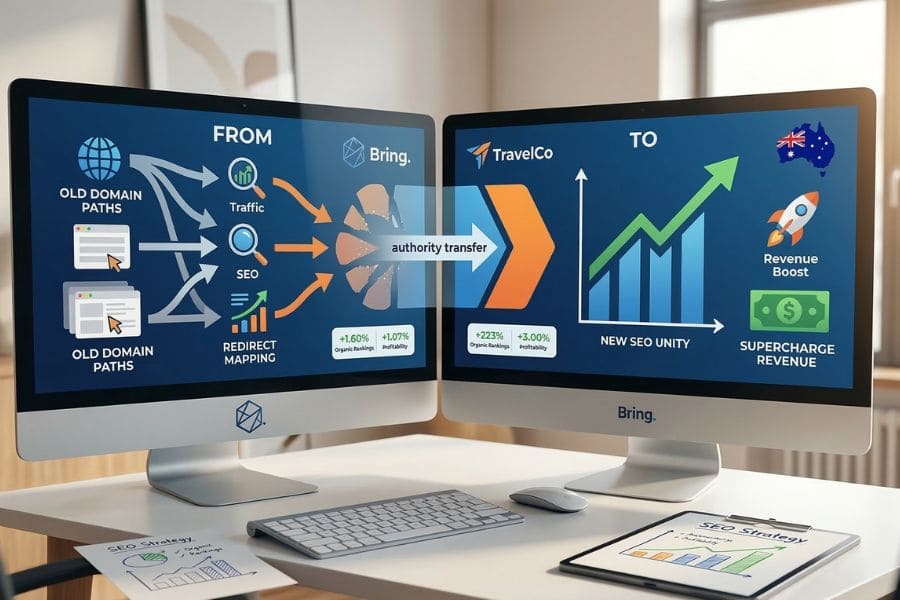
A poorly planned domain migration can wipe out years of SEO equity overnight. Done right, it can supercharge organic revenue. The difference lies in treating domain migration SEO as a strategic pillar of the rebrand rather than an afterthought.
One recent migration managed by our team, where a specialised travel brand rebranded to a full-service identity, shows exactly what “good” looks like. The project resulted in a clean handover of authority, zero structural traffic loss, and a sharp organic uplift once the new brand took hold. Following the move, enquiries more than doubled and profit from organic search rose several hundred per cent year on year in the first three months post-launch.

Why rebrands can quietly destroy your SEO
For brand teams, a rebrand is about meaning: a new narrative, an updated identity, and a clearer promise to the market. For search engines and AI systems, it is about continuity.
This includes stable URL patterns, redirects, schema, entity references, and behavioural signals that prove the new domain still represents the same underlying organisation that earned trust over time.
When those views clash, three predictable problems follow:
- Link equity from years of PR and partnerships is diluted because high-value URLs do not receive one-to-one redirects.
- Google temporarily treats the new site as a different entity, especially if the name, design, content, and information architecture all change at once.
- AI-powered experiences, such as AI Overviews and answer engines, lose confidence and quietly omit the brand while they reconcile conflicting signals.
The commercial impact shows up fast through fewer high-intent organic visits, shrinking branded share of voice, and a growing reliance on paid media just to stand still.
What a domain migration actually does to your SEO
A domain migration is not just a set of redirects. It triggers a multi-stage re-evaluation across crawling, ranking, and entity systems.
1. Crawling and indexing
Search bots discover the new URLs and follow redirects from the old domain. Canonical signals, internal links, and XML sitemaps help them decide which URLs to keep in the index. Even in a well-managed move, there will be short-term volatility while search engines recrawl and reindex the site, particularly for larger properties.
2. Ranking and link signals
Redirects pass most of the signals from old URLs, but chains, loops, or irrelevant target pages dilute that value. Sudden changes to content and structure mean ranking systems need to re-evaluate topical relevance as well as authority. Poor implementations here are why some migrations see 50–80% organic traffic drops that can take six to twelve months to recover.
3. Entity and AI systems
Knowledge-graph systems reconnect the new domain, brand name, and key properties, such as address, phone, and social handles, to the existing organisation. AI search layers then use that consolidated entity when generating summaries, recommendations, and conversational answers. If the entity picture is messy, AI systems often play it safe and surface competitors or aggregators that look more stable.
Case study: Transitioning to a National Travel Authority
Managed by our specialist digital strategy team, this migration is a live example of domain migration SEO done right. Over a 25-month period, organic traffic data shows the legacy domain sustaining demand while the new domain took over and scaled. This occurred without the post-launch traffic crash that characterises most poorly managed migrations.
Inside the business, that technical stability translated directly into commercial outcomes:
- Organic enquiries grew by approximately 220% year on year in the three months post-migration.
- Closed deals from organic search rose by more than 400% in the same period.
- Gross profit attributed to organic search increased by around 500% versus the same period the year before.

These are not edge-case results. They reflect what happens when domain migration SEO is treated as a revenue-critical discipline rather than a technical formality. For a CMO, the takeaway is clear: a well-executed rebrand migration can turn organic search into one of your highest-returning channels.
The AI search layer: From pages to entities
AI search has shifted the focus from optimising individual pages to managing brand entities. AI-driven features often surface only a handful of URLs, or none, while relying on trusted entities to answer queries. Brands with clean, consistent signals across domains, schema, and off-site citations are more likely to be referenced, even when users never click through.

During a rebrand, that trust is fragile. If AI systems see the old brand and the new brand as unrelated or inconsistently linked, both can be sidelined until the model is confident they represent the same organisation. In this case, reinforcing the full new brand name across the new domain, social profiles, and partner references helped AI systems treat it as a single, evolving entity rather than a new player.
Common domain migration SEO mistakes
Most failed migrations share a familiar set of patterns that both SEOs and CMOs should recognise:
- Partial or generic redirects: Only some URLs are redirected, or everything points to the homepage, which destroys relevance and wastes link equity.
- Redirect chains and loops: Old URLs hop through multiple destinations before reaching the final page, which slows crawling and weakens signals.
- The “Triple Threat”: Teams launch a new CMS, new IA, and new messaging on a new domain, forcing algorithms to relearn everything simultaneously.
- Robots and noindex mistakes: Staging rules go live and block key sections or the entire new site from being crawled.
- Neglected external signals: Major profiles, directories, and partner sites continue to reference the old domain with no “formerly” language, encouraging algorithms to treat the rebrand as a different company.
Domain migration SEO checklist for brand leaders
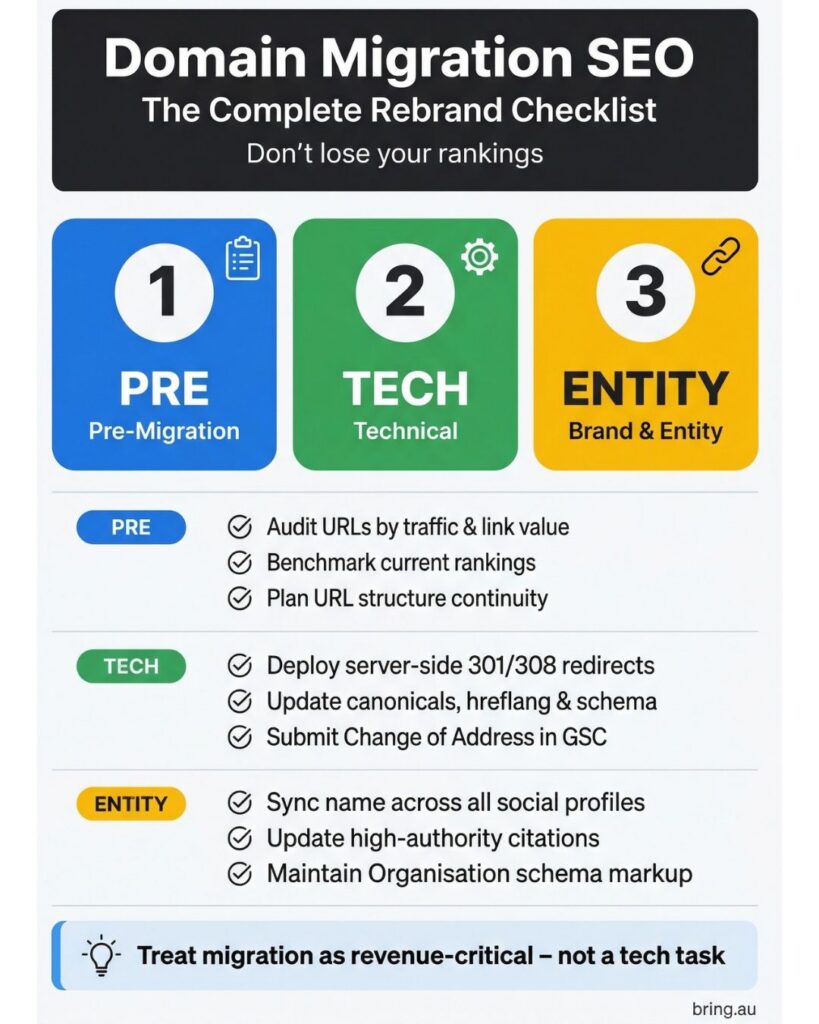
You do not need to write server rules, but you do need to own the standards. The following framework is designed to drop straight into briefs, RFPs, and board packs.
1. Pre-migration alignment
- Audit and prioritise URLs: Crawl the existing site, list every canonical URL, and tag pages by traffic, revenue, and link value. This ensures the most important assets receive one-to-one redirects and extra QA.
- Benchmark performance: Capture baseline data for traffic, rankings, entry pages, conversions, and crawl stats so you can spot issues quickly.
- Design for structural continuity: Keep URL paths and information architecture stable wherever possible.
2. Technical spine
- Implement server-side 301/308 redirects: Map every old URL to the best matching new URL and avoid redirect chains or hops.
- Update internal signals: Ensure internal links, canonical tags, hreflang, sitemaps, and schema all reference the new domain.
- Use official change-of-address tooling: Submit a Change of Address notification via Google Search Central and request indexing of the new sitemap in Search Console immediately after launch.
3. Brand and entity alignment
- Synchronise naming and messaging: Align the name, tagline, and key value props across the site, social profiles, PR, and major directories.
- Refresh off-site citations quickly: Prioritise high-authority profiles and partners, updating domains and adding “formerly” language where relevant.
- Maintain consistent schema: Use Organisation, Website, and sameAs markup to point to official profiles and reinforce that the new domain represents the same business.
Bringing it back to the boardroom
A rebrand is a strategic decision, while a migration is an operational decision. Your traffic, rankings, AI-search visibility, and ultimately revenue sit squarely between the two.
This case study demonstrates that when domain changes are treated as a core pillar of the rebrand, you can protect existing performance and unlock significant growth. For senior marketers and CMOs, the takeaway is simple: involve SEO and data teams early, insist on a clear migration plan, and treat your domain as the digital identity that all of your brand equity depends on.
Planning a rebrand or domain migration? Bring. offers a dedicated domain migration SEO service, including pre-migration audits, redirect mapping, entity alignment, and post-launch monitoring. Get in touch at bring.au to discuss your project.
Sources and further reading
- Google Search Central — Move a site with URL changes: https://developers.google.com/search/docs/crawling-indexing/site-move-with-url-changes
- Google Search Central — Change of Address tool: https://support.google.com/webmasters/answer/9370220
- Google — How Google Search works: https://developers.google.com/search/docs/fundamentals/how-search-works
- Semrush — Website Migration Guide: https://www.semrush.com/blog/website-migration/
- Ahrefs — The Complete SEO Guide to Website Migration: https://ahrefs.com/blog/website-migration/
- Moz — Domain Migration SEO Best Practices: https://moz.com/blog/domain-migration-seo